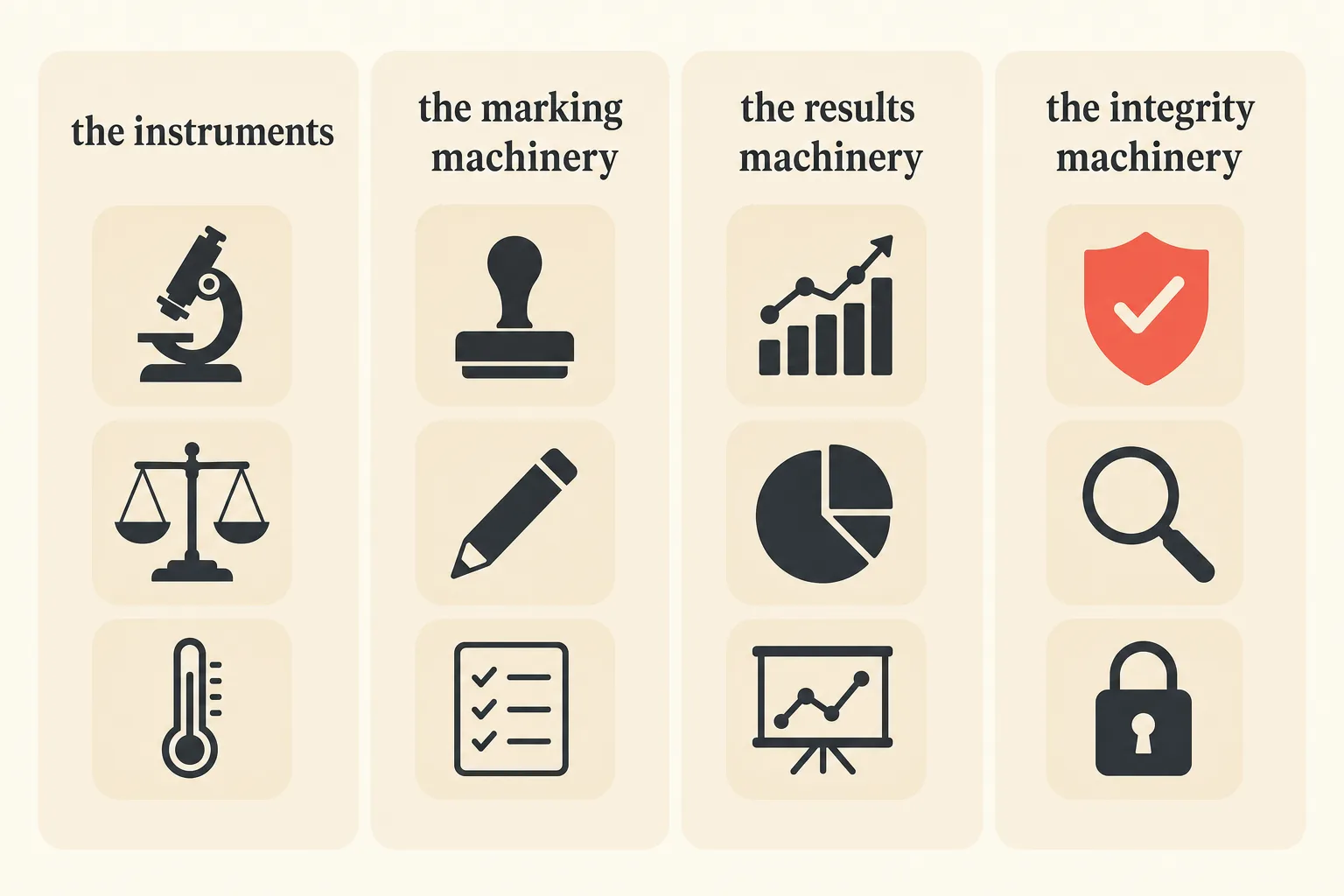
Queensland senior assessment runs on about twenty words that every Year 11 and 12 student meets and half-understands: ISMG, criterion, qualifier, band, on-balance judgement, confirmation, endorsement, subject result, QCE, ATAR. They sort into four groups: the instruments you sit, the machinery that marks them, the machinery that turns marks into a result, and the machinery that keeps it fair.
The instruments: what you actually sit
Internal assessment (IA)
An assessment task set and marked by your school, then checked by the QCAA. A General subject has three internal assessments across Units 3 and 4, labelled IA1, IA2, and IA3.
Why it matters: the mark your teacher gives an IA is provisional until the QCAA confirms it, so an internal mark can change.
External assessment (EA)
The examination set and marked by the QCAA, not your school. It is worth 50% of the result in the science and mathematics subjects, and 25% in most other General subjects, such as English.
Why it matters: nobody at your school marks the EA, so the skills it tests are worth practising under exam conditions.
ISMG
The Instrument-Specific Marking Guide: the marking sheet attached to one exact task. It is not a generic rubric reused across assignments. It lists the criteria for that task, each as a ladder of characteristics tied to mark ranges.
Why it matters: reading it before you write turns it from a report card into a plan. See how to read an ISMG.
Conditions and response length
The rules for a task: how long you have, and how long your response may be, stated as a word count, a page count, or a time. Set out in each syllabus.
Why it matters: going over length is usually not penalised with a deduction; the marker simply stops reading at the limit, so the end of your response is what gets lost.
Draft
A version of your response submitted before the final, on which your teacher may give feedback within the QCAA's rules. The rules limit how much a teacher can change or correct.
Why it matters: a draft is where feedback still has time to change your result. See why drafts matter before submission.
The marking machinery: how a response becomes a mark
Criterion
One row of the ISMG. Each criterion groups some of the task's assessment objectives and is worth a set number of marks. Criteria differ by subject, so name the subject when you name a criterion.
Why it matters: criteria are rarely worth the same, so the highest-weighted one deserves the most time.
Descriptor and characteristic
The wording in a cell of the ISMG that describes a level of performance. Each descriptor names a single characteristic the marker looks for.
Why it matters: turning each top-band descriptor into a question you can ask your own draft is the most direct revision method there is.
Band
A mark range within a criterion, such as 4 to 5 or 2 to 3, each with its own set of descriptors. The top band sits at the top of the ladder.
Why it matters: moving up a band is usually a change of quality, not quantity. See how to move a draft up a band.
Qualifier
The quality word attached to a characteristic, such as considered, justified, discerning, or thorough. The qualifier is what changes between bands while the thing being judged stays the same.
Why it matters: the qualifier usually is the mark. Aim at it directly rather than adding more content.
Cognitive verb
The verb that tells you what thinking to do, such as analyse, evaluate, or justify. It appears in the task and inside the ISMG descriptors, and it escalates across bands.
Why it matters: answering to the wrong verb caps your mark. See the cognitive verbs decoded.
Assessment objective
A statement of what a task assesses, drawn from the syllabus objectives. Each ISMG criterion maps to one or more assessment objectives.
Why it matters: the criteria are simply the objectives made markable, so the objectives tell you what the criteria are really testing.
On-balance judgement
Also called best fit. The marker places your response in the band whose characteristics describe it best overall, rather than ticking every bullet and adding them up.
Why it matters: missing one descriptor does not automatically drop you a band, and hitting one top-band line does not lift a response that sits lower overall.
Provisional mark
The mark your school reports to the QCAA for each internal assessment, by criterion, before the QCAA confirmation process is complete.
Why it matters: it is the number you usually see first, and it is not necessarily the final one.
The results machinery: how marks become a result
Units 3 and 4
The final two units of a General subject, whose assessment counts towards your subject result. Units 1 and 2 come earlier in the course.
Why it matters: the summative assessment that builds your result sits in Units 3 and 4.
Subject result
The QCAA combines your confirmed internal marks with your external assessment mark and reports a subject result as a mark out of 100 and as a letter from A to E.
Why it matters: it is built from every instrument, so no single task decides it. See how your subject result is built.
Confirmation
The QCAA process that checks the provisional marks a school awarded on its internal assessments before they become final.
Why it matters: it is why an internal mark can move after your teacher has marked it, and it is normal.
Endorsement
The QCAA process that approves a school's assessment instrument before students sit it, checking it against the syllabus.
Why it matters: it happens before you ever see the task, and it is why your school's assessment has to match the syllabus.
QCE
The Queensland Certificate of Education, the senior schooling qualification awarded when you meet its requirements for learning, achievement, literacy, and numeracy.
Why it matters: it is the certificate itself, and completing an academic integrity course is one of its requirements.
ATAR
The Australian Tertiary Admission Rank, used for university entry. It is calculated separately by QTAC, not by the QCAA, from your results across subjects.
Why it matters: a subject result is not an ATAR. The two are produced by different bodies through different processes — see how the Queensland ATAR is calculated for the scaling and aggregation steps.
The integrity machinery: how work is kept original
Academic integrity
Doing and submitting your own work, and acknowledging any contribution from other sources, including AI tools. Every QCE student completes a QCAA academic integrity course.
Why it matters: it is a QCE requirement, not just a rule. See academic integrity and AI tools.
Authentication
The strategies a school uses to confirm that work is a student's own, such as drafts, checkpoints, and document version history.
Why it matters: keeping your drafts and version history is the evidence that protects you if your authorship is ever questioned.
AI use in assessment
Using AI to generate work you submit as your own is a breach of academic integrity. The QCAA also describes AI detection tools as inconsistent and to be used with caution.
Why it matters: a detector flag is not proof of anything. See why AI detectors flag real student writing.
Key takeaways
The vocabulary of QCAA assessment sorts into four groups, and knowing which group a word belongs to tells you what it controls.
| Point | Details |
|---|---|
| Instruments are the tasks | Three internal assessments and one external assessment make up a General subject. |
| The qualifier is the mark | Bands turn on the quality word attached to a characteristic, not on how much you write. |
| Marking is best fit | Markers place a response in the band that describes it on balance, not by ticking every bullet. |
| A result is built, not given | Confirmed internal marks and the external mark combine into a result out of 100 and A to E. |
| A subject result is not an ATAR | The ATAR is calculated separately by QTAC from results across subjects. |
Why I keep this list
For a long time I used these words without quite knowing them. I could say ISMG and criterion and best fit, and if you had stopped me and asked what confirmation actually was, or why a subject result is not an ATAR, I would have guessed.
The guessing costs you. A student who does not know that internal marks are provisional panics when one changes. A student who thinks marking is a checklist writes to tick boxes instead of aiming at a band. The words are not decoration. Each one describes a real gear in the machine that produces your result.
Learning them is quiet, unglamorous work, and it pays off every time you open a task sheet and actually understand what it is asking of you.
Put the vocabulary to work with ISMGenius
ISMGenius reads your draft against your task's own ISMG and reports back in exactly this vocabulary: which band each criterion reaches, the descriptor wording behind it, and what the next band up asks for. It is built for Queensland senior students, gives an informed estimate to guide your revision rather than your official grade, and never writes the work for you.
You can run a draft through ISMGenius, read the fuller ISMG rubric guide, decode the cognitive verbs, see how your subject result is built, and work through the subject guides for the maths PSMT, the science research investigation, and the English analytical essay. When the deadline is close, there is a night-before-submission checklist, and teachers can see how a whole class is marked in the educator feedback workflow. The QCAA publishes the source syllabuses and glossaries at qcaa.qld.edu.au.