Here is one line from a real Biology marking guide: a considered rationale for the experiment. That single phrase is worth marks, and it has three parts. "Rationale" is the thing you must produce. "Considered" is the quality it must reach. And the mark range printed beside it tells you what that quality is worth. Learning to read an ISMG is learning to take every line apart like that, before you write, so the marks stop being a surprise. This guide walks through how to do it, criterion by criterion, and clears up the one misconception that costs the most.
Pull one descriptor apart
An ISMG, an instrument-specific marking guide, is the marking sheet attached to your exact task. It is not a generic rubric borrowed from another assignment. QCAA's handbook puts it plainly: "Each ISMG groups assessment objectives into criteria." Each criterion is then a ladder of descriptions, each tied to a mark range.
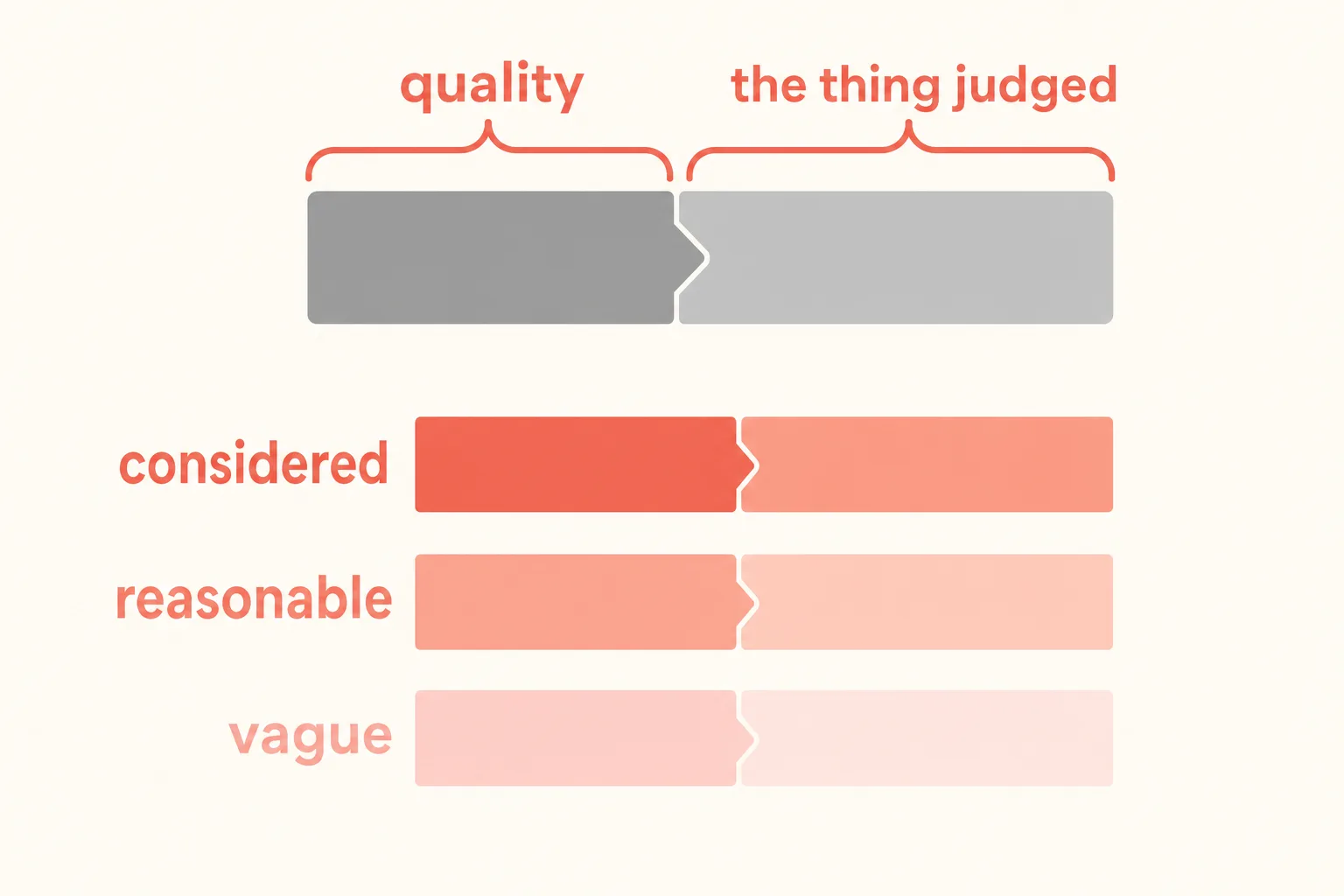
Every descriptor line is built the same way: a quality word, then the thing being judged. Split them and the line tells you exactly what to do.
a considered rationale for the experiment
How to read it: "rationale" is what you must include. "Considered" is the quality that earns the top band. Drop to the next band and the same line reads "a reasonable rationale"; drop again and it is "a vague or irrelevant rationale". Same object, different quality word.
Read the criteria before you write
Most students meet the ISMG after the mark comes back. Reading it first turns it from a report card into a plan. Work through it in this order.
List the criteria and their marks
Write down each criterion and the marks it is worth. This is the map of where the marks actually live.
Read only the top band of each criterion first
The top band is the target. Read it before the lower bands so you are aiming at the standard, not settling into the middle.
Turn each top-band line into a question
"A considered rationale" becomes "Have I given a considered rationale, and how would I prove it?" Now every line is a check you can run on your own draft.
Find the qualifier that changes between bands
Compare the top two bands of one criterion. The word that changes is the exact quality you are being marked on.
Map the qualifier ladder
Within a criterion, the mark almost always turns on the qualifier. This is one real criterion, the "Forming" criterion of a Biology student experiment, top to bottom:
- 4–5
considered · justified · specific and relevant
A considered rationale, justified modifications to the method, and a specific and relevant research question.
- 2–3
reasonable · feasible · relevant
A reasonable rationale, feasible modifications, and a relevant research question. Solid, not sharp.
- 1
vague · inappropriate
A vague rationale, inappropriate modifications, an inappropriate research question.
- 0
no match
"The student response does not match any of the descriptors above."
The lesson is uncomfortable and useful. Moving from a 3 to a 5 here is not about adding more content. It is about turning a relevant research question into a specific and relevant one, and a reasonable rationale into a considered one. The task does not change. The quality does.
Spend your time where the marks are
Criteria are rarely worth the same amount, and students routinely pour hours into the criterion they enjoy rather than the one that pays. Before you start, look at the split. A mathematics problem-solving task, for instance, weights its four criteria unevenly:
- Formulatelower weight
- Solvehighest weight
- Evaluate and verifymid weight
- Communicatelower weight
Check your own task's ISMG for the real numbers. The point stands regardless of subject: the criterion with the most marks deserves the most drafting time, and the criteria about form, such as communication, organisation and referencing, are often the cheapest marks to secure, because they reward care rather than insight.
It is best fit, not a checklist
This is the misconception that costs the most marks, so it gets its own section. Students read an ISMG as a checklist where every dot point must be ticked or the band is lost. That is not how it is marked.
Two things follow. First, do not panic if one line in your target band does not quite fit. The question is which band describes your work as a whole. Second, do not coast because you hit one top-band line. A single strong feature does not lift a response whose overall spread sits lower. Aim for the band, not the bullet.
Key takeaways
Reading the guide before you write, aiming at the qualifier, and understanding best fit are the three habits that turn an ISMG from a verdict into a plan.
| Point | Details |
|---|---|
| Split every descriptor | Each line is a quality word plus the thing judged; the quality word is what moves between bands. |
| Read the top band first | Aim at the standard from the start rather than drifting into the middle band by default. |
| Aim at the qualifier | Moving up a band is usually about quality, not quantity: specific rather than relevant, considered rather than reasonable. |
| Follow the marks | Give the most drafting time to the highest-weighted criterion, and secure the cheap form marks. |
| Best fit, not a checklist | Markers place you in the band that fits on balance; one missing line does not drop the band. |
Why I read the guide first now
I used to leave the marking guide until the assignment was almost finished, as a way of checking my work at the end. It felt responsible. It was actually too late.
By then the structure was set. If the guide rewarded something my draft was not built to do, there was no time to rebuild it, only time to apologise for it. Reading the ISMG at the start would have cost twenty minutes and changed the shape of the whole response.
The guide is not the marker's secret. It is handed to you on purpose. The students who improve fastest are not the ones who write more. They are the ones who read the guide first and let it decide where their effort goes.
Turn your ISMG into feedback with ISMGenius
ISMGenius reads your draft against your task's own ISMG and shows you, criterion by criterion, which band each part of your work reaches and the descriptor wording behind it. It is built for Queensland senior students who want to know where a draft sits before the marker sees it. The result is an informed estimate to guide your revision, not your official grade, and it never writes the work for you.
You can run a draft through ISMGenius, read the fuller ISMG rubric guide, decode the cognitive verbs that appear in every descriptor, and see how the same guide feeds a stronger second draft.