You do not need to rewrite everything. One precise structural change, made where your weakest criterion can reward it, can move a draft further than hours of polishing.
One paragraph, two bands
Put the two versions side by side and the change is not vocabulary. It is structural.
Mid band
"The composer uses a minor key in the second movement, which is sad. This makes the piece emotional and shows the composer's skill."
Top band
"The shift to a minor key in the second movement withholds the resolution the first movement promised, so the listener is left waiting for a return that never comes, and the unease becomes the argument the work is making."
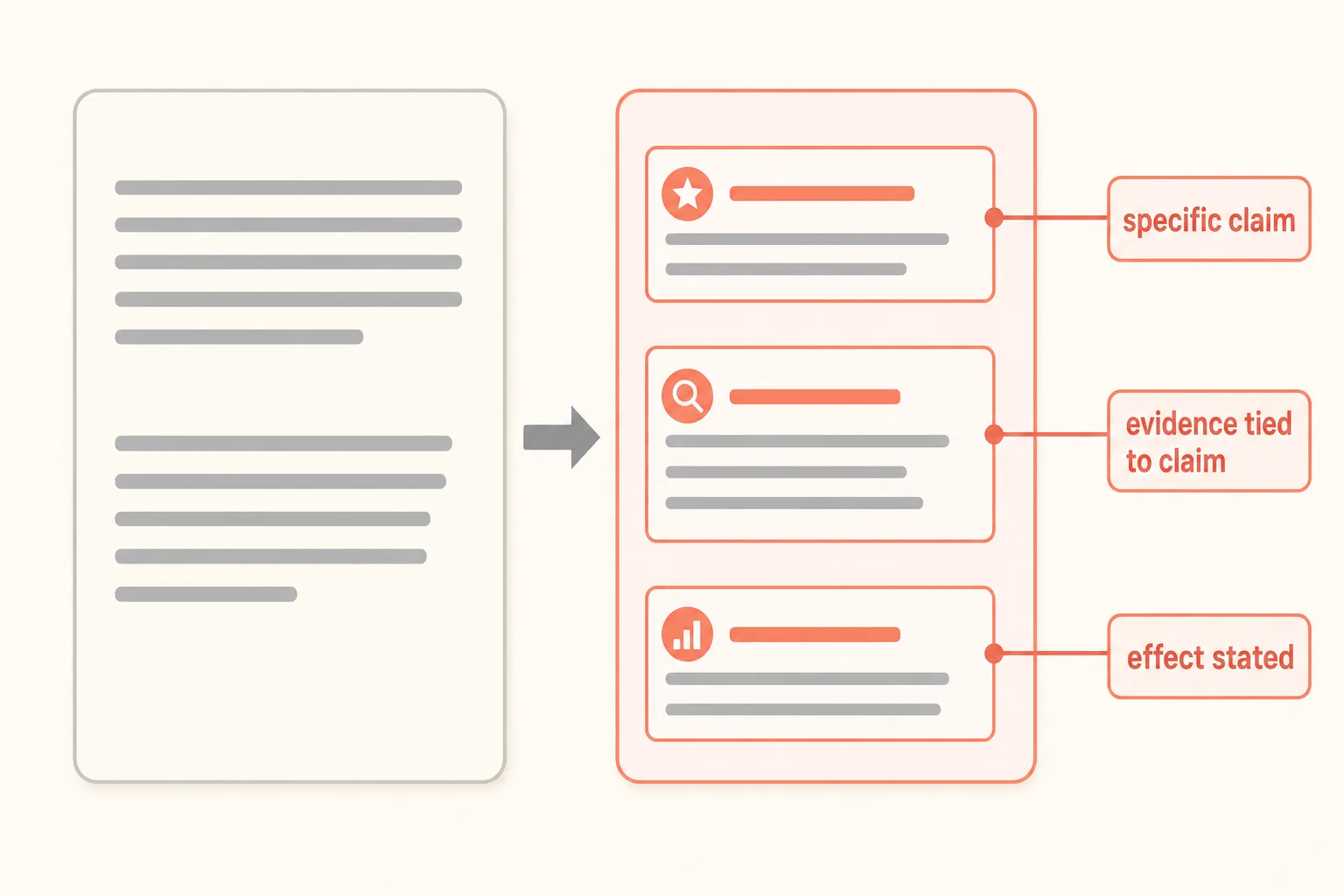
Three things changed, and they are the same three things every time. The claim got specific: "sad" became a withheld resolution. The evidence got attached to the claim rather than floating beside it. And the effect on the audience got stated outright, instead of the empty "shows the composer's skill". None of that required knowing more about the piece. It required saying what the observation does.
The moves that carry a band
Across subjects, the same handful of structural moves separate a middle response from a strong one. They are worth more than any amount of polishing, because they change what the marker can credit.
Name the effect, not the feature
Naming a technique is the low band in almost every ISMG. Stating what it does to the reader, listener, or result is the high one. After every observation, answer "so what does this do?"
Make the claim contestable
"The text explores identity" cannot be argued against, so it cannot score. "The text presents identity as imposed rather than chosen" is a position the rest of the response can defend.
Tie evidence to the criterion's verb
If the criterion says "justify", your evidence must show why something is reasonable, not just that it happened. Match what your evidence proves to the cognitive verb the ISMG is marking.
Cut the summary the marker already knows
Retelling the plot, restating the data, or re-describing the method spends words the marker does not reward. Replace summary with analysis of what it means.
Make the structure visible
Open each paragraph with the claim, put evidence in the middle, and close on the effect and its link back to your thesis. Markers read fast; visible structure gets credited.
Act on one thing at a time
This is where most revision goes wrong. Feedback feels like it should always help, so students try to act on all of it at once, and the draft gets worse. The research is blunt about this. A landmark meta-analysis of 607 studies of feedback found that more than a third of feedback interventions actually reduced performance rather than improving it. Feedback is powerful, but only the right kind, acted on the right way.
Feedback that says "be more analytical" is not actionable. Feedback that says "in paragraph three, state what the technique does to the reader" is. When you get a comment, convert it into a single concrete action before you touch the draft. If you cannot, ask the person who gave it what one change they would make first.
What the working clause looks like
You can usually find the exact clause that earns the mark. It is the one that connects the evidence to the effect.
The narrow depth of field isolates the subject against a blurred crowd, so the viewer reads the figure as separate from the society around them before a single caption explains why.
Why this scores: the sentence names the feature (narrow depth of field), then the marked clause states its effect on the viewer and when it lands. Delete the marked clause and the sentence drops a band, because all that is left is identification.
One band step, in descriptor language
Moving up a band is usually a change of quality word, not a change of content. An ISMG criterion tends to read like this from the middle up.
- top
discerning · justified
A discerning analysis, with claims justified by evidence tied directly to the effect.
- mid
reasonable · relevant
A reasonable analysis, with relevant evidence that supports the claim but is not tied to its effect.
- low
identifies · describes
Identifies features and describes content, without analysing what they do.
Read up that ladder and the instruction is clear. To move from the middle to the top you do not add more evidence. You justify the evidence you already have by connecting it to the effect. That is one move, and it is the move to spend your revision time on.
Key takeaways
Naming the effect, making claims contestable, and acting on one targeted change at a time are the practices that most reliably move a draft up a band.
| Point | Details |
|---|---|
| Effect beats feature | State what an observation does to the reader or result; identification alone stays in the lower bands. |
| Claims must be arguable | A contestable position can be defended and credited; a description of the topic cannot. |
| Match evidence to the verb | If the criterion says justify, evidence must show why something is reasonable, not just that it occurred. |
| Change one thing | More than a third of feedback interventions reduce performance; act on the single highest-value change first. |
| Convert comments to actions | Turn every comment into one concrete edit before touching the draft, or ask what to change first. |
Why I stopped rewriting everything
When I got feedback, my instinct was to rebuild the whole assignment. Every comment felt urgent, so I acted on all of them at once, and the new draft was often flatter than the one before it. I had confused motion with improvement.
What changed things was picking one criterion, usually my weakest, and making exactly one structural change to it. Name the effect in every paragraph. Or make the thesis contestable. Just one, checked against the descriptor before I moved on. The gains were larger and the drafts were calmer.
Moving up a band is rarely about doing more. It is about doing the one right thing and being able to see that you did it. That is a skill you can practise on the next assignment, not a talent you either have or do not.
Find your one change with ISMGenius
ISMGenius reads your draft against your task's own ISMG and shows you, criterion by criterion, which band each part reaches and what the next band up asks for. That is useful here because it points at the single criterion where one change moves your result the most, instead of leaving you to rewrite everything. It is an informed estimate to guide your revision, not your official grade, and it never writes the work for you.
You can run a draft through ISMGenius, learn to read your ISMG so you know which band you are in, decode the cognitive verbs your evidence has to satisfy, and see why drafts matter before submission. The three-question model of effective feedback is set out in Hattie and Timperley's review of the power of feedback.