Two research questions for the same Chemistry investigation. First: "How does concentration affect cell potential?" Second: "What is the relationship between the cell potential and the electrolyte concentration in a Daniell cell at 25 degrees Celsius when one electrolyte concentration varies and the other is held constant at 1M?" The first cannot reach the top band. The second is the actual example QCAA publishes. The gap between them is the difference between a middle result and a strong one, and it is decided before you collect a single piece of evidence.
Which task this is
The research investigation is IA3 in Biology, Chemistry, Physics, Psychology, Marine Science, Agricultural Science, and Earth and Environmental Science, worth 20% of your subject result, and it draws on Unit 4 subject matter. Do not confuse it with IA2, the student experiment, which draws on Unit 3 and asks you to modify a practical. IA3 is different: you evaluate a claim by gathering evidence from research, not by running your own experiment.
It is marked out of 20 across four criteria, each worth 5 marks. Under the 2025 syllabus those criteria are Forming and Finding, Analysing, Interpreting, and Evaluating. If a resource lists "Research and planning" or "Conclusion and evaluation", it is describing the retired 2019 criteria.
- Forming and Finding5 marks
- Analysing5 marks
- Interpreting5 marks
- Evaluating5 marks
The ISMG is identical across all seven subjects. Only the subject matter and the examples change. So the skill of writing to it transfers between them.
A research question that can earn marks
The top band of Forming and Finding needs "a specific and relevant research question". The syllabus does not define those words, but QCAA does in its subject reports, and the definition is precise. A question is specific when it names a measurable independent variable and a measurable dependent variable, states the relationship between them, and is narrow enough to answer within 2000 words. It is relevant when it uses Unit 4 concepts and addresses a particular aspect of the claim.
Caps at "relevant"
"Does the reserve maintain genetic diversity?"
Specific and relevant
"Does supplementing the prey population of the cheetah (Acinonyx jubatus) increase the carrying capacity in the named reserve to maintain 90% heterozygosity?"
Look at what the second question added: a named species with its binomial name, a named location, a precise technical term instead of a vague one, and a quantified threshold. That is the QCAA Biology example, and every addition narrows the question towards something you can actually answer with evidence.
Forming and Finding: decompose the claim
This criterion covers the rationale, the research question, and the sources. The top-band rationale does one thing students often skip: it breaks the claim into its parts and shows the logical path from the claim to the question. A rationale that is only background theory, with no line of development from the claim, does not meet "considered".
Sources are broader than most students assume. QCAA lists books and podcasts by well-credentialed scientists, popular science websites and magazines, and the websites of governments, universities, research bodies, and scientific journals as scientifically credible. The top band needs "sufficient and relevant sources", which means enough that the limitations of one source can be offset by another, plus consistent referencing in an accepted style such as APA or Harvard.
Analysing: find relationships between sources
Analysing is worth 5 marks for identifying sufficient and relevant evidence, thorough identification of trends, patterns, or relationships, and thorough identification of limitations. The word that trips students is "between". The top band rewards trends and relationships found between your sources, not a summary of each source in turn.
Two failure points recur. Evidence is described but never actually shown, when QCAA wants referenced snippets of the relevant tables and graphs on the page so a relationship can be seen. And limitations are generic, when they should be specific to your research question and explain how or why each limitation makes the evidence less effective.
Interpreting: argue, then conclude
Interpreting asks for justified scientific arguments and a justified conclusion linked to the research question. "Justified" is the ceiling word across this whole ISMG. A scientific argument is justified when it links the specific trends and relationships you found in the evidence to the point you are making. An argument that asserts a position without tying it to the evidence is reasonable at best, not justified.
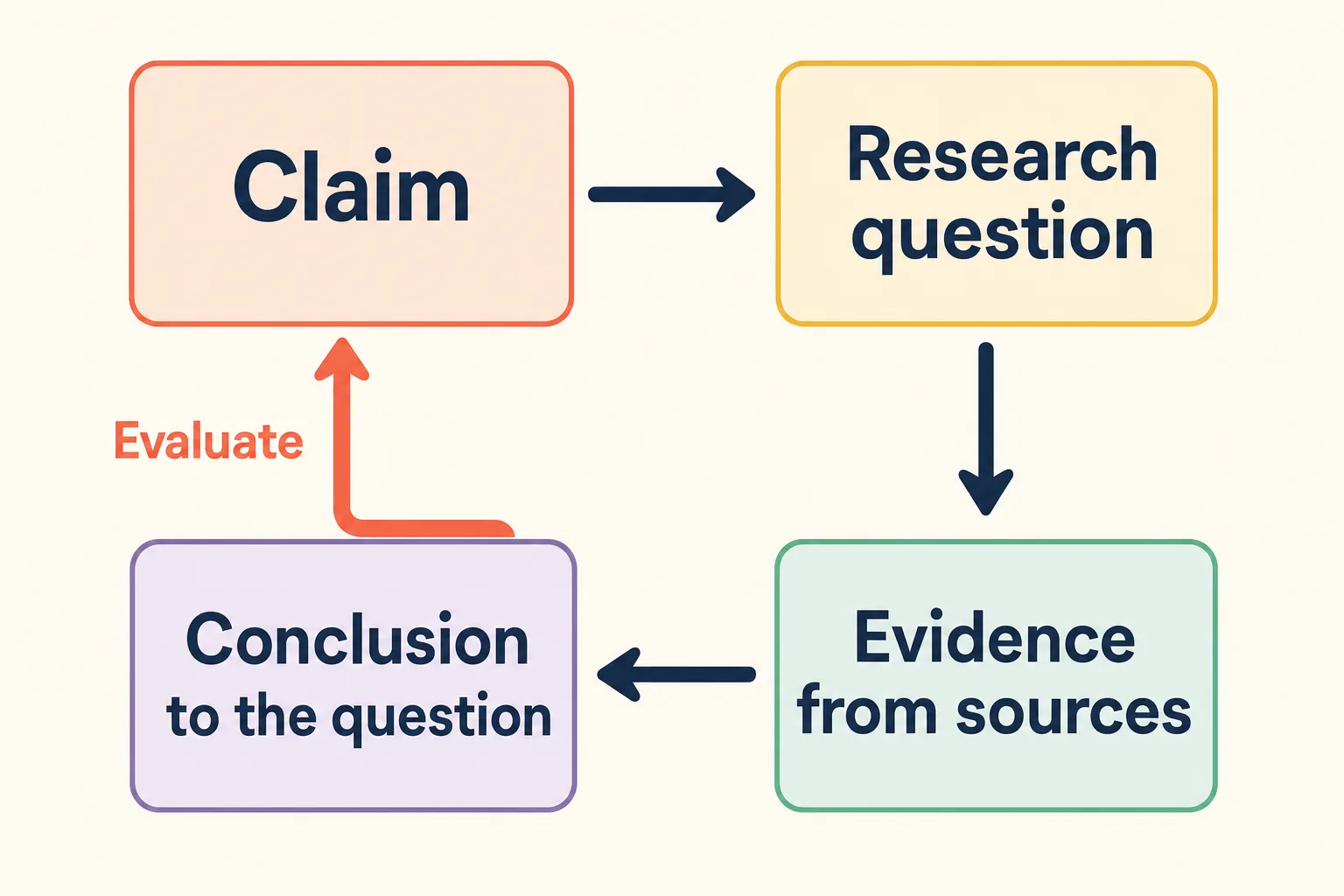
The conclusion here answers the research question. Hold that thought, because the next criterion asks for something different, and mixing them up is where a quarter of the marks quietly disappears.
Evaluating: go back to the claim
Evaluating is the criterion most often left thin, because it comes last. It has three parts, and the middle one is the trap.
The top band needs a justified discussion of the quality of evidence, extrapolation of credible findings to the claim, and suggested improvements and extensions relevant to the claim. For the quality of evidence, QCAA names five dimensions to work through: credibility, bias, relevance, accuracy, and recency. Discuss each across your sources rather than asserting that your evidence was "good".
- Quality of evidence discussed across the five dimensions: credibility, bias, relevance, accuracy, and recency.
- Findings extrapolated back to the original claim, not only to the research question.
- Improvements and extensions that would produce more valid or reliable evidence about the claim.
The response conditions
That last point is the same trap as the mark order. The section worth returning to the claim sits at the end of the report, so an over-length draft loses exactly the marks that are hardest to win back.
Key takeaways
A specific and relevant research question, evidence compared between sources, and a real return to the claim are the three habits that separate a top-band research investigation from a middle one.
| Point | Details |
|---|---|
| Make the question specific | Name measurable variables, state the relationship, and tie it to a particular aspect of the claim in Unit 4. |
| Decompose the claim | The rationale must show the logical path from the claim to the research question, not just background theory. |
| Compare between sources | Top-band analysis finds trends between your sources and shows the evidence on the page, with specific limitations. |
| Conclude, then evaluate | The conclusion answers the research question; the evaluation applies findings back to the original claim. |
| Judge the evidence | Discuss credibility, bias, relevance, accuracy, and recency rather than calling the evidence good. |
Why I plan the return to the claim first
The first research investigation I wrote answered its research question well and then stopped. I thought the conclusion was the finish line. The evaluation was a short paragraph saying the evidence was reliable, and it scored exactly what a short paragraph saying the evidence was reliable deserves.
What I would tell an earlier version of myself is simple: the claim is the point, not the research question. The research question is the tool you build to interrogate the claim. So plan the paragraph that goes back to the claim before you write the body, and leave it enough words to breathe.
None of the marks in this task reward cleverness for its own sake. They reward a question narrow enough to answer, evidence shown in full, and a conclusion that travels all the way back to where it started. That is a structure, and structures can be planned.
Check your investigation with ISMGenius
ISMGenius reads your draft against your task's own ISMG and shows you, criterion by criterion, which band your research question, your analysis, and your evaluation of the claim reach, along with the descriptor wording behind each. It is an informed estimate to guide your revision before you submit, not your official grade, and it never writes the work for you.
You can run a draft through ISMGenius, read the companion guide to the maths PSMT write-up, learn how to read your ISMG, and look up any term in the assessment glossary. The syllabuses and marking guides are published on the QCAA science subject pages.