A QCAA task sheet hands you one word that decides everything: Evaluate the effectiveness of the model. Change that one word to Describe and a top response becomes a mid-band one, even if every fact in it is correct. The cognitive verb is the instruction. It tells you what kind of thinking earns the marks, and most lost marks trace back to answering a different verb than the one on the page. This guide covers what the high-frequency QCAA cognitive verbs actually demand, how they rank by difficulty, and why the verb hides inside your ISMG once marking begins.
What a cognitive verb actually asks of you
A cognitive verb names the mental process you must perform. QCAA publishes the definitions in one place: the cognitive verb framework. That document quietly grew in August 2025, from 75 defined terms to 117. If you are working from a printout a teacher made a few years ago, some of your definitions are out of date.
The verb is not decoration. It sets the ceiling on your marks. Answer describe when the task said evaluate and you cannot reach the top band, because you never did the thing the criterion rewards.
If you already have a response, check whether the evidence in your draft actually performs the verb in your ISMG. That is more useful than checking whether the verb appears somewhere in a sentence.
The verbs grouped by what they demand
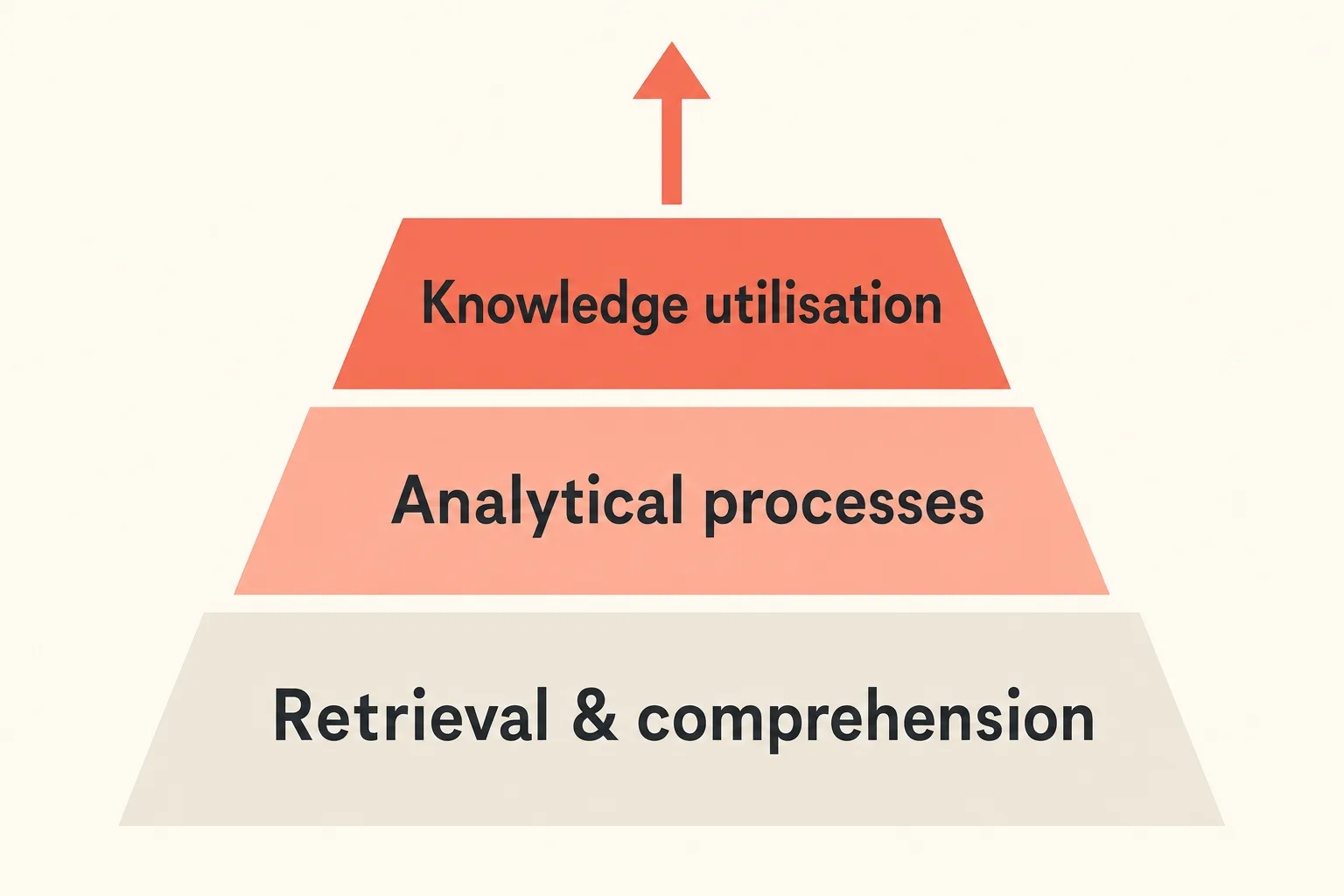
QCAA does not list the senior verbs alphabetically for marking. It sorts them into three categories of increasing demand, adapted from Marzano and Kendall's taxonomy: retrieval and comprehension, analytical processes, and knowledge utilisation. The category tells you how hard the thinking is.
Retrieval and comprehension
describe, explain, identify, recognise, demonstrate, summarise, use
What it asks: recall information and make it clear. This is the floor. Describe gives an account of a feature or event; explain makes it clear by revealing a cause or relationship. Necessary, rarely enough on its own.
Analytical processes
analyse, apply, compare, contrast, interpret, distinguish, critique
What it asks: break things apart and reason about how they relate. Analyse means dissecting into constituent parts and their relationships. This is where mid and upper bands begin.
Knowledge utilisation
evaluate, justify, examine, discuss, appraise, assess, synthesise, solve
What it asks: use knowledge to reach and defend a position. Evaluate, justify and examine sit here. These verbs carry the top-band marks in most senior subjects.
Two rankings in that table surprise almost everyone. Explain is not a step above describe; both sit on the floor together, and the real step up is analyse. And examine is not a gentler word for analyse. It outranks it, because examining an argument means uncovering the assumptions the argument rests on.
The verb alone does not fix the level, either. The object matters. Identify is a retrieval verb, but "identify errors" is analytical. Construct a diagram is retrieval; construct an argument is knowledge utilisation. Read the whole instruction, not just its first word.
The confusion pairs that cost marks
Four pairs of verbs get mixed up more than any others. Each pair looks similar and marks differently.
Describe
Gives an account of what. "The membrane became more permeable as temperature rose." A true statement with no cause in it.
Explain
Reveals why. "Permeability rose because heat disrupted the lipid bilayer, widening gaps between phospholipids." The connective does the work.
Justify
Defends a position already taken. Give reasons and evidence for your conclusion. One direction. You never have to argue against yourself.
Evaluate
Weighs strengths against limitations, against named criteria, then judges. An "evaluation" with no weaknesses in it is really a justification, and it caps below the top band.
The other two are quieter but just as expensive. Compare requires both similarities and differences, and the significance of each; it does not mean similarities only. Contrast requires differences, referring to both items throughout rather than a block on one followed by a block on the other.
Six before-and-after verb rewrites
Use these as sentence moves, not as templates to copy. The point is the extra thinking performed after the arrow.
1. Describe only
"The unemployment rate fell after the policy began."
Explain
"The unemployment rate fell because the wage subsidy reduced the cost of hiring inexperienced workers."
2. Identify only
"The author uses a storm metaphor."
Analyse
"The storm metaphor turns the disagreement into an uncontrollable force, shifting responsibility away from the narrator and positioning the reader to excuse her choice."
3. Similarity list
"Both sources report a temperature increase."
Compare
"Both sources show warming, but Source A records twice the increase over a shorter period; that difference makes it stronger evidence for rapid change."
4. Assertion
"Six concentration levels are better than three."
Justify
"Six levels are appropriate because three cannot distinguish a linear trend from a plateau, while six preserve the range and reveal the curve's shape."
5. One-sided praise
"The model is effective because its predictions are close to the data."
Evaluate
"Against prediction error, the model is effective within the measured range; however, its error doubles beyond 12 m, so it is not reliable for extrapolation."
6. Summary
"The argument says stricter rules will improve safety."
Examine
"The argument assumes compliance rises when penalties rise, but provides no evidence that students know the rule or believe enforcement is likely."
Maths gives the clearest worked case of the difference, because the PSMT's Formulate criterion pays for justification and nothing else: see how to justify a PSMT observation or assumption rather than merely stating one.
Where the verb hides inside your ISMG
Here is the catch that costs marks even when students know the verb. In the ISMG, the verb is rarely printed as a verb. Analyse becomes "analysis". Justify becomes "justified". Organise becomes "organisation". You search the marking guide for your verb and cannot find it.
Worse, the band levels usually keep the same verb and change only the qualifier in front of it. This is the Literature analytical response criterion, one criterion, top to bottom:
- 8–9
discerning analysis
The judgement is selective and perceptive. You chose the evidence that matters and showed its effect.
- 6–7
effective analysis
Relevant analysis that mostly lands. The common ceiling for careful students.
- 5
adequate analysis
Analysis is present but stays close to the surface.
- 3–4
superficial analysis
Thin, or drifting back toward description.
- 1–2
identification only
The verb itself has dropped. You are naming features, not analysing them.
Two things follow from that ladder. Moving from a 5 to a 7 is not "analyse more". It is the same verb done effectively rather than adequately. And at the bottom the verb quietly changes: the 1–2 band is not weak analysis, it is a lower-order act, identification. QCAA's handbook is blunt that the guide is fixed: "Schools cannot change or modify an ISMG for use with summative internal assessment." That is the exact language your work is matched against.
Key takeaways
Reading the cognitive verb correctly, ranking it honestly, and finding its qualifier in the ISMG are the three habits that move a response up a band.
| Point | Details |
|---|---|
| Answer the verb on the page | The cognitive verb sets your mark ceiling; answering a different verb caps the response below the top band. |
| Explain is not above describe | Both are retrieval-level; the real step up in demand is analyse, then examine and evaluate. |
| Evaluate needs limitations | An evaluation without weaknesses and criteria is a justification, and it marks lower. |
| The object changes the level | "Identify" is low, but "identify errors" is analytical; read the whole instruction, not the first word. |
| Find the qualifier, not the verb | In the ISMG the verb is nominalised and the qualifier moves between bands; aim at the qualifier. |
Why I read the verb before anything else
For a long time I treated the cognitive verb as a formality. I read the task, understood the topic, and started writing about the topic. The verb was just how the sentence happened to begin.
The change came when I lined up my response against the marking guide and saw that I had written a careful description of something the task had asked me to evaluate. Every fact was right. The thinking was the wrong shape. I had built a solid wall in the wrong place.
Now the verb is the first thing I read and the last thing I check. It is a small habit, and it is the cheapest marks in senior assessment. You do not need to know more content to use it. You need to answer the question that was actually asked.
See the verb the way a marker does, with ISMGenius
ISMGenius reads your draft against your task's ISMG and shows you where each criterion sits, with the descriptor wording it matched. Because it works from your actual marking guide, it treats the cognitive verb the way a marker would rather than like a generic writing checker. It gives you an informed estimate to help you improve before you submit, and it never writes the assignment for you.
If you want to check whether your response actually performs its verb, you can start getting rubric-aligned feedback on a draft, read what an ISMG rubric is asking for, and work through how to read an ISMG criterion by criterion.
Recommended
- why drafts that evaluate outscore drafts that explain, from 970 Queensland drafts
- the complete list of all 117 QCAA cognitive verbs
- how to read your ISMG rubric
- finding the marks you are leaving behind on your ISMG
- how your QCAA subject result is actually built
- rubric-aligned feedback on your assignment drafts