Two sentences about the same novel. First: "The author uses first-person narration throughout the novel." Second: "By locking the reader inside the narrator's first-person account, the author withholds every other character's motive, so we inherit the narrator's suspicion as if it were our own." The first identifies a feature. The second analyses its effect on the reader. In the QCAA English analytical essay, the first sentence sits near the bottom of the marking ladder and the second sits near the top, and the distance between them is the whole subject.
What the analytical essay is
In General English the four assessment instruments are each worth 25%: a spoken persuasive response, a written response for a public audience, an examination extended response, and the external assessment, which is the analytical essay. The analytical essay is written under examination conditions in response to an unseen question about a studied literary text, and it is worth 45 marks across three criteria: Knowledge application, Organisation and development, and Textual features.
Knowledge application is where the marks are won or lost, because it rewards analysis of three things: the perspectives and representations in the text, the cultural assumptions and values that underpin it, and the writer's stylistic and aesthetic choices. Note that Literature is a separate QCAA subject with its own syllabus and its own criteria; if you are still choosing between them, compare General English, Literature and EAL instrument by instrument. The moves in this guide apply to General English.
The ladder that decides your mark
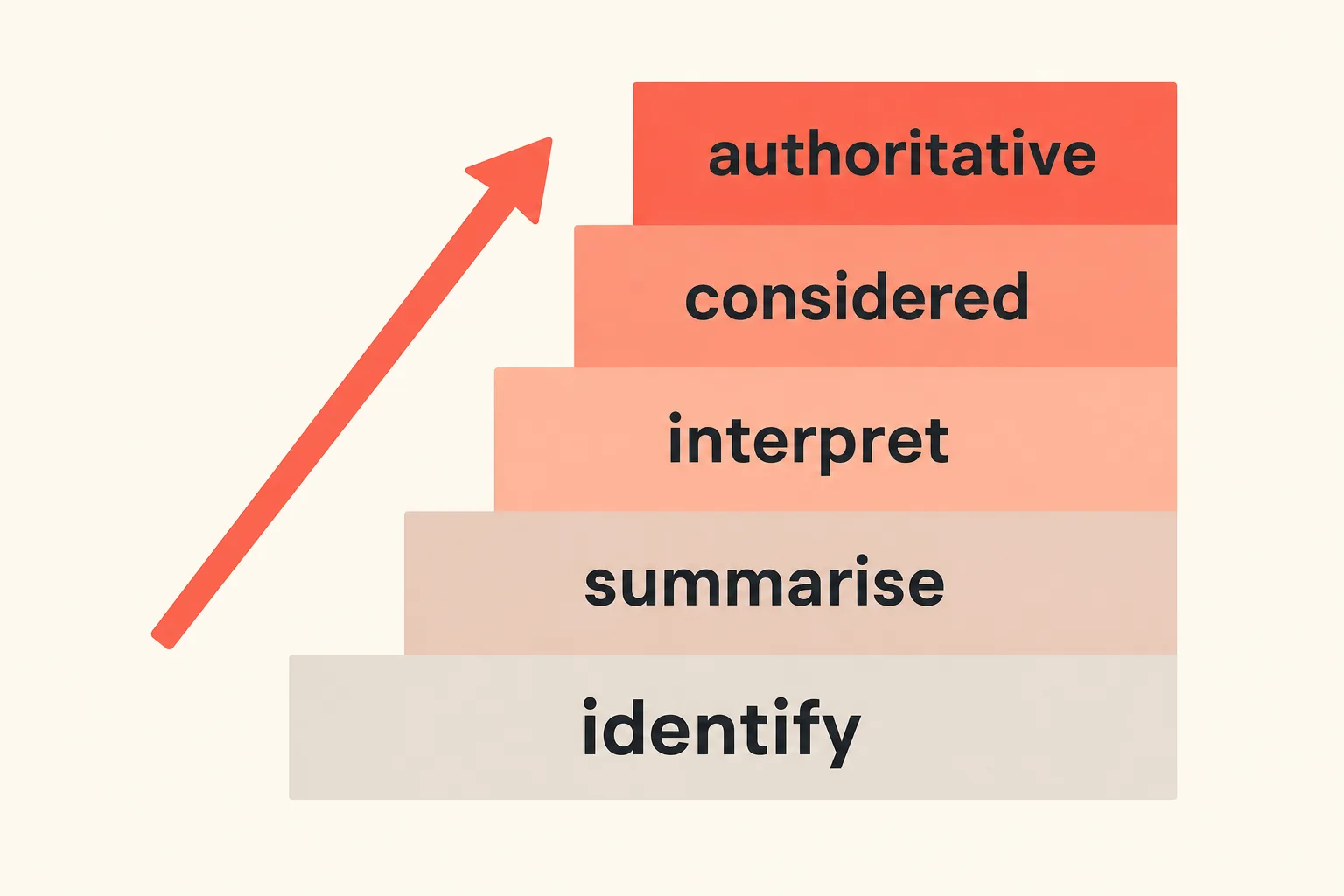
The Knowledge application criterion is a ladder, and each rung is a verb. This is the ladder for analysing the writer's choices, top to bottom, in the marking guide's own words.
- 6
examines · authoritative interpretation
Examines how the writer's choices shape the text, and provides an authoritative interpretation of them.
- 5
examines · considered interpretation
Examines the choices and provides a considered interpretation.
- 4
examines · an interpretation
Examines the choices and provides an interpretation.
- 3
examines · a summary
Examines the choices but only provides a summary of them.
- 2
identifies
Identifies the writer's choices in the text.
- 1
identifies some
Identifies some choices of the writer.
The climb is what matters. Identifying a technique is a 2. Examining it but only summarising is a 3. The jump to 4 and above is the word "interpretation": you have to say what the choice does and argue why. "Considered" then "authoritative" reward how well you argue it. So the top band is the same techniques, interpreted with authority.
Write about effect, not feature
"Authoritative interpretation" has a practical meaning: write about the effect a choice has on the reader, not the fact that the choice exists. Feature-spotting stays on the lower rungs no matter how many features you spot. Interpreting the effect is what climbs.
The writer's use of short, fragmented sentences in the final chapter mirrors the narrator's collapsing composure, so the reader experiences the breakdown at the pace the narrator does rather than being told about it after the fact.
Why this scores: the marked clause moves from the feature (fragmented sentences) to its effect on the reader (experiencing the breakdown in real time). That shift from what the text contains to how it positions the reader is the move the top band rewards.
A useful self-test: after each analytical sentence, ask "so what does this do to the reader?" If the sentence already answers that, it is interpreting. If it stops at naming the device, it is still identifying.
Make the thesis contestable
The Organisation and development criterion rewards a "discriminating thesis" at the top, and a "credible" one below it. A discriminating thesis takes a position that could be argued against. "The novel explores identity" is not contestable, so it cannot discriminate. "The novel presents identity as something imposed by others rather than chosen, and invites the reader to distrust the narrator's claim to self-knowledge" is a position, and the rest of the essay can argue for it.
The same criterion rewards evidence "used explicitly to strengthen arguments". That is the difference between quotation that fills space and quotation that does work. A quotation dropped in to prove the technique exists is filler. A quotation chosen because it is the clearest instance of the effect you are arguing is evidence.
This distrust is sharpened by the narrator's own qualifiers. When they concede, "or so I told myself at the time," the admission invites us to reread every earlier certainty as a possible self-deception.
Why this scores: the quotation is short, embedded in the sentence, and chosen because it carries the exact effect the argument needs. The analysis then extends the effect across the whole text, rather than stopping at the quote.
Architecture that makes analysis visible
Markers read fast and under calibration. Structure that makes your analysis easy to see is structure that gets credited. Open each body paragraph with the claim, not the evidence. Put the technique and the quotation in the middle, as support. Close on the effect on the reader and its link back to the thesis. That order signals interpretation before it signals feature, which is the order the ladder rewards.
The Textual features criterion sits underneath all of this, rewarding grammar, vocabulary used "with discrimination", punctuation, and spelling. These reward control, not insight, so they are the cheapest marks to secure with a careful final proofread.
Key takeaways
Interpreting effect rather than naming features, arguing a contestable thesis, and using evidence that does work are the three habits that lift an analytical essay into the top band.
| Point | Details |
|---|---|
| Climb the verb ladder | Identify is a 2, summarise is a 3; interpretation and an authoritative reading are what reach 4 to 6. |
| Write the effect | State what a choice does to the reader, not just that the choice is present in the text. |
| Take a contestable position | A discriminating thesis can be argued against; a description of the theme cannot. |
| Make evidence work | Choose short, embedded quotations for the effect they carry, not to prove a technique exists. |
| Lead with the claim | Open each paragraph with the argument so the interpretation is visible before the feature. |
What I wish I had known about analysis
My early essays were catalogues. I could find metaphor, symbolism, and structure on any page, and I listed them proudly, and I could not understand why a full page of techniques scored in the middle.
The essay that finally scored well had fewer techniques in it. Each one was there because it did something to the reader that supported one arguable idea, and I said what that something was. The essay stopped being a tour of the text and became an argument about it.
That is the shift the marking ladder is built to reward, and it is learnable. You do not need to notice more. You need to say, every time, what the thing you noticed does.
Pressure-test your essay with ISMGenius
ISMGenius reads your draft against your task's own ISMG and shows you, criterion by criterion, whether your analysis is identifying, summarising, or interpreting, and the descriptor wording behind the band. For an analytical essay that means seeing where a paragraph stops at the feature before a marker does. It is an informed estimate to guide your revision, not your official grade, and it never writes the essay for you.
You can run a draft through ISMGenius, decode the cognitive verbs behind analyse and examine, learn how to read your ISMG, and see the general moves for lifting any draft in how to move a draft up a mark band.