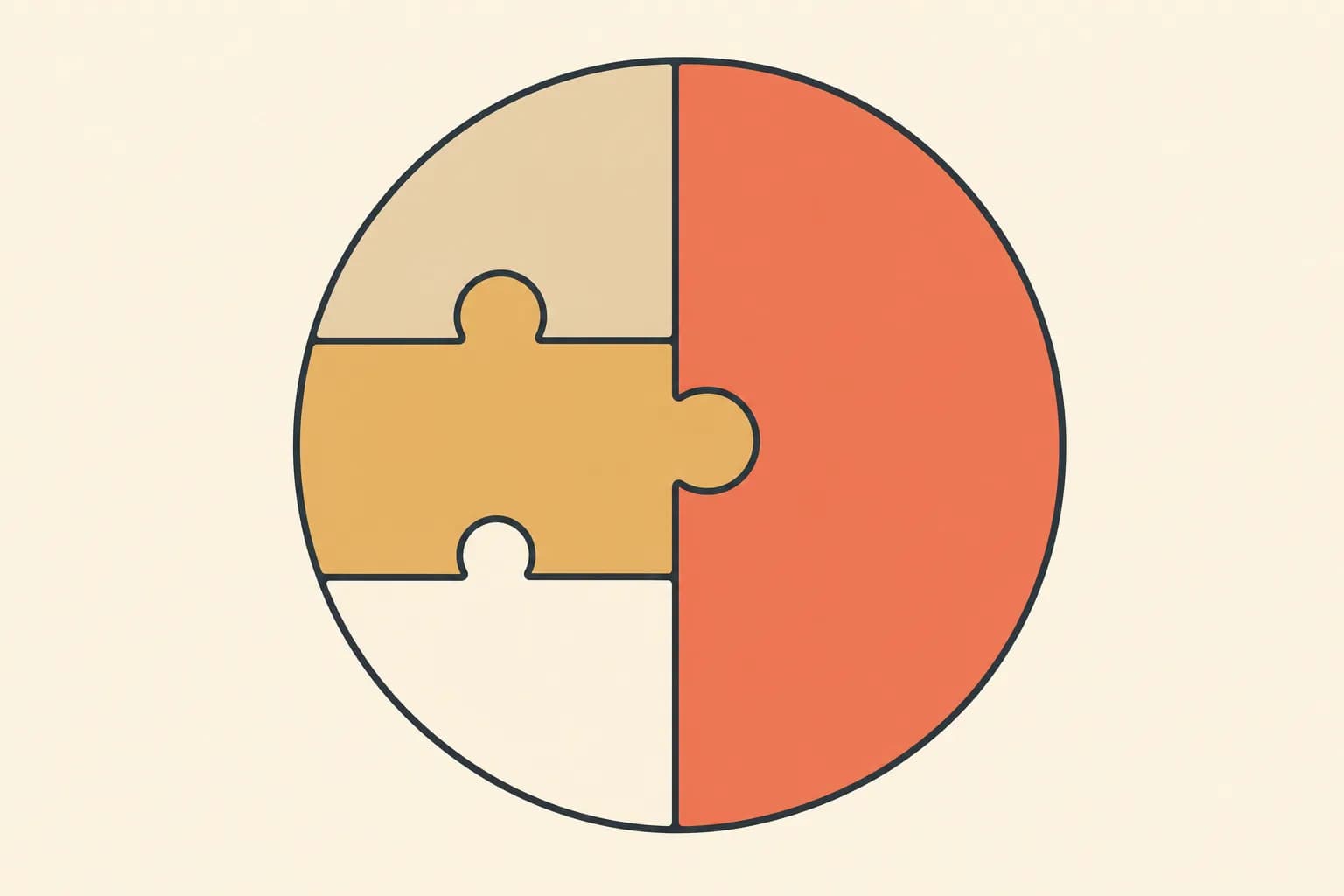
Your final result in a QCAA General subject is a number out of 100, and it is built from exactly four pieces. In English, each of them is worth the same: three internal assessments at 25 per cent each, and one external exam at 25 per cent. In Biology the split is different. The three internal tasks together are worth half, and the external exam is the other half. Knowing which four pieces make up your subject, and what each is worth, tells you where your effort actually counts. This explains how the result is assembled, why an internal mark can change after your teacher marks it, and where the ATAR fits in.
The four pieces of a subject result
A General subject in Units 3 and 4 is assessed by four instruments: three internal assessments, labelled IA1, IA2 and IA3, and one external assessment, the EA. Your school sets and marks the three internal tasks. QCAA sets and marks the external one.
What differs between subjects is how the 100 marks are split across those four. There are two common patterns.
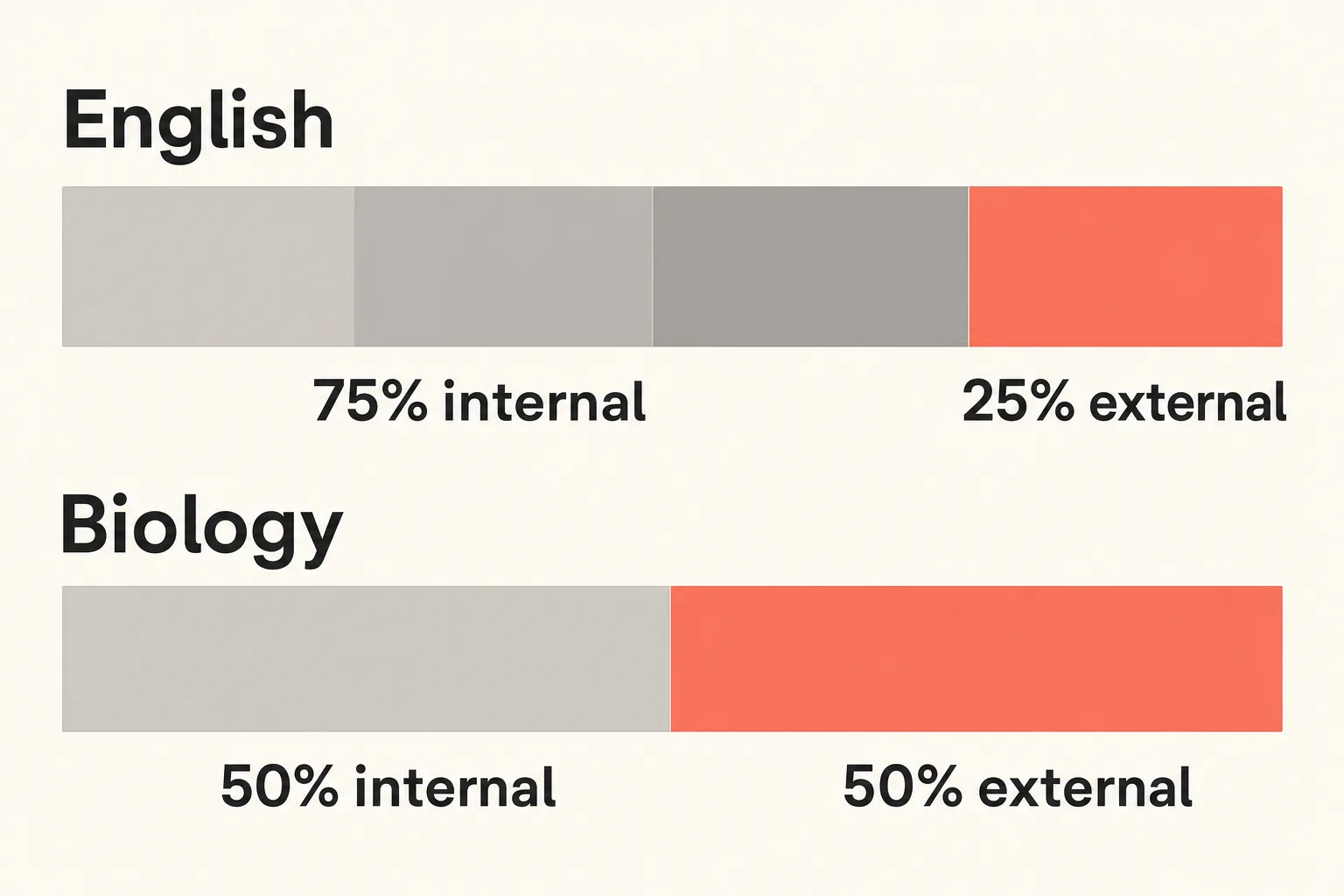
English is the clearest example of the first pattern. Its three internal assessments, a spoken persuasive response, a written response for a public audience, and an extended-response exam, are each worth 25 per cent, and the external exam is the final 25 per cent. Add them up and the internal tasks carry 75 per cent of the result.
A worked subject: Biology
Biology follows the second pattern, and its internal weightings are not even. Here is the actual split:
- IA1 Data test10%
- IA2 Student experiment20%
- IA3 Research investigation20%
- EA Examination50%
The external exam alone is worth as much as all three internal tasks combined. A student who is strong on assignments but neglects exam preparation is leaving half the subject on the table. The lesson is not "the exam is everything". It is "check your subject's split and plan around it", because a mathematics or science subject rewards exam readiness far more than most humanities subjects do. If you are in Year 12 now, the 2026 external assessment guide has every subject's exam date alongside its weighting.
How the marks become a result
The path from a marked task to a subject result has a step that surprises most students. Your teacher does not simply add up your marks and post a grade.
Your school marks each internal task against its ISMG
Each of the three internal assessments is marked using its instrument-specific marking guide, criterion by criterion.
The school sends QCAA a provisional mark
Those internal marks are reported to QCAA as provisional marks, by criterion. They are not final yet.
QCAA confirms the internal marks
QCAA runs a confirmation process across schools before the internal marks are locked in. This is why a provisional mark can change.
The external assessment is added
QCAA develops and marks the external exam, then combines it with the confirmed internal marks.
The outcome, in QCAA's own words, is that it uses these results "to determine each student's subject result as a mark out of 100 and as an A–E".
Why an internal mark can change after marking
A provisional mark is exactly that: provisional. When your teacher hands back an internal assessment with a mark on it, that mark has not yet been confirmed by QCAA.
This is not a reason to distrust your teacher. It is a reason to understand that the internal mark you see is part of a larger system designed to be fair across the whole state. It also means the external exam, marked entirely by QCAA, is the one piece no local factor can shift.
Where the ATAR fits in
A subject result is not an ATAR. The two are calculated by different bodies for different purposes.
QCAA produces your subject results, the mark out of 100 and the A–E for each subject. The ATAR is calculated separately by the Queensland Tertiary Admissions Centre, QTAC, from your results across your subjects. The mechanics of that calculation — inter-subject scaling, the Tertiary Entrance Aggregate and the rank — are QTAC's, and worth understanding separately from anything your school controls.
Key takeaways
Knowing your subject's split, planning around its heaviest piece, and understanding confirmation are what turn "how am I graded" from a mystery into a plan.
| Point | Details |
|---|---|
| Four instruments, one result | Three internal assessments and one external exam combine into a single mark out of 100 and an A–E. |
| The split varies by subject | Most General subjects are 75% internal and 25% external; sciences and maths are 50% internal and 50% external. |
| Weightings are uneven inside a subject | Biology's internal tasks are 10%, 20% and 20%, so a single task can matter far more than another. |
| Internal marks are provisional | Schools report provisional marks by criterion; QCAA confirms them before they are final, so they can change. |
| A subject result is not an ATAR | QCAA sets subject results; QTAC calculates the ATAR separately from your results across subjects. |
Why the weightings changed how I worked
I spent my first year of senior treating every assessment as equally important, because no one had shown me the numbers. It felt fair and it was inefficient. I gave a 10 per cent data test the same anxious weekend I should have given the exam worth five times as much.
Seeing the split laid out changed how I planned a term. Not "work harder", but "work in proportion". The heavy pieces got the long runway. The light ones got done properly and quickly, without the spiral.
The weightings are public. They are printed in every syllabus. Reading them is fifteen minutes that reshapes an entire year of effort, and almost no one does it early enough.
Plan your drafts around the marks with ISMGenius
Once you know which internal task carries the most weight, ISMGenius helps you get that task right before it is marked. It reads your draft against the task's ISMG and shows where each criterion sits, so your revision time goes to the piece that counts most. It gives an informed estimate to guide you before you submit, not your official grade, and your teacher's confirmed mark is always the real one.
You can check a draft before you submit, browse the QCAA subjects ISMGenius supports, learn how to read an ISMG, and see how feedback before a summative task lifts your result.