PSMT stands for Problem-solving and modelling task, the QCAA maths investigation marked out of 20. The marks are not spread evenly: Formulate is worth 4, Solve is worth 7, Evaluate is worth 5, and Communicate is worth 4. That split matters more than it looks, because QCAA's own confirmation data shows the marks that get taken away most often sit in Formulate and Evaluate, while Communicate is almost never disputed. Most students spend their time the other way around.
Where the 20 marks actually sit
The PSMT is IA1 in General Mathematics, Mathematical Methods, and Specialist Mathematics, worth 20% of your subject result. Essential Mathematics runs two of them, at IA1 and IA3. Before you write a word, look at the allocation, because it tells you where your hours should go.
- Solve7 marks
- Evaluate5 marks
- Formulate4 marks
- Communicate4 marks
One naming change matters. Under the 2025 syllabuses the third criterion is called Evaluate, not Evaluate and verify. The marks did not change. The wording did, and verification is now an explicit, separately marked requirement. If your teacher or a textbook still says "evaluate and verify", they are describing the retired 2019 syllabus.
If you already have a draft, you can check its Formulate, Solve, Evaluate and Communicate evidence against your own ISMG before you spend another revision session polishing the wrong section.
Formulate: justify, do not just explain
Formulate is worth 4 marks and it has three top-band requirements. QCAA's wording is "justified statements of important assumptions", "justified statements of important observations", and "justified mathematical translation of important aspects of the task". Two words in there do the work: justified, and the plurals.
The plurals are load-bearing. QCAA states that the top band requires "justified statements of important assumptions" and "important observations" in the plural, so you need at least two justified assumptions and at least two justified observations. State one of each and you are capped at the lower band.
The more common failure is confusing explaining with justifying. QCAA warns schools to teach the difference between the two. An assumption that is explained tells the reader what you assumed. An assumption that is justified shows why it is reasonable and what breaks without it.
The other failure is mislabelling: a supplied dimension listed as an assumption, or a task instruction listed as an observation. If you are not certain which of your statements is which, work through the difference between PSMT observations and assumptions, which has worked examples and a set of statements to classify.
Explained (caps lower)
"I assume air resistance is negligible."
Justified (top band)
"I assume air resistance is negligible because the object is dense and slow-moving; including it would add a drag term that the collected data cannot resolve, and it would change the result by less than the measurement error."
Because the available measurements are rounded to the nearest metre, treating each value as exact would overstate the model's precision. I therefore assume a measurement uncertainty of ±0.5 m and test whether that range changes the chosen model.
Why this scores: it names the task-specific evidence, justifies the assumption from that evidence, and shows what the assumption changes in the mathematics.
One more trap: an "important" assumption is one the problem cannot be mathematised without. A list of general definitions is not translation. QCAA wants translation that is specific to this problem, not a glossary of the topic.
Solve: show complex work, and justify the technology
Solve carries the most marks, 7 of 20. The top band needs "accurate use of mathematical knowledge for important aspects of the task", "efficient use of technology", and "a complete solution". QCAA describes the top standard as accurate use of complex procedures, meaning sequential, interrelated steps that draw on a range of relevant subject matter, reaching a valid solution consistent with the problem.
The quiet mark leak here is technology. "Efficient use of technology" means the tool was chosen because it developed the solution quickly and effectively, and QCAA is explicit that use must go beyond simple computation, graphing, or word processing. Two things sink this criterion: using a spreadsheet or calculator without ever stating why, and dumping the technology output in an appendix. Appendixes are not marked. A residual plot that justifies a linear model earns nothing if it lives at the back of the report.
A cubic regression was fitted in the spreadsheet because the residuals from the linear model curved systematically. The cubic model reduced the largest absolute residual from 8.2 to 2.1 and produced no remaining pattern, so it was used to calculate the turning point.
Why this scores: the technology has a stated purpose, the model choice is supported by evidence, and the result is carried into the solution rather than pasted in as unexplained output.
Evaluate: the five things that must be there
Evaluate is worth 5 marks, and in 2025 it has five separate top-band descriptors. This is the criterion most students leave thin, because it comes last and the word count is running out. Treat it as five deliberate checks, not one closing paragraph.
- Verified results, in the plural. One check is a 2 to 3; several are needed for 4 to 5. Verify using estimation, an alternative or algebraic method, technology, or research.
- Reasonableness of the solution judged against your assumptions by name.
- Reasonableness judged against your observations by name.
- Justified statements of relevant strengths of the solution, plural.
- Justified statements of relevant limitations of the solution, plural.
Two mechanical rules follow. First, verification is separate from evaluation, and it is now explicitly required for the top band. Checking a result with a second method is verification. Judging whether the answer makes sense in the real context is reasonableness. You need both. Second, reasonableness is marked against the results and the assumptions and the observations, not the results alone. The clean way to guarantee this is to revisit every assumption and observation you stated in Formulate, by name, and say whether the solution still holds given each one.
Substituting the predicted maximum back into the original equation returns the same value to three significant figures, independently verifying the result. It is reasonable only within the observed 0–12 m interval; extrapolating past it would break the assumption that the rate remains unchanged.
Why this scores: the first sentence verifies by a second operation; the second evaluates reasonableness against a named range and assumption. It does two different jobs deliberately.
Communicate: write it so a stranger could follow
Communicate is worth 4 marks: correct use of appropriate mathematical language, logical organisation that can be read independently of the task sheet, and justification of decisions using mathematical reasoning. That last one moved into Communicate in 2025, having previously sat in the evaluation criterion, so do not assume an old exemplar shows it in the right place.
"Read independently of the task sheet" is the practical test. A marker with no copy of the question should be able to follow your report from a clear introduction, through the body, to a conclusion that answers the problem. That means restating the problem in your own words at the start, not diving straight into calculations.
Instead of "the answer is 14.6", write: "The model predicts that the storage tank reaches its maximum useful volume at a radius of 14.6 m, within the 15 m site limit."
Why this scores: the quantity, unit, context and constraint travel with the result, so the conclusion can be understood without reopening the task sheet.
PSMT pre-submission checklist
Run this against the report itself, not against what you remember doing. If the evidence is only in your calculator, spreadsheet or appendix, it is not yet on the marked page.
- At least two important assumptions are stated and justified from the task context.
- At least two important observations are stated and justified.
- Variables, constraints and relationships translate the specific problem into mathematics.
- Every technology choice is named and its purpose is stated in the body.
- The solution is complete, sequential and supported by visible working or output.
- More than one important result is verified with an alternative method, substitution, estimation, technology or research.
- Reasonableness is judged against the results, assumptions and observations by name.
- Strengths and limitations are both plural, relevant and justified.
- The conclusion answers the original problem with quantities, units and context.
- The report stays inside the page and word limit before Evaluate and Communicate are cut off.
Key takeaways
Justifying rather than explaining, verifying results, and returning to your assumptions in the evaluation are the three habits that move a PSMT from the middle band to the top.
| Point | Details |
|---|---|
| Follow the mark split | Solve is worth 7 and Evaluate 5; give both more time than the 4-mark Formulate and Communicate. |
| Justify, plural | Formulate needs at least two justified assumptions and two justified observations, not one of each explained. |
| Evidence the technology | Name the tool and the reason in the report body; outputs left in an appendix are not marked. |
| Verify, then evaluate | Check results with a second method, then judge reasonableness against your assumptions and observations by name. |
| Finish inside the limit | Over-length work is not deducted, it is left unread, and the unread part is usually Evaluate. |
Why I write the evaluation section first now
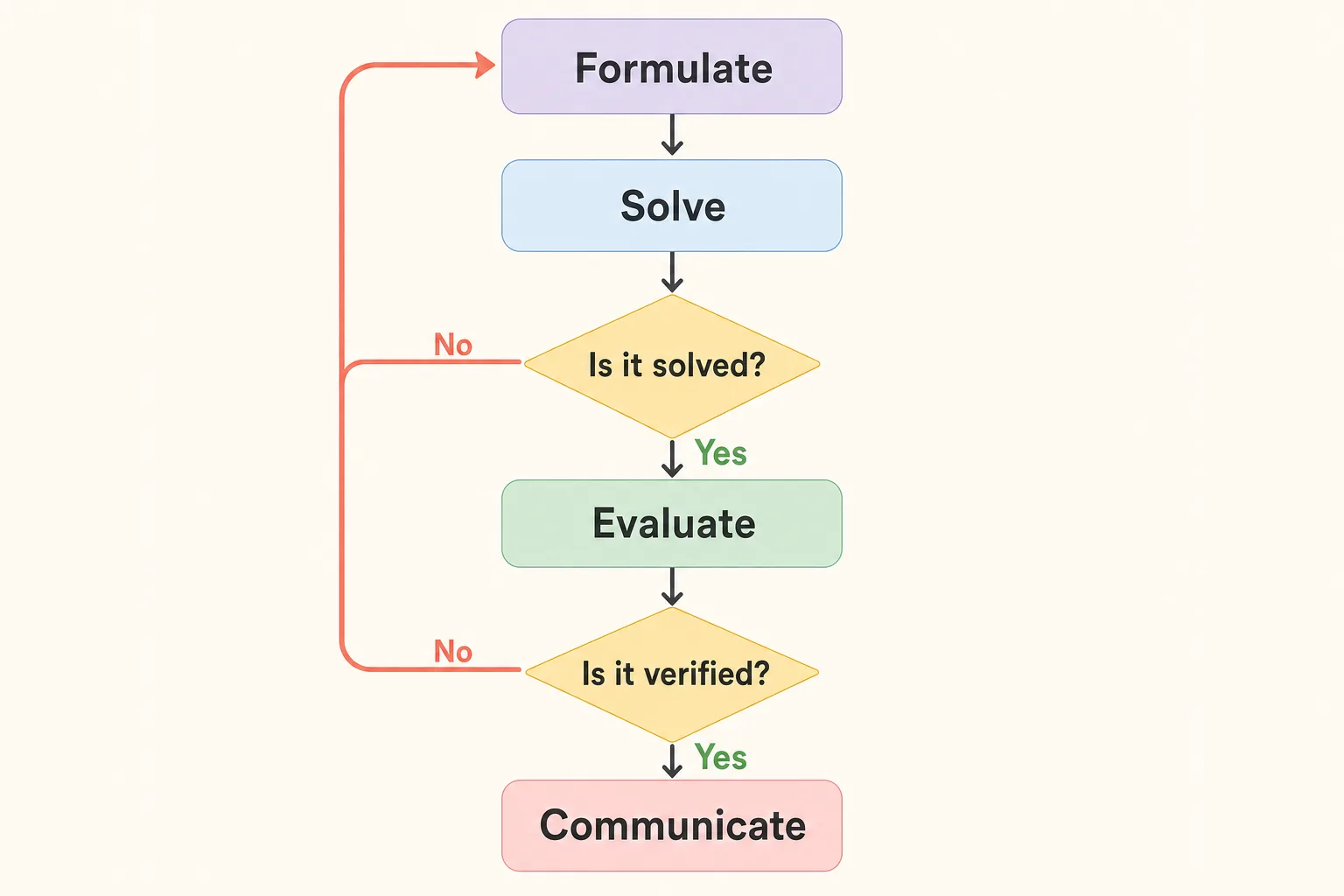
For a long time I wrote a PSMT in the order the flowchart is drawn: formulate, solve, then evaluate whatever time was left. The evaluation was always the weakest part, because it was always the tired part, written at midnight with three hundred words to spare.
The change that helped was drafting the evaluation checklist before the solution was even finished. I would write down the five things Evaluate needs, and the assumptions I would have to return to, as soon as I had a draft solution. That way the section was planned when I was fresh, not improvised when I was not.
The marks in a PSMT are not hiding in harder algebra. They are hiding in the parts students treat as admin: justifying an assumption, stating why a tool was used, checking a result twice. None of that is talent. It is a checklist you can run every time.
Check your PSMT against the ISMG with ISMGenius
ISMGenius reads your draft against your task's own ISMG and shows you, criterion by criterion, which band each part reaches and the descriptor wording behind it. For a PSMT that means seeing whether your Formulate justifications, your verification, and your evaluation actually land in the top band before you submit. It is an informed estimate to guide your revision, not your official grade, and it never writes the work for you.
You can run a draft through ISMGenius, learn to read your ISMG before you write, decode the cognitive verbs behind justify and evaluate, and check the assessment glossary for any term here you want defined. The syllabus and marking guides themselves are published by the QCAA mathematics subject pages.
Recommended
- finding the marks you are leaving behind on your ISMG
- the science research investigation, criterion by criterion
- the humanities investigation, criterion by criterion
- planning an internal assessment from task sheet to submission
- how to read your ISMG rubric
- rubric-aligned feedback on your assignment drafts