In its 2025 Ancient History report, QCAA gives teachers an example of a judgment that should earn little: "Plutarch is reliable because he's an ancient source". It is superficial because the reasoning "is interchangeable with other similar sources": it would fit Livy or Herodotus just as well. Here is an invented judgment about the same author, for an essay on why the Peloponnesian War began: "Plutarch's Life of Pericles is useful for showing the explanations Greeks were still giving for the war five centuries later, including rumours about Pericles' private motives. It is a weak guide to what Pericles intended, because Plutarch wrote around 100 CE, more than 500 years after the war began, and wrote biography to reveal character rather than to settle causes." Only the second decides how far this source can be used for this question, with reasons that belong to this source. Evaluating was the criterion QCAA marked down most often in every Ancient History IA in 2025.
The four Ancient History assessments in Units 3 and 4
General Ancient History on the 2025 syllabus has three internal assessments and one external exam, each worth 25% of your subject result. The 2025 syllabus applies to everyone finishing Year 12 in 2026 or later, so if you start Unit 3 in 2027, this is your structure. The current version is v1.4, from March 2026. Its only change from v1.3 names the exam personalities for 2026 and 2027.
| Assessment and unit | Length |
|---|---|
| IA1 Examination: an essay in response to historical sources, Unit 3 | 120 minutes, plus 15 minutes planning |
| IA2 Investigation: an independent source investigation, Unit 3 | Up to 2000 words |
| IA3 Investigation: a historical essay based on research, Unit 4 Topic 1 | Up to 2000 words |
| External exam: short responses to historical sources, Unit 4 Topic 2 | 120 minutes, plus 15 minutes planning |
Unit 3, Reconstructing the Ancient World, is two historical periods your school picks from a list of 14, from Thebes in the 18th to 20th Dynasties to Pompeii and Herculaneum, Fifth Century Athens and the Medieval Crusades. IA1 and IA2 come from those two periods. Unit 4, People, power and authority, has two topics. Topic 1 is a period your school picks from eight, such as the Persian Wars, the Peloponnesian War, the Punic Wars or the Augustan Age, and it is assessed in IA3. Topic 2 is an ancient personality, and it is assessed in the external exam. For 2026 and 2027 the personality is Cleopatra VII or Julius Caesar.
See how four 25% pieces combine on the subject result calculator, and check your other subjects on the QCAA subjects hub.
When each IA falls in 2027
Your school sets the due dates, and its assessment schedule is the one that counts. QCAA's Senior Education Profile calendar sets the deadlines schools work back from.
- Term 1
Your first Unit 3 period and the IA1 exam. Schools must enter IA1 provisional marks by Tuesday 13 April 2027, early in Term 2, so expect the exam in Term 1.
- Terms 1 and 2
Your second Unit 3 period and the independent source investigation. Schools that opt in to QCAA's second confirmation event enter IA2 marks by Tuesday 8 June 2027. Every other school submits them with IA3 by Tuesday 17 August 2027.
- Terms 2 and 3
Unit 4 Topic 1 and the historical essay based on research. IA3 provisional marks are due by Tuesday 17 August 2027.
- 25 Oct to 16 Nov
The external assessment block, where your Unit 4 personality is examined. QCAA sets the day of the Ancient History paper.
For how a single task runs from task sheet to submission, see the internal assessment timeline.
Ancient and modern sources: the rule that changed
The biggest change in the 2025 syllabus for Ancient History is a word swap with real consequences. IA2 and IA3 now ask for evidence from "ancient and modern historical sources", where the 2019 syllabus asked for primary and secondary. The syllabus gives the reason directly:
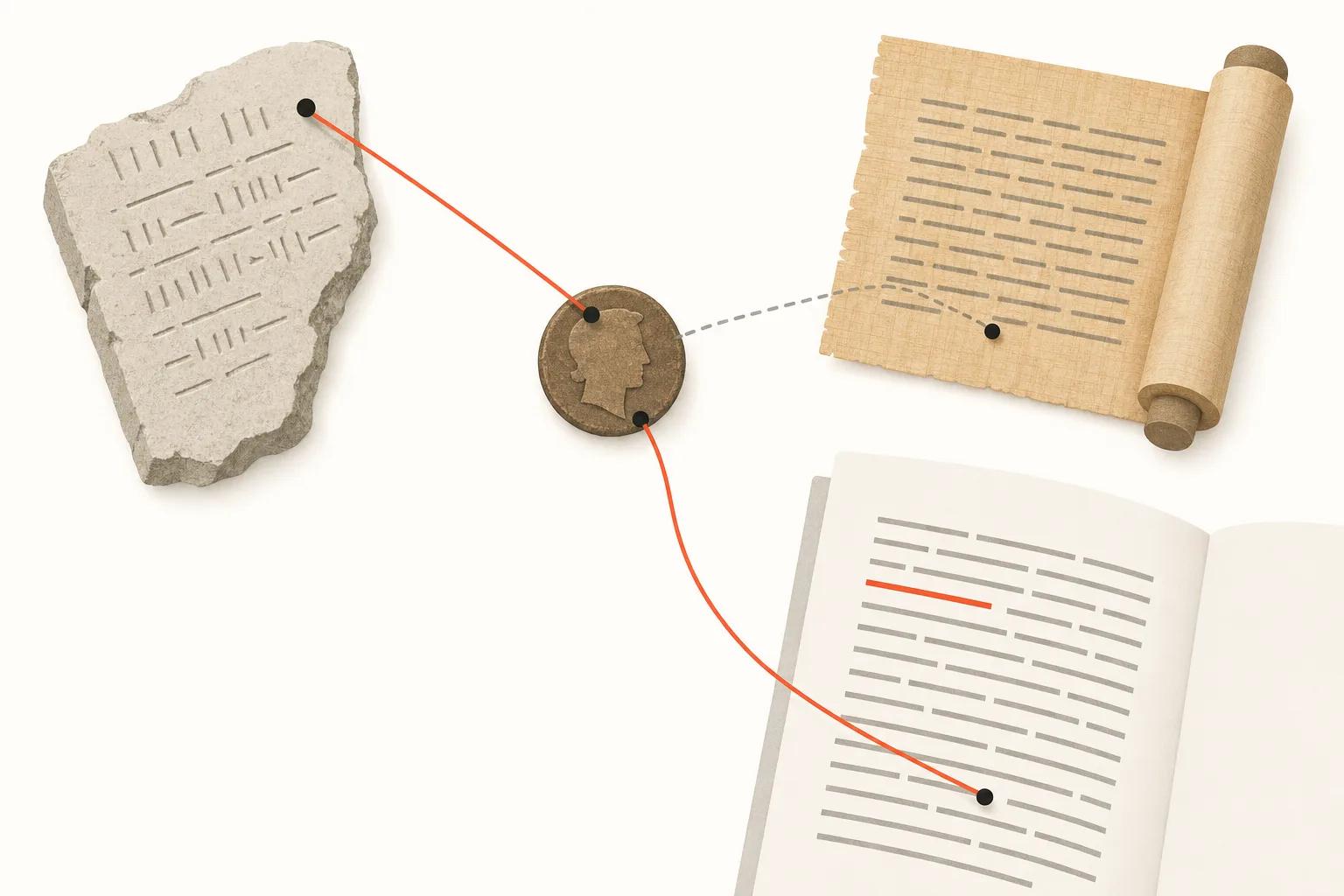
An ancient source was made between the earliest human communities and the end of the Middle Ages, from a narrative history or a letter to an inscription, a coin or human remains. A modern source was made later, usually by a historian or archaeologist interpreting the ancient evidence. Primary and secondary answer a different question: was the source made during the time you are investigating, or afterwards? The two pairs don't line up.
| Source and question | Classification |
|---|---|
| Thucydides on the outbreak of war in 431 BCE | Ancient and primary: he lived through it |
| Herodotus on the Persian succession crisis of 522 BCE | Ancient but secondary: written about a century later |
| Plutarch on Pericles | Ancient but secondary: written about 500 years later |
| A plaster cast of a Pompeii victim | Ancient remains shaped by a modern method, which the analysis has to separate |
| A historian's 2015 book on Persian kingship | Modern and secondary |
In Devising and Conducting, the top band wants a "discerning selection of relevant evidence from ancient and modern historical sources", so an IA2 or IA3 built only on modern books, or only on ancient authors, falls short. In Evaluating, "it's ancient, so it's primary, so it's reliable" is two errors and no reasoning. IA1 asks instead for "a range of sources", which QCAA's report says might mean primary and secondary, ancient and modern, literary and non-literary, or different perspectives.
What changed from the 2019 syllabus
Many exemplars and past task sheets still circulating were written for the 2019 syllabus. QCAA's 2025 subject report lists the differences that change how you should write.
IA1: the essay in response to historical sources
IA1 is a supervised exam on one of your Unit 3 periods. You write an essay answering an unseen question, using 6–7 seen sources given to you a week before and 3–5 unseen sources you meet in the exam. Each has a context statement, which may cover the author, the date and the circumstances it was made in.
- Comprehending5 marks
- Analysing5 marks
- Evaluating5 marks
- Synthesising5 marks
- Communicating5 marks
You get 15 minutes of planning and 120 minutes of working time, no notes, and a clean copy of the stimulus. QCAA's sample IA1 asks how far the evidence supports the Gesta Francorum's picture of First Crusaders driven by religious duty. The example used here is invented, on Pompeii and Herculaneum: "To what extent was Pompeii a city in decline between the earthquake of 62 CE and the eruption of 79 CE?"
Use the week with the seen sources
Your teacher can't help you interrogate the seen sources, and QCAA tells schools to keep analysis and evaluation out of context statements, so the thinking is yours. QCAA also praised tasks that put "any longer literary sources" in the seen set, so the long extract from Tacitus or Herodotus is likely the one you get to prepare. For each seen source, work out:
- what kind of source it is: literary, epigraphic, numismatic, archaeological or modern interpretation
- how far it sits from the events in time and place, and what its author could have known
- why it was made and for whom, from the context statement as well as the extract
- which other seen sources agree with it, and whether that agreement is independent.
Comprehending and Analysing: the right features for each source
The top band of Comprehending (4–5) asks for "thorough and mostly accurate use of terms in historical context", an "informed understanding of concepts related to the unseen question" and a "detailed explanation of issues related to the unseen question". Writing that Pompeii "had elections" uses no terms. Writing that painted notices urged votes for candidates for aedile and duovir, the annual magistrates of what had been a Roman colony since 80 BCE, places the terms in the time and place.
Analysing at 5 asks for "discerning selection and detailed examination of features of evidence from historical sources". Beyond origin, motive, audience, perspectives, context and meanings, the syllabus allows "other features unique to the evidence from specific historical sources". Discerning means choosing the features that matter for each source. In its IA2 advice to teachers, QCAA's report suggests the origin, context and meanings of the painting on an Athenian funerary oil flask might be examined, but only meanings and perspective for a modern historian. The same discernment applies to the stimulus in IA1.
Ancient evidence often has features a modern source never does. A plaster cast of a Pompeii victim exists because excavators from the 1860s poured plaster into the hollows bodies left in the ash, so its origin is two moments: 79 CE and the nineteenth century. A 2024 genetic study reported that some identities long given to people in the casts, including a supposed mother and child, did not match their DNA. A response that examines the cast without separating the ancient remains from the modern reconstruction has missed the feature that matters most.
Evaluating: judgments, plural, and "and/or"
The IA1 top band asks for "discerning and well-reasoned judgments about the usefulness and/or reliability of evidence from historical sources in the stimulus". Every IA1 band says "and/or", so you don't strictly need both qualities, though the strongest responses usually weigh both. QCAA's report reminds teachers that a judgment "must include a decision or opinion about the degree to which a source is reliable or useful, and reasoning to support this decision or opinion."
Consistency matters too. The report tells teachers that a response that "demonstrates one discerning judgment but all other judgments are effective" matches "effective judgments" and can be given 4. One brilliant paragraph does not lift the rest.
Superficial
"Source 2 is by Seneca, who lived at the time, so it is a reliable primary source about Pompeii."
Discerning and well-reasoned
"Source 2 is useful for establishing that the earthquake seriously damaged Pompeii, because Seneca wrote about it within a few years. It is of little use for this question's real issue, whether the city recovered, because Seneca died in 65 CE, fourteen years before the eruption. Any argument about Pompeii in the 70s has to rest on the archaeological sources instead."
The source number is invented; the dates are not. The second judgment says what Seneca is good for, where that stops, and what follows for the argument.
Synthesising: account for the range, not just the agreement
The top band (5) asks for a "sophisticated historical argument that skilfully combines evidence from a range of historical sources to justify decisions". A decision is a main point within your argument. QCAA's report tells teachers an argument is sophisticated "when it demonstrates intellectual complexity, e.g. by acknowledging and accounting for the range of ideas presented in the available sources". In Ancient History, that often means explaining why the same evidence can be read two ways, or why archaeological and literary sources seem to disagree.
Basic
"Source 4 shows damaged buildings. Source 7 shows elections were still held. Source 9 says the city was in decline. Therefore Pompeii was partly in decline."
Sophisticated
"Pompeii in the 70s was a building site, not a ruin. The unfinished Central Baths (Source 4) show that a major public project was still under way when the eruption came. The electoral notices (Source 7) were mostly painted in the city's last years, because older ones were whitewashed over, so they show a political life active enough to be worth advertising. Source 9's case for decline rests on the same unrepaired buildings, read as neglect. The evidence fits better a city whose repairs were slow and possibly interrupted by fresh tremors, which would explain both the building work and the gaps."
The source numbers are invented, and this is the shape of an answer, not a set one. It reads the same archaeological evidence two ways and explains why one fits better, and it uses a feature of the notices, why so few early ones survive, to strengthen the point.
Communicating: the features, and naming your sources
The top band (4–5) asks that "all features of an essay in response to historical sources are consistently applied". They are an introduction with context, a hypothesis and an outline of your argument; body paragraphs with topic sentences; a conclusion; and ethical scholarship, which in the exam means naming each source. QCAA's report tells teachers that "under examination conditions the use of (Source 1) or (S1) is acceptable".
IA2: the independent source investigation
For IA2 you research an area of a Unit 3 period studied in class that was not assessed in IA1, which usually means your second period. You devise your own questions, find 4–6 sources, interrogate them and argue from them. It is individual, designed to take about 15 hours of class time plus your own time, and up to 2000 words.
| Section | Suggested words |
|---|---|
| Key inquiry question and sub-questions | 150 |
| Interrogation of evidence | 1200 |
| Critical summary | 650 |
The interrogation may be in bullet points, but QCAA's report notes that in top-band responses they were not "so brief that communication of ideas was unclear". The critical summary must be in paragraphs. All five criteria are worth 5 marks: Devising and Conducting, Analysing, Evaluating, Synthesising and Communicating.
Devising and Conducting: a question your sources can test
The top band (4–5) asks for the "development and application of a nuanced key inquiry question and relevant sub-questions", a "discerning selection of relevant evidence from ancient and modern historical sources" and "acknowledgment of different perspectives in the evidence from historical sources". QCAA's report says nuanced questions narrow the focus by naming, for example, "the issue, event, time, individual, group, location, society". Applying your questions means using them: your sub-questions should reappear in the interrogation and critical summary.
Descriptive
"How did Darius I become king of Persia?"
Nuanced, with sub-questions
"To what extent was Darius I's account of the 'false Bardiya' designed to legitimise his seizure of the Persian throne in 522 BCE?"
- What does the Behistun inscription claim happened in 522 BCE, and for which audiences was it made?
- How does Herodotus's version compare, and how might it have reached him?
- What does evidence from Bardiya's months as king suggest about how his rule was received?
- How have modern historians interpreted the episode?
This invented example sits in Persia from Cyrus II to Darius III. In 522 BCE a king ruling as Bardiya, the brother of Cambyses II, took power, and Cambyses died that year. Within months Darius, who was not a king's son, had killed him and taken the throne. In a long inscription cut into a cliff at Behistun, in Old Persian, Elamite and Babylonian, Darius claimed that the real Bardiya had been secretly murdered and that the king he killed was an impostor, a Magian named Gaumata. Some modern historians accept the story in outline; others suspect the "impostor" was the real Bardiya. The question doesn't ask who was right, which the evidence may never settle. It asks what Darius's account was for, which the evidence can test.
Choosing 4–6 ancient and modern sources nobody gave you
The sources must not have been studied or supplied in class, and the set must include both ancient and modern sources. A strong set also mixes types and perspectives. For the Darius question, it might be:
- the Behistun inscription in translation: ancient, primary, a royal monument
- the Aramaic copy of Darius's account on papyrus, found at Elephantine in Egypt: ancient, and evidence of how far the official version travelled
- Herodotus, Histories Book 3: ancient, Greek, written about a century later
- a Babylonian business tablet dated by Bardiya's reign: ancient, primary, and not written to persuade anyone
- two modern historians who disagree about whether the impostor story is true.
Among the ways the syllabus says perspectives differ is "level of representativeness or the absence thereof". Almost every surviving voice on 522 BCE belongs to a king or to Greeks writing later, and noticing whose voices are missing is part of acknowledging perspectives.
Analysing and Evaluating in the interrogation
QCAA's report tells teachers "there is no requirement for students to analyse all features of evidence for each source", and warns that templates forcing every feature onto every source "may limit a student's opportunity to demonstrate discernment". Pick the features that do work for your questions.
In IA2 and IA3, unlike IA1, the top two Evaluating bands need judgments about usefulness and reliability: "discerning and well-reasoned judgments about the usefulness and reliability of evidence from historical sources" at the top, and "effective judgments" one step down. Below that, "and/or" returns. QCAA's report describes discerning judgments as ones that "weigh up the strengths and limitations of the evidence in the source and are directly linked to the focus of the inquiry". Here is how that can look for Herodotus in a bullet-point interrogation.
Source 3: Herodotus, Histories Book 3, written in Greek about a century after 522 BCE.
- Origin and audience: a Greek writing for Greek audiences, with no access to the Persian court of 522 BCE.
- Explicit meaning: a Magian impostor took the throne and was killed by seven Persian nobles, Darius among them. Implicit meaning: by Herodotus's time, Darius's version was the accepted story among Greeks.
- Usefulness: directly useful for sub-question 2. Five of the six fellow conspirators he names match the list on the Behistun inscription, which suggests his account descends from the official version.
- Reliability: that same match makes Herodotus a weak check on Darius. His agreement shows how far the story spread, not whether it was true, so it cannot corroborate Source 1 independently. Story-telling details, such as the impostor exposed by a wife who finds he has no ears, lower his reliability further on what happened inside the palace. I use him for how the account travelled, not for the events.
Why this scores: both judgments are tied to a sub-question and reasoned from this source's features, and the reliability judgment spots that two ancient sources agreeing is not always corroboration. The interrogation is invented; the match between the two lists of names is real.
Only your 4–6 sources carry the argument
QCAA's report tells teachers that evidence from the 4–6 chosen sources "is the only evidence students use to analyse, evaluate and synthesise". Extra sources may be cited only for background on an author or a source, such as when Herodotus was writing. In the report's words, "It is not appropriate for a response to use additional sources to corroborate the 4–6 chosen sources, or to develop the historical argument in the critical summary." If an extra source is doing real work, make it one of your 4–6.
Show the evidence, too. The report recommends to schools that the excerpt you interrogate is included in the response, because "Inclusion of only the URL or reference details does not demonstrate the student's selection of evidence", and that the excerpt does not count towards the length. Your task sheet will say how your school applies this.
The critical summary is where Synthesising is marked
Synthesising at 5 asks for a "sophisticated historical argument that skilfully combines evidence from historical sources". The middle band is a "basic historical argument that combines evidence from historical sources". QCAA's report tells teachers the critical summary "requires creation of a historical argument in response to the key inquiry question", and "No additional sources are to be included in this argument, only the 4–6 sources that appeared in the interrogation of evidence."
Recaps the sources
"Source 1 says Gaumata was an impostor. Source 2 is a copy found in Egypt. Source 3 tells the same story. Source 4 is dated to Bardiya's reign. Sources 5 and 6 disagree. So Darius's account was partly propaganda."
Combines them into an argument
"Whether or not the impostor story was true, it was built to solve Darius's problem of legitimacy, and it worked. Source 4 shows that Bardiya was recognised as king in Babylonia, so Darius was removing a king, not filling an empty throne. That is why his inscription (Source 1) insists on the impostor and traces Darius's own descent from Achaemenes. Copies were sent across the empire (Source 2), and a century later Herodotus repeated the story, with most of the same names (Source 3). Sources 5 and 6 cannot agree on whether the story was true, but the evidence settles what it was for."
The second version makes a claim no single source states. It separates two questions, whether the story was true and what it was for, and answers the one the evidence can settle.
Communicating: referencing ancient texts and the word count
The top band (4–5) asks that "all features of an independent source investigation are consistently applied", including a recognised referencing system and a reference list. For ancient texts, cite the translation you read, with its year, and note when the original was written, as QCAA's own reference lists do: Plutarch. (1973). The Age of Alexander. Penguin Books. (Originally written c. 100 CE). Our referencing guide covers the rest.
Direct quotes count towards the 2000 words unless cited for authentication, such as a quote alongside your interrogation of that source; the QCAA word count rules cover the rest. For how the history investigation compares with Legal Studies and Study of Religion, see the humanities investigation, criterion by criterion.
IA3: the historical essay based on research
IA3 is a research essay on the Unit 4 topic studied in class that is not the focus of the external exam, which means your Topic 1 period. If it overlaps with the exam personality, you cannot focus on that person. QCAA's example: a school that picked Julius Caesar for the exam and the Civil War and breakdown of the Republic for IA3 cannot let students focus on Caesar. The same logic applies to Cleopatra VII if your Topic 1 period is the Civil War and the breakdown of the Republic or the Augustan Age. The essay is individual, designed to take about 15 hours of class time plus your own time, and up to 2000 words, including the key inquiry question and direct quotes.
- Synthesising5 marks
- Devising and Conducting4 marks
- Comprehending4 marks
- Analysing4 marks
- Evaluating4 marks
- Communicating4 marks
There is no fixed number of sources and no separate interrogation, so analysis and evaluation happen inside your paragraphs. QCAA's report praised tasks aligned with the unit's focus on people, power and authority, so ask how power was gained, used or challenged, not just what happened.
The question at the top, the hypothesis in the introduction
The syllabus features are your key inquiry question at the beginning, then an introduction with context, hypothesis and an outline of the argument, body paragraphs with topic sentences, a conclusion, and a recognised referencing system with a reference list.
QCAA's 2026 endorsement report praised IA3 task sheets whose checkpoints "did not require sub-questions as these are not a feature of IA3", though you can still plan with them. Devising and Conducting at 3–4 asks for the "development and application of a nuanced key inquiry question", a "discerning selection of relevant evidence from ancient and modern historical sources" and "acknowledgment of different perspectives in the evidence from historical sources". Here is an invented example from Ancient Greece: the Peloponnesian War, one of the Unit 4 Topic 1 options.
The question names a decree, two states, a year and a competing explanation, and it is about power, which keeps it inside Unit 4. The hypothesis takes a position the evidence could prove wrong.
Comprehending: the terms of ancient power
The top band (3–4) asks for "thorough and mostly accurate use of terms in historical context", and QCAA's report wants explanations related "directly to the key inquiry question, rather than to the general time period". Writing "the Athenian empire" is a label. Writing that Athens collected phoros, tribute, from the members of the Delian League and moved the League's treasury from Delos to Athens around 454 BCE uses the term to show how an alliance became an empire, which is the power Sparta feared.
Evaluating inside an essay: statements are not judgments
Evaluating was the most-lowered criterion in IA3 in 2025. The top band (4) is "discerning and well-reasoned judgments about the usefulness and reliability of evidence from historical sources". QCAA's report gives teachers two examples of statements that only allude to reliability: "Livy wrote 200 years after the battle, which must be considered when using his evidence" and "It must be noted that Polybius had close ties to Scipio Aemilianus." Neither decides anything. The report's fix adds the decision: the first becomes "Livy wrote 200 years after the battle, which must be considered when using his evidence, as his proximity in time to Scipio Africanus limits reliability".
You don't have to judge every source, or both qualities for each. The report tells schools that students should choose which sources to evaluate, "ensuring that judgments about both usefulness and reliability are evident across the response". Judge the sources your argument leans on hardest.
Thucydides records that Spartan envoys told Athens war could be avoided if it revoked the decree, and that Pericles persuaded the Assembly to refuse. He is especially useful for this question because he was an Athenian adult in 431 BCE and reports what each side demanded. His reliability on the decree's importance is more limited. He set out to show that the deepest cause was Sparta's fear of growing Athenian power, and he gives the decree far less space than the disputes over Corcyra and Potidaea, so his account may underrate it. He also admits that his speeches give the general sense of what was said rather than the words, so Pericles' refusal is Thucydides' version of the argument, not a record of it.
Why this scores: one judgment of usefulness and one of reliability, each reasoned from what this author knew, how he wrote and what he was trying to prove, and each tied to the key inquiry question. The paragraph is an invented model; the details paraphrase Thucydides' own account, and a real essay would cite the translation used.
Synthesising, 5 marks: decisions that justify the argument
Synthesising is the only 5-mark criterion in IA3. The top band asks for a "sophisticated historical argument that skilfully combines evidence from historical sources to justify decisions". The middle band asks for a "basic historical argument that combines evidence from historical sources to support decisions". A basic essay supports each point; a sophisticated one shows why its points hold together, and why the evidence that seems to cut against them doesn't.
Basic: decisions supported
Three body paragraphs: the Megarian Decree angered Sparta's allies, the Corcyra and Potidaea disputes raised tension, and Thucydides blames Spartan fear. Each is supported with evidence, and the conclusion says all three mattered.
Sophisticated: decisions justified
"The ancient sources divide on the decree by genre. Aristophanes, writing comedy for Athenians in 425 BCE, could mock a war started over Megara because his audience already talked about it that way. Plutarch, five centuries later, collects the same talk. Thucydides, writing to explain rather than to entertain, reports that Sparta voted for war less because of its allies' complaints than out of fear of Athenian power. The sources are not contradicting each other. They are answering different questions: the decree was the grievance people argued about, and Athenian power was the reason the argument could not be settled."
The second version reconciles evidence that looks contradictory by explaining what each kind of source could know and why it was written. In a real essay, each step needs its own cited evidence.
What QCAA's 2025 and 2026 reports say
QCAA's Ancient History subject report: 2025 cohort, published in January 2026, reviewed the last cohort assessed under the 2019 syllabus: 2,776 students completed Units 3 and 4, and 213 schools offered the subject. Its criterion names are the old ones. "Creating and communicating" is now Communicating, and IA2 had no Synthesising criterion. The other names carry over. When QCAA checked the marks of 206 schools through confirmation, Evaluating was the criterion it lowered most often in every IA.
| IA | Schools' marks agreed | Evaluating lowered |
|---|---|---|
| IA1 source essay | 89.32% (184 of 206) | 7.28% (15 of 206) |
| IA2 source investigation | 84.95% (175 of 206) | 8.74% (18 of 206) |
| IA3 research essay | 91.26% (188 of 206) | 6.31% (13 of 206) |
The next most-lowered criterion was IA2 Analysing, for 3.40% of schools (7 of 206). No other criterion in any IA was lowered for more than 1.94% (4 of 206). The 2025 Evaluating criterion is worded differently, but the skill is the same, so treat these figures as a warning. The report's advice, and the May 2026 endorsement report for the current syllabus, point to these mistakes:
- Statements in place of judgments. Say what a fact about the author does to the source's usefulness or reliability for your question.
- Generic judgments. A reason that would fit any ancient author is superficial, however confident it sounds.
- Every feature on every source. Choose the features that matter for each source and your questions.
- Extra sources in IA2. Only the 4–6 interrogated sources can corroborate or carry the critical summary.
- An IA3 about the exam personality. If your Topic 1 period overlaps with Cleopatra VII or Julius Caesar, keep the focus off them.
- A missing key inquiry question at the top of IA3. It is a feature marked in Communicating, and it counts towards your words.
QCAA's first subject report on the 2025 syllabus, for the 2026 cohort, should follow the same January pattern. Our guide to QCAA subject reports shows where to find it and how to use it.
How the IAs prepare you for the external exam
The external exam is short responses on your Unit 4 personality: Cleopatra VII or Julius Caesar, whichever your school chose. QCAA provides evidence from up to 12 historical sources, each with a context statement, and you answer in paragraphs, with 15 minutes of planning and 120 minutes of working time. In 2026, QCAA put both personalities in one combined question and stimulus book, with one personality in each half. 2027 uses the same two topics, so expect a similar layout and check you are in your half.
The 2025 paper, the last on the 2019 syllabus, asked students to synthesise four sources on whether the conspirators killed Caesar for the greater good of the Republic, and to explain how two of them corroborated a point. IA1 is the closest rehearsal: the same planning time, context statements and unfamiliar sources.
One difference catches students out. The exam rewards only what you draw from the stimulus. QCAA's report tells teachers "marks cannot be awarded for generic or pre-prepared judgments that are broadly about the author of a source but are supported by outside knowledge that is not drawn or reasonably inferred from the stimulus provided". A learnt line about Suetonius loving gossip earns nothing unless the extract and its context statement support it. Reason from this source, for this question: the same habit that protects your IA Evaluating marks. When the exam is closer, our guide to preparing for QCAA external exams covers the final weeks.
Check your Ancient History draft with ISMGenius
Your teacher can give feedback on one draft of each investigation, so test it before that draft goes in. If you are unsure of the draft rules, start with why drafts matter before submission, or print the IA draft checklist and work through it criterion by criterion.
If the descriptor words themselves are the problem, reading your ISMG for the marks you are leaving behind and what QCAA's cognitive verbs ask for are the fastest fixes. To see what a mark out of 25 means for your result, read what your ISMG mark means. Feedback stays within the academic integrity rules.
Sources
Assessment conditions, task features, unit topics, mark allocations and ISMG wording are from QCAA's Ancient History 2025 v1.4 General senior syllabus (March 2026) and its v1.4 amendment report. Confirmation figures and quoted advice to schools are from the Ancient History subject report: 2025 cohort (January 2026) and the Subject report: Endorsement, Ancient History 2026 cohort (May 2026). The 2026 exam format is from QCAA's key senior subject changes for external assessment in 2026. Sample-task details are from QCAA's IA1 to IA3 sample assessment instruments on the Ancient History subject page. The 2027 dates are from QCAA's Senior Education Profile calendar. The syllabus and reports are © State of Queensland (QCAA) 2026, and the sample instruments © State of Queensland (QCAA) 2025, all licensed under CC BY 4.0; see the QCAA copyright notice. The example questions, sources, judgments and arguments in this guide are original illustrations, not QCAA material. Statements about ancient authors are paraphrased from their works, not quoted.
Recommended
- the Modern History IAs, for comparison with the other history
- the humanities investigation in History, Legal Studies and Study of Religion
- referencing and using sources in QCAA assessment
- what counts towards a QCAA word limit
- which QCAA syllabus applies and how to use it
- how to move a draft up one mark band
- test yourself on which IA is which
- work out your subject result from your IA marks