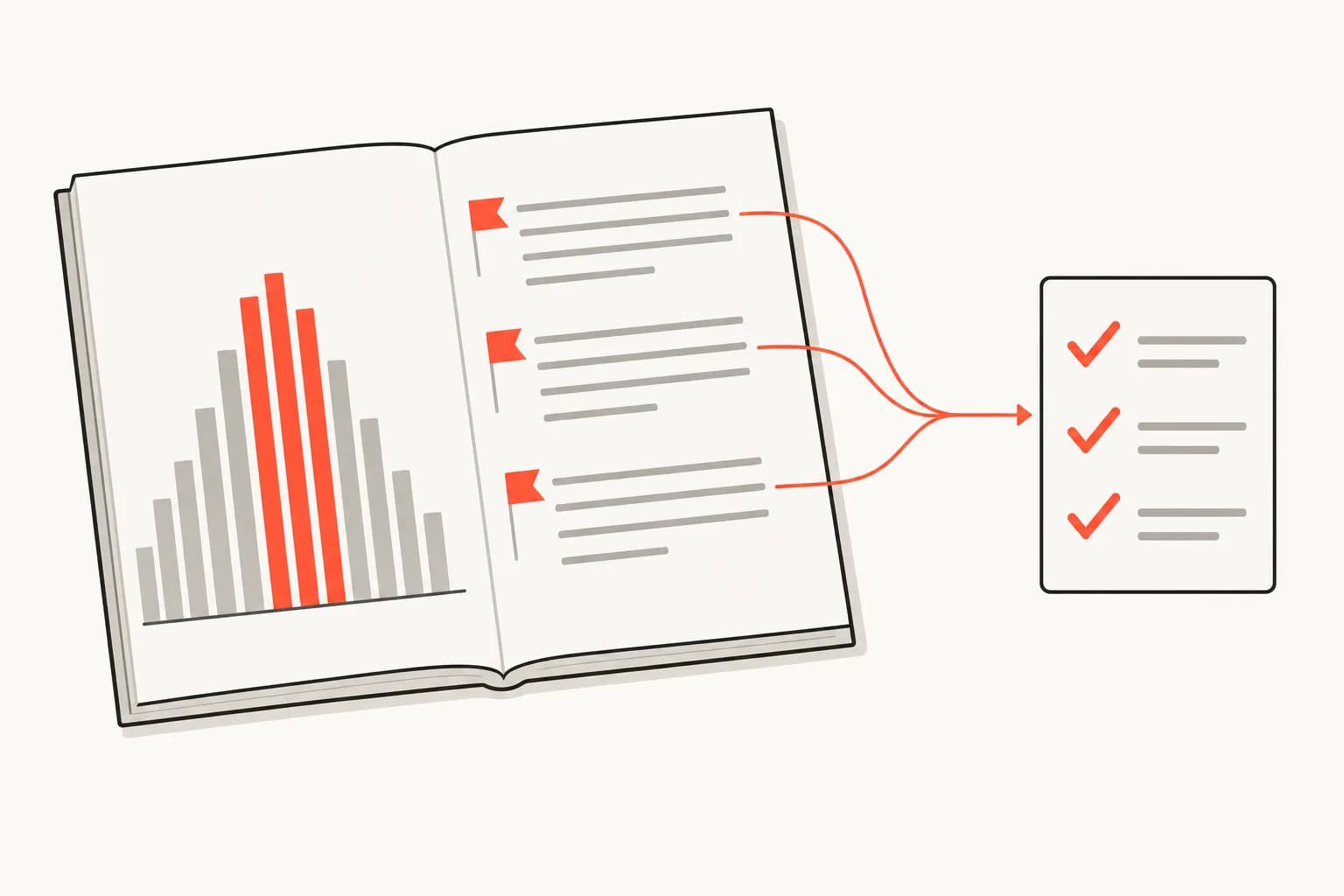
After each year's external exams are marked, QCAA publishes three documents for every General subject: the past paper, the external assessment marking guide its markers used, and a subject report. The subject report holds the exam insights. It describes what the strongest responses did, lists the habits that cost students marks, shows annotated excerpts of high-scoring answers, and charts how every student in the state scored. All three sit on your subject's syllabus page on the QCAA website, under Resources.
This guide is for students starting Year 12 in 2027 and the teachers preparing them. It covers what each document contains, where to find it, what QCAA does and doesn't publish about grades, and how to turn a report into a study plan you can start in Term 1. For exam dates, use the QCAA external exam timetable. For the final weeks before your first paper, use our guide to preparing for QCAA external exams.
What QCAA publishes after each external exam
There is no QCAA document called "exam insights". If that is what you searched for, these are the three documents you want.
The subject report
An annual report on each subject, written after the exams are marked. It covers the whole assessment cycle: how schools designed and marked their three internal assessments, and how students responded to the external assessment. QCAA writes it for school leaders and teachers, and says students and parents can use it too.
What you get from it: what the best responses did, the habits markers saw costing marks, annotated excerpts of high-scoring answers, and charts of how the state scored.
The external assessment marking guide
The guide markers used for that year's paper. QCAA says it is the tool for calibrating markers, and that it "informs schools and students about how marks are matched to qualities in student responses".
What you get from it: exactly what earns each mark. The General Mathematics guide gives a sample response to every question with a statement for each mark. The English guide is a set of criteria with a descriptor for every mark.
The past paper
The question book and response book, plus any stimulus or multiple-choice book, for each year since 2020. QCAA publishes the papers and marking guides in the year after the exam.
What you get from it: real questions to sit under exam conditions and then mark with the guide.
Two smaller documents sit beside them. A subject reports factsheet explains how to read a report. A short Subject report: Endorsement covers how schools' internal assessment tasks fared when QCAA checked them, and is written for teachers. For students, QCAA's myQCE external assessment page has a yearly external assessment guide with what is tested, the equipment you need and study tips.
Where to find subject reports and past papers
Open your subject's syllabus page
Start at QCAA's senior subjects page, choose the learning area, then the subject. English is under English and General Mathematics is under Mathematics. The English syllabus page is a good example of the layout.
Open Resources
Below the syllabus files is a Resources list with Past papers, Quality assurance, Sample assessment instruments and Subject reports. Show all opens every list.
Download the two most recent years
Each year under Past papers has its marking guide with the question and response books. Subject reports lists one report per year back to 2020, each beside that year's factsheet. Start with the two most recent of each.
If you start Year 12 in 2027, the most useful report hasn't been published yet. The 2026 reports will be the first written about exams on your syllabuses. QCAA hasn't announced a release date, but the 2024 and 2025 reports are both dated January of the year after the exam. Check your syllabus pages again at the start of Term 1, and again during the year for the 2026 papers and marking guides.
What is inside a subject report
Every report follows the same layout. The 2025 English report runs to 49 pages and the General Mathematics report to 60, but a student needs about a third of either.
- Subject data summary. Enrolments, charts of marks for each internal assessment and the external assessment, a chart of final marks, the grade boundaries, and how many students got each grade. Read it for how the state scored and the marks each grade needed.
- Internal assessment, IA1 to IA3. How schools' tasks fared at endorsement, how closely teachers' marks matched QCAA's at confirmation, effective practices, practices to strengthen, and excerpts of high-level student work. Read it for what top-band internal work looks like in your subject.
- External assessment. What the paper contained, what students did well, practices to strengthen, additional advice, and annotated excerpts of highly effective responses. Read it for the habits that cost marks and what the top answers did.
Read the external assessment section first. In the 2025 English report it runs from page 34 to page 48. The samples in it are excerpts, not whole answers. QCAA says complete responses are not included, and each excerpt comes with annotations describing the features that earned the high marks.
What the 2025 reports said about English and General Mathematics
English and General Mathematics are the two largest General subjects, so here is a sample of what their 2025 reports found. These are the points that should change how you practise. The full sections are worth reading on QCAA's site.
English: answer the question on the paper
The 2025 English exam was an analytical essay on one of eight prescribed texts, worth 45 marks. The 2025 English subject report found these patterns.
- Answering the hoped-for question. Some students wrote about Macbeth's ambition, the question they had hoped for, instead of the one on the paper, about what the play says about the consequences of immoral actions.
- Answering half the question. Weaker theses dealt with part of the question. Stronger ones addressed all of it and drew on the whole text.
- Treating characters as people. On the character question, weaker essays retold the plot or treated the character as a real person. Stronger ones analysed the character as a construction the writer uses to explore bigger ideas.
- Leaning on the famous lines. Essays built on Macbeth's best-known lines, or that reused one piece of evidence for different arguments, were less authoritative than essays drawing evidence from across the text.
- Slipping out of register. Colloquial phrasing such as "Lady Macbeth goes crazy" weakened a response, and so did careless commas, apostrophes and contractions.
Its recommendations are careful planning, with ideas edited at the planning stage, regular practice at editing your own sentences, and practice with a wide range of question types so an unexpected one doesn't throw you. Our guide to the English analytical essay and its top band works through the criteria in detail.
General Mathematics: show the reasoning the marks pay for
The 2025 General Mathematics exam had two papers. Paper 1 held 15 multiple-choice marks and 42 short-response marks, and Paper 2 held 38 short-response marks. The 2025 General Mathematics subject report found students did well on Earth geometry and time zones, scatterplots, familiar financial situations and networks. It asked teachers to strengthen these.
- Interpreting the slope. Say what the slope means in the context of the question, rather than stating its value.
- Earliest and latest starting times. Tell EST from LST, and use the right values from the forward and backward scans to calculate float for a non-critical activity.
- Seasonal indices in order. Average each year first, express each value as a percentage of its own year's average, then average the matching seasons across years.
- Working conventions. Define your variables, write the formula and identify values before substituting, give reasons for decisions, and re-read the question to check you have answered all of it.
- Pen, not highlighter. Mark a path on a network diagram in blue or black pen so the evidence shows up when your response is scanned.
- Multiple choice in the right book. Answers written in the multiple-choice question book are not marked. Fill the bubbles in the response book with a 2B pencil.
The report also explains how marks are earned. A question worth more than one mark needs working or reasoning, and a response earns one mark for each mark allocation statement in the marking guide it gives evidence for. Our guide to studying for QCAA maths exams shows how to log errors like these and drill them.
How to turn a subject report into a study plan
A report is only useful if it changes what you practise. This routine works for one subject. Repeat it for each General subject you take.
Build a list of known traps
Read the external assessment section of the two most recent reports. On one page, copy every practice to strengthen and every description of what weaker responses did, one line each, in your own words. That page is your traps list.
Match each trap to a past question
Reports often name the question they are discussing, such as Question 19 in Paper 1 of the 2025 General Mathematics exam. Find it and try it cold. Where the report names no question, find a past question that tests the same skill.
Read the samples for features, not wording
Read the annotation before the excerpt, so you know what to look for. Find that feature in the excerpt, then write a paragraph of your own that does the same thing on your text or topic. Don't memorise an excerpt. The question you get won't be the one it answered.
Mark your attempt with the marking guide
Give yourself a mark only where you can point to the evidence in your own writing. In General Mathematics, check each mark allocation statement in turn. The guide allows follow-through marks, so a correct method after an early error can still earn marks. In English, find the descriptor your essay matches for each criterion, such as a considered interpretation rather than an authoritative one.
Come back to the list
Cross a trap off only when you have avoided it twice under time, a few weeks apart. Our guide to active recall and spaced practice explains why the gap matters.
Here is how a marking guide turns one answer into marks. This is the sample response QCAA published for Question 17b in Paper 1 of the 2025 General Mathematics exam, which asked students to justify a suggested link between a student's year level and their travel time to school.
Percentage of Year 6 students who travel less than 15 minutes = 11 ÷ 17 × 100 = 64.7%. Percentage of Year 10 students who travel less than 15 minutes = 3 ÷ 12 × 100 = 25%. The large difference in the percentages for the different year levels (64.7% is more than double 25%) suggests there is an association between a student's year level and their travel time.
How it scores: the guide gives one mark for each percentage and a third for comparing them to justify the association. The subject report adds the detail that decides the third mark: saying the percentages differ is not the same as saying they differ by a lot, and similar percentages, such as 45% and 55%, suggest no association. Source: QCAA's 2025 General Mathematics marking guide and subject report.
What grades do students get? What QCAA publishes, and what it doesn't
QCAA doesn't publish an average external exam mark or an average subject result. Each subject report publishes four things instead: a chart of the share of students on each external assessment mark, a chart of final marks out of 100, the grade boundaries, and the number and share of students on each grade from A to E. QCAA's Year 12 certification summary puts the A to E split for every General subject in one table.
Nobody can tell you yet how the 2026 cohort went. The exams run until 17 November, results are released on 16 December 2026, and the subject reports come after that. Here is what QCAA published for the 2025 cohort.
| 2025 cohort | English | General Mathematics |
|---|---|---|
| Students who completed Units 3 and 4 | 27,657 | 21,188 |
| A | 23.3% | 14.3% |
| B | 46.5% | 41.3% |
| C | 29.7% | 40.8% |
| D | 0.5% | 3.6% |
| E | 0% | 0.1% |
Source: the 2025 subject reports for English and General Mathematics. B was the most common grade in both subjects. In General Mathematics, almost as many students got a C.
The grade boundaries are the final marks out of 100 that each grade needed. An A needed 84 in both subjects. A B needed 64 in English and 68 in General Mathematics, and a C needed 41 and 45.
The external assessment chart is the closest thing QCAA publishes to an average exam mark. It shows each mark as the exam's share of the subject result: out of 25 in English, where the paper itself carried 45 marks, and out of 50 in General Mathematics, where the two papers carried 95. Reading the 2025 charts by eye, since QCAA prints no figure for them, most English students scored between 12 and 24 out of 25, and the most common mark was 18. Most General Mathematics students scored between about 25 and 45 out of 50, with the tallest bars in the mid to high 30s.
The same mark can be a different grade
Grade boundaries are set for each subject separately. QCAA says they are determined by comparing results on the numeric scale with the reporting standards. In 2025, a final mark of 65 was a B in English and a C in General Mathematics. Boundaries can also move between years. The General Mathematics B started at 67 for the 2024 cohort and at 68 for 2025, while English's boundaries were the same both years. Treat last year's boundaries as a guide, not a promise.
QCAA's exam block and your school's exam block
"Exam block" means two different things in Year 12, and it helps to keep them apart.
QCAA's external assessment block
QCAA's calendar calls it the external assessment block: the weeks in Term 4 when every General subject sits its external assessment. The 2026 block runs from Monday 26 October to Tuesday 17 November 2026, and our 2026 external exam timetable has each subject's day and session. For students finishing Year 12 in 2027, QCAA's Senior Education Profile calendar has the block from Monday 25 October to Tuesday 16 November 2027, with results released through the Student Portal on Wednesday 15 December 2027. QCAA sets the day and session of each paper. Your school confirms the room and start time.
Your school's exam block
Many schools also run their own exam blocks during Year 12, for internal assessments that are exams. In General Mathematics, for example, IA2 and IA3 are both examinations, worth 15% each, and they count towards your result like any other internal assessment. A school may also set practice papers before the externals, sometimes called mocks or trials. They are good preparation, but they are not one of the four assessments in your subject result. Your school sets these dates, so check its assessment calendar.
For teachers: using the report with a class
- Start from practices to strengthen. The external assessment advice is addressed to teachers preparing students, and each point can become a short lesson starter.
- Use the samples as a puzzle. Show an excerpt with its annotation hidden, ask students to find what earned the marks, then reveal it.
- Check your own instruments. The internal assessment sections, and the newer Subject report: Endorsement, list the most common reasons tasks were not endorsed at first submission. For the 2026 English cohort, 76% of IA2 instruments were endorsed at Application 1.
- Look at your own school's data. QCAA's 2025 subject reports factsheet points to school-specific subject reports in the Analytical Dashboard in the QCAA Portal, alongside confirmation decisions and previous cohorts' results.
If a report changes how you set or mark a task, the ISMGenius tools for educators show where a class's drafts sit against the ISMG before submission.
The short version. QCAA publishes a subject report, the past paper and the external assessment marking guide for every General subject, on the subject's syllabus page under Resources. The report's external assessment section names the habits that cost marks and shows annotated excerpts of top answers, and the marking guide shows exactly what earns each mark. QCAA doesn't publish an average exam mark, but each report charts how the state scored and gives the grade boundaries, which differ between subjects and can move between years. If you start Year 12 in 2027, read the 2025 reports now and the 2026 reports when they appear, keep a traps list, and practise each trap on a past question marked against the guide. Your external assessment block runs from 25 October to 16 November 2027.
Recommended
- how to prepare for QCAA external exams
- the QCAA external exam timetable for 2026
- the QCAA English analytical essay and its top band
- how to study for QCAA maths exams
- active recall and spaced practice for QCAA exams
- how your QCAA subject result is built
- QCAA reassessment and review of results
- how to read an ISMG and find the marks you are leaving behind
- what the 2025 Chemistry subject report says about each IA
- the QCAA subject result calculator
The Question 17b sample response and quoted report wording are © State of Queensland (QCAA), licensed under CC BY 4.0; see the QCAA copyright notice.