IA draft checklist bycriterion
Any General subject · IA1, IA2 or IA3 · Before your draft date
Two pages to run the night before your draft is due: the verb, every criterion in your ISMG, what counts towards the limit, referencing and your school’s AI rules.
2-page PDF · 357 KB. Needs a free ISMGenius account, with nothing to pay. Already have one? Sign in
Every page has a job
An A4 PDF that prints cleanly in black and white, or fills in on a tablet. Here is what each part does.
Your one draft
The handbook’s one-draft rule, quoted, and three checks that the draft you hand in is the one worth feedback.
Read the task again
The task statement, the cognitive verb in your own words, the mode and the length condition.
Criterion by criterion
A row for each criterion in your ISMG: its top-level words, where your draft shows them, and Yes, Partly or No.
Prompts by kind of criterion
Questions for criteria that judge knowledge, planning, analysis, evaluation or communication, whatever your subject calls them.
Length, and what counts
The handbook’s word count inclusions and exclusions, page counts, time limits and what happens over the limit.
Referencing, integrity and AI
Citations that match a real reference list, your school’s AI rules, and the misconduct the QCAA names.
A look inside
Both pages, as they print, and their content below.
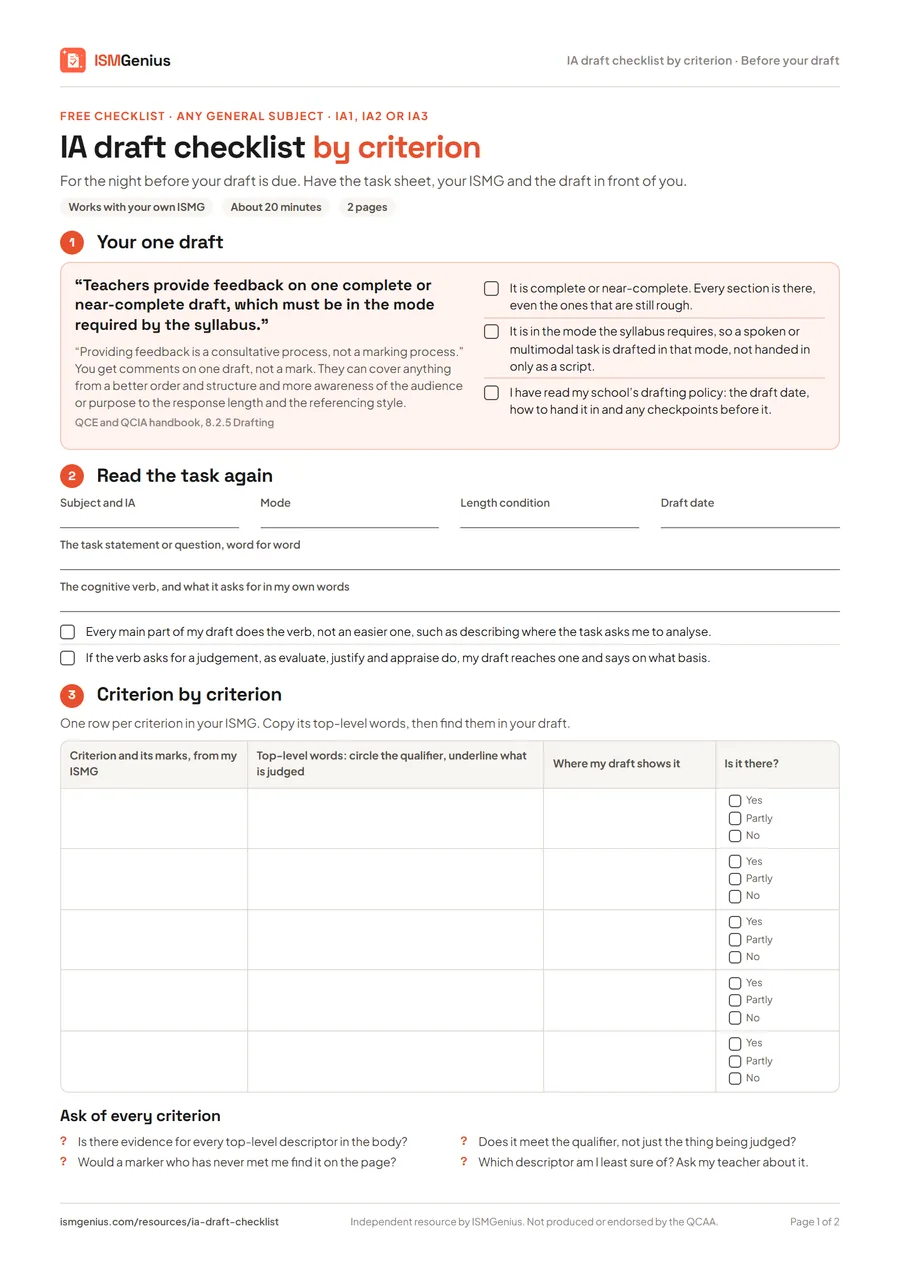
From page 1
Your one draft
“Teachers provide feedback on one complete or near-complete draft, which must be in the mode required by the syllabus.”
The handbook adds: Providing feedback is a consultative process, not a marking process. You get comments on one draft, not a mark. They can point to other aspects of the task to consider, more awareness of the audience or purpose, a better order and structure, a concept to investigate further, excess information to cut, the response length or the referencing style. So before you hand it in, check three things.
- It is complete or near-complete. Every section is there, even the ones that are still rough.
- It is in the mode the syllabus requires, so a spoken or multimodal task is drafted in that mode, not handed in only as a script.
- I have read my school’s drafting policy: the draft date, how to hand it in and any checkpoints before it.
Then, for every criterion in your ISMG
- Is there evidence for every top-level descriptor in the body?
- Does it meet the qualifier, not just the thing being judged?
- Would a marker who has never met me find it on the page?
- Which descriptor am I least sure of? Ask my teacher about it.
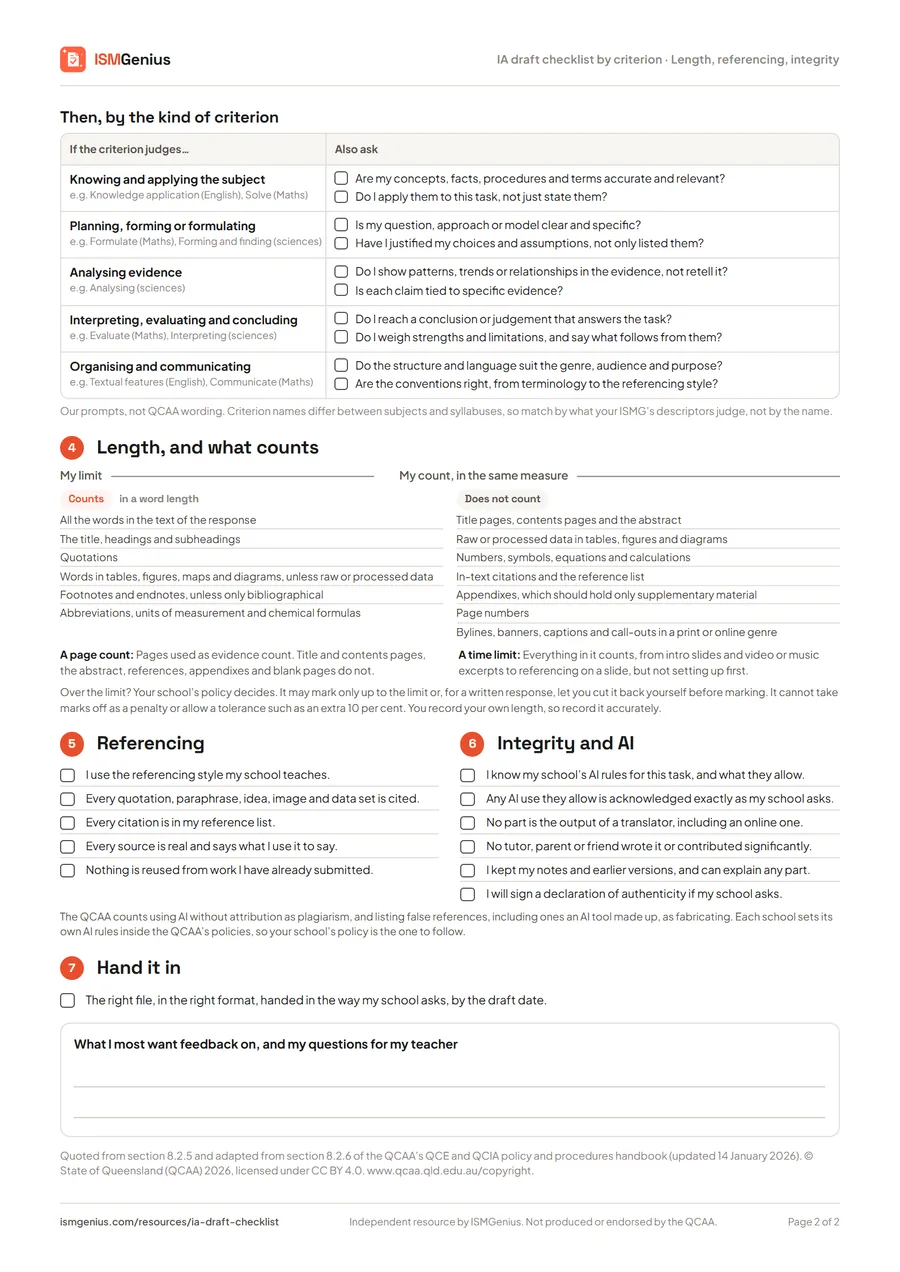
From page 2
Prompts by the kind of criterion
General subjects name their criteria differently, but most judge one of a handful of things. Match each criterion in your ISMG to what its descriptors judge, then ask these as well.
| If the criterion judges | Also ask |
|---|---|
| Knowing and applying the subjecte.g. Knowledge application (English), Solve (Maths) | Are my concepts, facts, procedures and terms accurate and relevant?Do I apply them to this task, not just state them? |
| Planning, forming or formulatinge.g. Formulate (Maths), Forming and finding (sciences) | Is my question, approach or model clear and specific?Have I justified my choices and assumptions, not only listed them? |
| Analysing evidencee.g. Analysing (sciences) | Do I show patterns, trends or relationships in the evidence, not retell it?Is each claim tied to specific evidence? |
| Interpreting, evaluating and concludinge.g. Evaluate (Maths), Interpreting (sciences) | Do I reach a conclusion or judgement that answers the task?Do I weigh strengths and limitations, and say what follows from them? |
| Organising and communicatinge.g. Textual features (English), Communicate (Maths) | Do the structure and language suit the genre, audience and purpose?Are the conventions right, from terminology to the referencing style? |
Our prompts, not QCAA wording. Criterion names differ between subjects and syllabuses, so match by what your ISMG’s descriptors judge, not by the name.
From page 2
Length, and what counts
The QCAA handbook’s list for a written response measured in words, from section 8.2.6. Your task sheet sets the limit.
Counts
- All the words in the text of the response
- The title, headings and subheadings
- Quotations
- Words in tables, figures, maps and diagrams, unless raw or processed data
- Footnotes and endnotes, unless only bibliographical
- Abbreviations, units of measurement and chemical formulas
Does not count
- Title pages, contents pages and the abstract
- Raw or processed data in tables, figures and diagrams
- Numbers, symbols, equations and calculations
- In-text citations and the reference list
- Appendixes, which should hold only supplementary material
- Page numbers
- Bylines, banners, captions and call-outs in a print or online genre
A page count: Pages used as evidence count. Title and contents pages, the abstract, references, appendixes and blank pages do not.
A time limit: Everything in it counts, from intro slides and video or music excerpts to referencing on a slide, but not setting up first.
Over the limit? Your school’s policy decides. It may mark only up to the limit or, for a written response, let you cut it back yourself before marking. It cannot take marks off as a penalty or allow a tolerance such as an extra 10 per cent. You record your own length, so record it accurately.
From page 2
Referencing, integrity and AI
Referencing
- I use the referencing style my school teaches.
- Every quotation, paraphrase, idea, image and data set is cited.
- Every citation is in my reference list.
- Every source is real and says what I use it to say.
- Nothing is reused from work I have already submitted.
Integrity and AI
- I know my school’s AI rules for this task, and what they allow.
- Any AI use they allow is acknowledged exactly as my school asks.
- No part is the output of a translator, including an online one.
- No tutor, parent or friend wrote it or contributed significantly.
- I kept my notes and earlier versions, and can explain any part.
- I will sign a declaration of authenticity if my school asks.
The QCAA counts using AI without attribution as plagiarism, and listing false references, including ones an AI tool made up, as fabricating. Each school sets its own AI rules inside the QCAA’s policies, so your school’s policy is the one to follow.
Quoted from section 8.2.5 and adapted from section 8.2.6 of the QCAA’s QCE and QCIA policy and procedures handbook (updated 14 January 2026). © State of Queensland (QCAA) 2026, licensed under CC BY 4.0. www.qcaa.qld.edu.au/copyright.
Ready to print?The full 2-page PDF has every worksheet and checklist, ready to print.
Download freeQuestions
How is this different from the IA draft self-check?
How many drafts can I submit for an internal assessment?
Do headings and in-text citations count towards the word limit?
Can I use AI on my IA?
Why do I need an account to download it?
Is this an official QCAA checklist?
Checked against
- QCE and QCIA policy and procedures handbook, 8.2 Integrating learning and assessment: 8.2.5 Drafting, 8.2.6 Managing response length and 8.2.8 Authenticating student responses (QCAA)
- QCE and QCIA policy and procedures handbook, 8.1 Understanding academic integrity (QCAA)
- Academic integrity (QCAA)
- Copyright and the CC BY 4.0 licence (QCAA)
Written by ISMGenius and last checked on 6 November 2026. It is an independent resource, not produced or endorsed by the QCAA. Your task sheet, your ISMG and your school are the final word.
Print it, plan it,check it
The IA draft checklist by criterion is free with an ISMGenius account. It takes about a minute, and there is nothing to pay.
More free resources: see them all
Keep going
- QCAA word count rulesEvery inclusion and exclusion from the handbook in one table, with a draft word count checker.
- The QCE academic integrity requirementThe course every Year 12 graduate now needs, and the misconduct the QCAA names.
- PSMT planner and self-check, free PDFPlan your problem-solving and modelling task stage by stage, then check the draft against every top-band descriptor in the ISMG before you hand it in.
- IA draft self-check, free PDFRead your ISMG the way a marker does, turn every top-band descriptor into a question, and find the one change that would lift your draft the most.
- Year 12 2027 assessment planner, free PDFEvery term of Year 12 on one page each, with the 2027 Queensland term dates, the QCAA dates that shape when your assessment falls, and room for every due date.
- Year 11 QCE planner for 2027, free PDFThe QCE rules on one page, what Satisfactory and Unsatisfactory mean in Units 1 and 2, a credit tracker for every subject, and a page for each term of 2027.