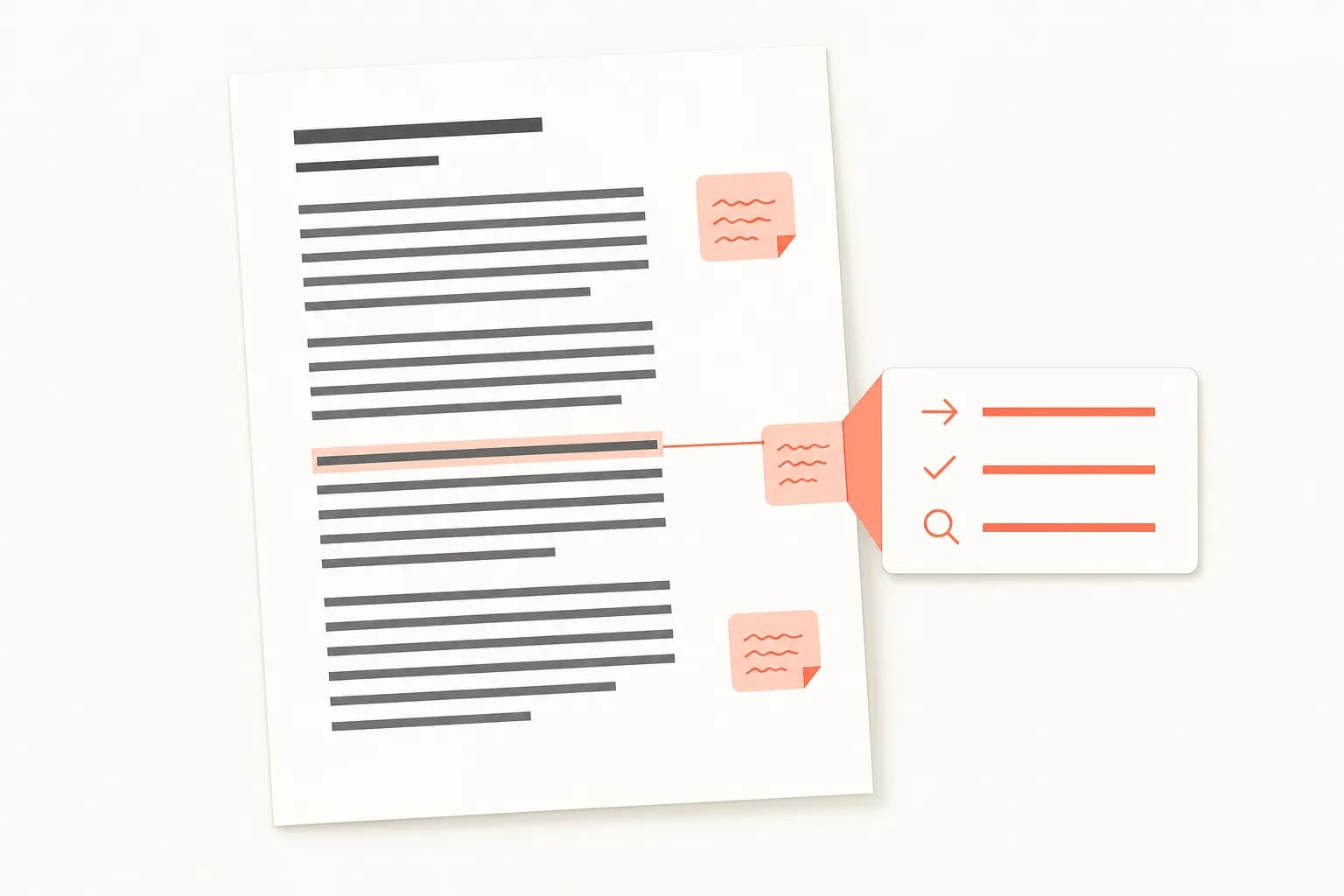
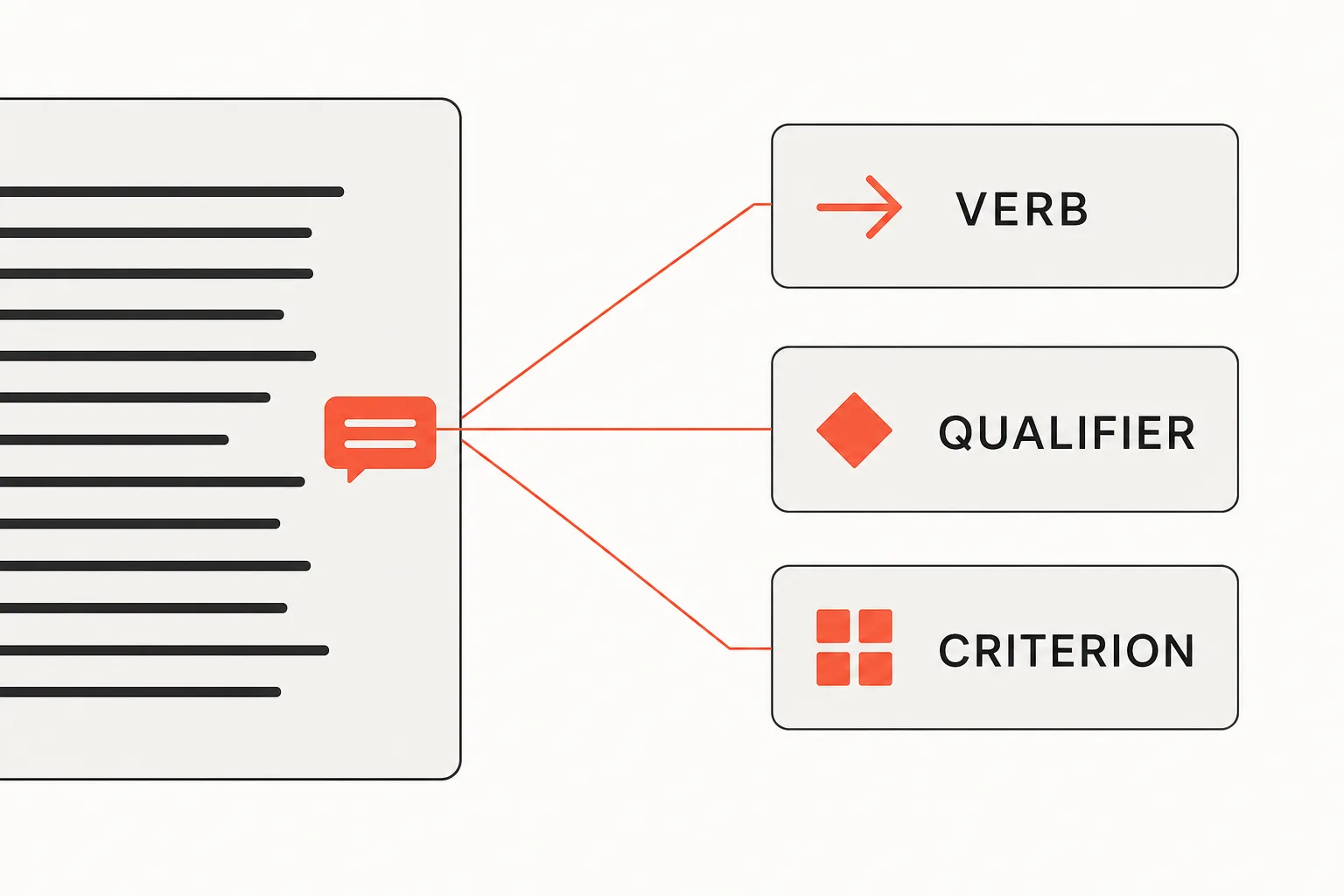
A short comment on your draft is usually a compressed instruction. Almost every one points at one of three things: a cognitive verb your paragraph did not carry out, a quality word in the ISMG your work has not reached yet, or one of the seven kinds of suggestion QCAA's handbook lists for draft feedback. Work out which one, and “needs more analysis” stops being a verdict and becomes a single edit.
This guide decodes ten comments that turn up on drafts and marked tasks across Queensland senior subjects. For each one you get what the marker is most likely pointing at in QCAA terms, an original before-and-after fix, and a sharper question to take back to your teacher. The examples come from different subjects on purpose, because the same three words can point at a different criterion in Geography than in Psychology. Your task's own ISMG is always the final word.
The ten comments at a glance
Tap a comment to jump to its fix.
| The comment | What it usually points at |
|---|---|
| “Align more to the ISMG” | A criterion the marker looked for and could not find |
| “Needs more analysis” | Sentences that say what the evidence is, not what it shows |
| “Too descriptive” | Too many words on the lowest-weighted criterion |
| “Be more specific” | A vague word where a number, name or quotation belongs |
| “Evaluate, don't describe” | A missing judgment of value, quality or significance |
| “Link back to the question” | A paragraph that never says what it proves |
| “Needs evidence” | A claim the reader is asked to take on trust |
| “Expand” | A point dropped before its “because” |
| “Check your referencing” | A citation problem, which some criteria mark directly |
| “Over the word limit” | Evidence past the limit that may not be marked at all |
Why draft comments are so short
Short comments are not a sign your teacher did not read the draft. Part of the reason is the limits QCAA puts on draft feedback. Section 8.2.5 of QCAA's QCE and QCIA policy and procedures handbook (version 7.0, January 2026) says teachers provide feedback on one complete or near-complete draft, and then sets the limit: “Providing feedback is a consultative process, not a marking process. Feedback on a draft must not compromise the authenticity of student work.”
A comment that told you exactly which sentence to write would make part of the response your teacher's. So the comment names the kind of problem and leaves the fix to you. The same section lists the kinds of suggestion draft feedback may include, and several of the most common margin comments are close to word-for-word versions of that list.
Read your comments against that list and a lot of them translate straight back:
| On your draft | The handbook's version |
|---|---|
| “Expand” · “Develop this” | Further investigating a concept to expand the response |
| “Too much summary” · “Cut this” | Synthesising the response by editing or removing excess information |
| “Over the word limit” | Adhering to the required response length |
| “Check your referencing” | Adhering to the referencing style required by the task |
| “Lead with your strongest point” | Rearranging the sequence and structure to prioritise the most important points |
| “Who is this for?” | Showing more awareness of the intended audience or purpose |
| “What about…?” | Considering other aspects of the text, report, performance or activity |
The rest of the common comments come from the ISMG itself: a verb from the task, or a quality word from one of the criterion's bands. Section 8.2.4 of the same handbook describes effective feedback as “related to the standards/descriptors” and “clear, and in language that is readily interpreted by the intended audiences”. If a comment is not clear to you yet, asking about it is not a complaint. It is how the process is meant to work.
The ten comments, decoded
Every entry follows the same pattern: what the comment usually points at, where that lives in QCAA's language, a before-and-after, and a question to ask. The examples were written for this guide. The criterion names and weightings are from the current syllabuses, as set out in our criterion-by-criterion guides, but your task sheet and ISMG can differ, so check the wording on yours.
“Align more to the ISMG” (or “to the rubric”)
Usually points at: a criterion the marker went looking for and could not find. The draft is doing something, often doing it well, but not the thing a criterion's top band names. It is the widest comment on this list, which is why it is the most frustrating one to receive: it tells you there is a mismatch without saying which criterion it is in.
In QCAA terms: an ISMG groups the task's objectives into criteria, and the marker places your work in each one by best fit. “Align” almost always means one criterion has thin evidence. The Legal Studies inquiry report (IA2) is a common case. Its Evaluating criterion is worth 6 of the 25 marks and asks for alternatives drawn from your analysis, a recommendation justified with legal criteria, and the implications of that recommendation. A draft that describes the problem and then proposes one fix has written to the topic, not to the criterion.
Written to the topic
“To sum up, young casual workers are often underpaid because they do not know their rights. The law should be changed to protect them better.”
Written to Evaluating
“Of the three reforms considered, compulsory rights information at the point of hire performs best on access, because it reaches workers before a problem arises instead of relying on them to complain. Higher penalties are fairer to employers who already comply, but change nothing for a worker who never reports. The recommendation has a cost: employers carry the administration, and the benefit depends on how well the information is delivered.”
The fix is a mapping job before it is a writing job. Write a criterion name in the margin beside every paragraph. A criterion with no paragraph beside it, or a paragraph with no criterion, is what “align” is pointing at. How to read an ISMG shows how to split each descriptor so you can see what it is asking for.
Ask instead: “When you wrote ‘align more to the ISMG’ on page 2, was it the Evaluating criterion you were thinking of?”
“Needs more analysis”
Usually points at: sentences that report what the evidence is rather than what it shows. QCAA's cognitive verb framework defines analyse as the techniques students use to “break down information and reveal aspects that are not immediately obvious”. If a reader could get your sentence by glancing at the graph, it is not analysis yet.
In QCAA terms: in a Geography field report (IA2), analysis is marked in one combined criterion, Analysing and Applying, worth 10 of the 25 marks. It is the biggest single criterion in the task, so a data section that only restates the figures is costing you where it hurts most.
Reports the data
“Figure 3 shows that turbidity was highest at Site B (412 NTU) and lowest at Site E (37 NTU). Sites C and D were in between.”
Analyses it
“Turbidity falls by about nine-tenths along 600 metres of creek, from 412 NTU at Site B to 37 at Site E, and most of the drop happens between Sites C and D, where the cleared estate gives way to the replanted riparian strip. Sediment in the creek appears to come from the cleared land rather than from upstream, which matters for the proposal in Section 5 to extend the replanting below the estate.”
Three moves did the work: the relationship was quantified, the point where it changes was located, and the consequence for the rest of the report was stated. The same pattern, naming what an observation does rather than what it is, is the core move in moving a draft up a mark band.
Ask instead: “Is it the Figure 3 paragraph you mean? Am I describing the readings without saying what they show?”
“Too descriptive”
Usually points at: proportion rather than a missing skill. You may analyse well in places, but too many of your words recount background, plot, method or company history. The fix usually starts with cutting, not adding.
In QCAA terms: describe means to “provide an account of a characteristic, feature or event”. That is useful, but it is rarely where the marks are. A Business report (IA2) is marked across Describing (4 marks), Explaining (4), Analysing (7), Evaluating (7) and Communicating (3). A report that spends half its length describing the business is spending it on a 4-mark criterion while 14 marks wait in Analysing and Evaluating. The handbook's phrase for the cure is “synthesising the response by editing or removing excess information”.
Background
“Harlow Street Coffee was founded in 2015 and now has four stores in Brisbane. It sells coffee, pastries and lunch items and employs 38 staff. In 2024 it launched an app that customers can use to order ahead.”
Analysis
“Harlow Street Coffee's app lifted sales but not profit. Orders rose 22% in the year after launch, but net profit fell 5%, because app customers buy the discounted bundles far more often than walk-in customers do and every app order carries a platform fee. The growth the owners describe as success is, on these figures, growth the business is paying for.”
The first version is not wrong, and a report does need some context. It needs a sentence of it, not a paragraph. Keep the facts the analysis uses, here the app launch, and cut the rest.
Ask instead: “Which section reads most like description to you, so I know where to cut first?”
“Be more specific”
Usually points at: a general word where the marker expected a precise one. The usual suspects are some, many, things, this shows and, in science, human error. Quality words such as specific, thorough and precise are often exactly what separates one band from the next, so this comment is frequently about a band boundary.
In QCAA terms: in a Biology student experiment (IA2), the Analysing criterion asks for “thorough and appropriate identification of the uncertainty and limitations of evidence”. “Human error” identifies neither. It does not say which measurement was uncertain, by how much, or what that does to the conclusion.
General
“Some errors may have occurred, such as human error, which could have affected the results.”
Specific
“Estimating percentage cover by eye made the quadrats at 20 metres the least consistent: three observers' estimates spread across 30 percentage points, against 10 or fewer at every other distance. The claimed zonation boundary therefore rests on the least reliable data in the set, and a point-intercept frame would remove the judgment call.”
Specific means a reader could check it: a number, a location, a named source, a quoted line. A quick test is to underline every phrase that could be pasted into someone else's assignment without changing. Those are the phrases the comment is about.
Ask instead: “Is ‘be more specific’ about my uncertainty paragraph, or about the research question as well?”
“Evaluate, don't describe”
Usually points at: the gap between two verbs. QCAA defines evaluate as to “make a judgment about the value, quality or significance of something”. A paragraph that says what a source is, who made it and what it says has described it. It has not said how far it can be trusted or what it is good evidence for.
In QCAA terms: the Evaluating criterion in a Modern History investigation (IA2) asks for “discerning and well-reasoned judgments about the usefulness and reliability of evidence”. Both nouns matter. Lower bands accept usefulness or reliability, so a draft that only ever discusses bias is answering half the criterion. The difference between the verbs is set out in more depth in what analyse, evaluate and justify actually demand.
Describes the source
“Source C is a speech by a government minister during the election campaign. It says that the government's economic policies were working and that unemployment was falling.”
Evaluates it
“Source C is useful for showing how the government wanted its record to be seen, but weak as evidence of the record itself: it was delivered to win votes and gives no figures a listener could check. I use it for the government's argument, and rely on Source F's labour force data for what actually happened to unemployment.”
The judgment has two halves, useful for what and reliable for what, and a consequence for how the source is then used. That consequence is what makes a judgment well-reasoned rather than asserted.
Ask instead: “Beside Source C, is it reliability you want more of, usefulness, or both?”
“Link back to the question”
Usually points at: a paragraph whose last sentence answers nothing, such as “this shows the issue is complex”, or a conclusion that answers the topic instead of the question. A marker cannot credit a link you have left for them to infer.
In QCAA terms: the comment is close to the descriptor's own wording. In a Psychology research investigation (IA3), Interpreting asks for justified scientific arguments and a justified conclusion linked to the research question. Evaluating then asks you to take the findings back to the original claim, which is a separate destination worth its own marks. Our guide to the research investigation, criterion by criterion covers why answering one and not the other costs a quarter of the task.
Answers the topic
“Overall, people react to emergencies in many different ways, so more research is needed.”
Answers the question
“On the research question, the evidence points one way: in all three experiments reviewed, participants took longer to help in a staged emergency when other passive bystanders were present than when they were alone. For face-to-face emergencies, the presence of others reduces helping. None of the three tested online settings, so the evidence cannot yet answer that half of the original claim.”
The repair is close to mechanical. Use the key terms of your question in the paragraph's final sentence and say which way the evidence answers it. If you cannot write that sentence, the paragraph may not belong in the response.
Ask instead: “Is it my conclusion that drifts from the research question, or particular paragraphs as well?”
“Needs evidence”
Usually points at: a claim the audience is asked to accept on trust, or evidence that is present but never connected to the claim. Phrases like “everyone knows” and “it is clear that” are the tell. QCAA's verb here is justify: to “show or prove something to be right, reasonable or valid”.
In QCAA terms: in the English spoken persuasive response (IA1), evidence sits in Organisation and development, worth 8 of the 25 marks, whose top band asks for “discerning selection and synthesis of subject matter to support perspectives”. The word is selection. One piece of evidence the audience cannot wave away does more than three statistics nobody can source.
Asserted
“Everyone knows teenagers do not read for fun any more, so our school should make silent reading time permanent.”
Supported
“When our library ran a ten-minute silent reading trial in Term 2, borrowing rose from 640 books a term to 1,140. That does not prove the trial caused the rise. It does show that when students were given the time, they chose to read, and that is the habit this proposal asks the school to protect.”
The second version also concedes what the evidence cannot prove, which is part of what makes it persuasive. For a spoken task, remember that your one draft has to be in the spoken mode, so test whether the evidence lands out loud. The English persuasive speech guide covers the other two criteria.
Ask instead: “Which claim needed evidence most: my opening, or the ones in my second argument?”
“Expand” or “develop this”
Usually points at: a point raised and then dropped before its “because”. It is rarely a request for more words. The handbook's version is “further investigating a concept to expand the response”, and the verb underneath is usually explain: to “make something clear by revealing a cause, reason, context or relationship”.
In QCAA terms: in a Study of Religion inquiry response, Explaining is worth 6 of the 25 marks, in IA2 and IA3 alike. A claim with no cause, reason or relationship attached gives that criterion nothing to credit, however true the claim is. The example below is the kind of claim an IA2 on religious ethics makes.
Stated
“Catholic teaching opposes voluntary assisted dying.”
Developed
“Catholic teaching opposes voluntary assisted dying because it holds that human life is a gift from God that a person holds in trust rather than owns. The same teaching does not require life to be prolonged at any cost, since refusing burdensome or disproportionate treatment is permitted, so for many Catholics it is expressed in a choice for palliative care rather than either extreme.”
The developed version adds a reason (stewardship), a limit (treatment may be refused) and an expression in adherents' lives (palliative care). If you are already near the word limit, expand by replacing a weaker point rather than adding to the total.
Ask instead: “Should I develop this point, or replace a weaker one with it so I stay under the limit?”
“Check your referencing”
Usually points at: one of four problems. An in-text citation with no matching reference list entry, or the reverse. A citation missing its year or page. A style that changes halfway through. Or a paraphrase that sits too close to its source, which is an academic integrity matter rather than a formatting one.
In QCAA terms: “adhering to the referencing style required by the task” is on the handbook's list of draft feedback, and QCAA leaves the choice of style to your school. In some tasks referencing is also marked inside a criterion. The Legal Studies Selecting criterion (4 marks) includes consistent and accurate citations and a reference list, and the science student experiment's Forming criterion includes “appropriate use of genre and referencing conventions”.
Untraceable
“Young casual workers are the group least likely to report underpayment, according to a news article.”
Traceable
“Young casual workers are the group least likely to report underpayment (Nguyen 2023, p. 14).” And a matching entry under Nguyen in the reference list.
Nguyen 2023 is invented for this example. The point is that every citation has to lead to one entry, in the style your school uses. Referencing and using sources in QCAA assessment has the patterns and a five-minute final check.
Ask instead: “Is the referencing issue the format, or is there a paraphrase you think sits too close to its source?” The second answer matters more, so it is worth asking directly.
“Over the word limit”
Usually points at: a condition of the task rather than the quality of the writing, but an expensive one. Section 8.2.6 of the handbook lets schools mark “only the evidence in the student response that meets the assessment conditions for response length”, which it describes as marking from the beginning of the response up to the point where it reaches the required length. The other strategy it lists is letting you redact the response yourself before a judgment is made, though not for exam responses or continuous ones such as a presentation or recording. “Teachers are not to redact a student response.”
In QCAA terms: schools cannot simply take marks off. The handbook says they cannot penalise an over-length response “by arbitrarily reducing their result, e.g. introducing a 2-mark penalty”, and cannot allow a tolerance such as +10%. The real cost is subtler. Your conclusion, which is often where the evaluation marks sit, may fall past the line and not be marked. Check what counts towards a QCAA word count before you start cutting.
48 words
“In this report I am going to be discussing the various different factors that have contributed to the decline of koala populations in South-East Queensland, which is an issue that has become increasingly important in recent years and is something that a lot of people are concerned about.”
17 words
“This report weighs three causes of koala decline in South-East Queensland: land clearing, vehicle strikes and disease.”
Every one of the 31 words saved was filler. Cut announcements, doubled words and restated questions before you cut a single piece of evidence.
Ask instead: “How does our school handle an over-length response: marking to the limit, or letting us redact?”
When the same words are on a marked task
Summative comments, the ones written on a task after it has been marked, use the same phrases but do a different job. On a draft, “needs more evaluation” is an instruction for the next version. On a returned investigation, it explains why a criterion landed in the band it did, and the action moves to your next task.
Read a summative comment beside the criterion it sits next to, not on its own. The comment next to the criterion where you lost the most marks is the one worth acting on first. Then keep a running list of the comments you receive across subjects. When the same one turns up twice, say “be more specific” in Biology and again in Legal Studies, it is telling you about a habit in your writing rather than a slip in one task, and that is the most useful thing a comment can tell you.
If the mark itself is the problem, what to do after a low mark walks through mapping each lost mark to a criterion and a cause. If you want the wider picture of how comments before and after marking differ, see formative versus summative feedback.
How to ask a follow-up inside the one-draft rule
You get feedback on one draft, but the handbook does not limit that feedback to what is written on the page. Teachers may give it “in writing or orally, to an individual or to the whole class, and/or through questioning”. A short conversation about a comment you received is part of that same feedback, not a second draft.
Two things shape what you can sensibly ask. Feedback is consultative, not marking, so a question about what mark or band the draft would get is likely to be declined. And feedback must not compromise authenticity, so asking your teacher to show you how they would write the paragraph is asking for something they should not give. Do not expect your teacher to check a rewritten paragraph either: QCAA allows feedback on one draft, and your school's own drafting policy sets out what happens after it. For the rules in full, see what feedback teachers can give on your draft.
Point at the passage
Bring the draft and name the page or paragraph. “The Figure 3 paragraph” can be answered. “My analysis” cannot.
Name the criterion you think it is about
Use the decoder above to make a guess. Being wrong is fine, because a guess gives your teacher something to correct in a sentence.
Offer your diagnosis
Say what you think is missing in the ISMG's own terms: the verb you did not carry out, or the quality word you have not reached yet.
Ask something answerable in one sentence
A yes-or-no or either-or question respects the time your teacher has and leaves the fix with you, which is where the rules want it.
Hard to answer
“I don't really get what you mean by ‘needs more analysis’. Can you explain what I need to do to get an A?”
Easy to answer
“You wrote ‘needs more analysis’ next to my Figure 3 paragraph. Is that the Analysing and Applying criterion, and is the problem that I describe the readings without saying what they show?”
Ask soon after the draft comes back, while there is still time to act on the answer. A clarifying question the week before the due date is worth far less than the same question the day you get the comments.
Sources
QCAA, QCE and QCIA policy and procedures handbook, version 7.0, January 2026, sections 8.2.4 (Feedback), 8.2.5 (Drafting) and 8.2.6 (Managing response length). Verb definitions are from QCAA's cognitive verb framework, August 2025. Criterion names, mark weightings and descriptor wording are from the current QCAA syllabuses, as summarised in our guides to the humanities investigation, the student experiment, the research investigation and the English persuasive speech. QCAA material quoted here is © State of Queensland (QCAA), used under a CC BY 4.0 licence; see www.qcaa.qld.edu.au/copyright.
Recommended
- how to read an ISMG and find the marks you are leaving behind
- the structural moves that lift a draft up a band
- what analyse, evaluate and justify actually demand
- what to do after a low mark comes back
- what each Modern History IA rewards, from the source essay to IA3
- what feedback teachers can give on your draft
- rubric-aligned feedback on your assignment drafts