The QCAA General English persuasive speech is Internal assessment 1, the spoken persuasive response: one quarter of your subject result, delivered live or recorded in up to 8 minutes, and marked out of 25 across Knowledge application (8 marks), Organisation and development (8) and Textual features (9). Under the 2025 syllabus it is the first summative task of Year 12, set in Unit 3 with four weeks' notice, and you choose the issue yourself. What the marker is looking for is not a talk about a topic. It is a contention you actually hold, argued to a named public audience, in language that was written to be spoken.
This guide works through the task in the order you will meet it: what it is worth and what the conditions allow, what “persuasive” means on the marking guide, how to turn a topic into a position, the structure that reaches the top band, how the three criteria are marked and where mid-band speeches lose marks, what counts as delivery, how many words fit in the time, and how to spend the last week before you present.
What is the QCAA English persuasive speech worth?
The syllabus name for the task is Internal assessment 1: Spoken persuasive response, and it carries 25 of the 100 marks in General English. It sits in Unit 3, Textual connections, whose first topic is a study of how different media texts construct different perspectives on the same issue. The syllabus says the unit “will culminate in a spoken persuasive text”: you spend weeks analysing how other people argue, and then you argue.
The conditions are short, and every one of them matters:
| Condition | What the 2025 syllabus says | What it means for you |
|---|---|---|
| Length | Spoken (live or recorded): up to 8 minutes, or signed equivalent | A ceiling, not a range. The syllabus prints no minimum; a short speech simply has less room to show discernment. |
| Mode | Students may use multimodal or digital components to support the development of the response, and the use of these elements is included in the response length | Slides, a video clip or a podcast intro all count inside the 8 minutes. |
| Editing | Students only use editing when appropriate for their response context and audience | A recorded podcast can be edited like a podcast. A recorded speech to a hall should sound like one take. |
| Notice and time | Students receive 4 weeks notification of task and can develop their responses in class time and their own time | Drafting, a timed rehearsal and a recorded run-through all fit inside the window if you plan them. |
| Resources | Open access to resources; an individual task | You may research, but the syllabus is explicit that research “is not the focus of this technique”. |
| Text list | There is no prescribed text list for this assessment instrument | The issue comes from the media, not from a set novel. |
Your school writes the actual task sheet inside those conditions. The QCAA's sample instrument for the task, for example, casts you as a student applying to feature on a vodcast or podcast about issues that matter to young people, and asks you to choose the form. Yours may name a school assembly, a community forum, a panel segment or a social media reel; the syllabus lists all of those as acceptable forms. Read the audience line on your task sheet twice, because it decides more of your marks than the topic does.
What does “persuasive” mean to the marker?
Three things have to be true of your speech before any technique earns anything. It takes a position that could be argued against. It is addressed to an identified public audience, not to the room in general. And it wants something from that audience: to reconsider, to accept, to act.
The syllabus specifications say this plainly. You must “present a contention or thesis in relation to the chosen issue”, “generate their own argument that adds to the public dialogue about the issue”, and “employ and synthesise nuanced rhetorical and persuasive strategies to position an audience to accept the perspective constructed in the text”. The word doing the work is position. A speech that informs an audience about an issue, however well, is not doing the task.
The same idea runs through the QCAA's own commentary. In the English subject report for the 2024 cohort, which covers the equivalent spoken persuasive task under the previous syllabus and the same three criteria, the top Knowledge application band went to speeches with “an astute and deliberately constructed perspective, cognisant of the complexity and nuances of the public conversation about the issue”, where “the speaker had deeply considered how best to persuade their audience”. The report also notes that a specific audience is what lets a student “tailor their use of aesthetic features and stylistic devices” and “select evidence, language, syntactical choices and complementary features to position their specific audience”. Vague audience, vague choices, mid band.
If the language of the criteria is unfamiliar, how to read an ISMG explains how the descriptor ladder works, and the cognitive verbs explained covers what “synthesise” and “create” ask of you.
How do you choose a persuasive speech topic for Year 12?
You do not choose a topic. You choose an issue, and then a position on it. The syllabus asks for “a contemporary contentious issue (or a perspective about a contentious issue studied) that has appeared in the media”, and offers the broad territories it may come from: “gender, power, race, religion, age, class and sustainability”. Those seven words are not topics either; each one contains hundreds of live arguments.
Run any candidate through four tests before you commit to it:
- Contestable. Someone informed and reasonable disagrees with you. “Bullying is bad” fails; “schools should be allowed to search students' phones” passes.
- Current. It has been argued in the media recently enough that your audience has heard the other side. The task asks you to add to a conversation, so there has to be one.
- Sized for eight minutes. “Climate change” is a decade. “Queensland should ban new gas connections in new homes” is a speech.
- Suitable for the room. The subject report reminds schools that a student's perspective and subject matter “should be suitable for the school context and meet community standards”. Your teacher will check the issue with you; the sample instrument builds that check in as a formal checkpoint.
Then narrow it from issue to contention. The difference is a verb and a claim:
| Topic | Issue | Contention |
|---|---|---|
| Age | Whether 16-year-olds should be able to vote | Queensland should let 16-year-olds vote in state elections, because the arguments against them are the same ones once used against women and renters. |
| Sustainability | Fast fashion returns and waste | Free returns are the engine of fast fashion, and the retailers offering them should pay a levy that funds textile recycling. |
| Power | School phone bans | The statewide phone ban was the right call, and the students most opposed to it are the ones it is protecting. |
Notice that each contention already contains an argument and a hint of who it is for. That is what you want. If you cannot write your contention as one sentence that someone could say “no” to, you have a topic, and a topic will cap Knowledge application at the middle of the scale no matter how confident the delivery is.
The structure that scores
The syllabus does not prescribe a structure, because Organisation and development is marked on how well you use “the patterns and conventions of a persuasive text” for your purpose, and those conventions belong to the form you chose. A TED-style talk, a podcast segment and an assembly speech open differently. But underneath all of them, the persuasive speeches the QCAA publishes as top-band samples share the same skeleton.
A hook that earns the audience
An image, a question, a number or a short story that puts the audience inside the issue before you tell them what you think. The QCAA's high-level annotated sample opens by asking what goes into making a new phone, then names the audience and the occasion by name. It is thirty seconds before the contention arrives, and every one of them is doing work.
The contention, stated as a claim
One sentence the audience could disagree with, followed by a short signpost of how you will get them there. “Today I am here to expose…” is the annotated sample's version. The marker should be able to write your contention down after the first minute.
Two or three arguments, each with evidence
Each argument is a reason your contention is right, not a sub-topic. Each carries something concrete: a figure with its source named aloud, a named person's experience, a comparison the audience can picture. Order them so the strongest lands last. Two arguments done fully beat three done thinly, and eight minutes rarely holds four.
A concession and a rebuttal
Voice the strongest objection in the audience's own words and answer it. The annotated sample does this with “I know what you're thinking”, then two lines of the counter-argument, then the answer. This is where “cognisant of the complexity and nuances of the public conversation” is demonstrated, and it is the step most mid-band speeches leave out.
A call to action the audience can actually take
Return to the hook, restate the contention in stronger language now that you have earned it, and ask for something specific. A speech to a tech conference ends by naming a fair-trade supplier and an industry initiative. A speech to a school assembly ends with something students can do this week.
Here is that skeleton as a timed outline for the voting-age contention, built for a youth-affairs podcast audience and paced to finish inside the limit with room for pauses:
| Section | Time | Roughly | What it does |
|---|---|---|---|
| Hook | 0:30 | 70 words | A 16-year-old who pays tax on a part-time job, describing the election she watched from the sidelines. |
| Contention and signpost | 0:25 | 60 words | Queensland should let 16-year-olds vote in state elections; three reasons, then the objection everyone raises. |
| Argument 1: responsibility already granted | 1:30 | 210 words | Work, tax, driving, criminal responsibility; the inconsistency made visible. |
| Argument 2: what other places found | 1:30 | 210 words | Named jurisdictions that lowered the age, with one sourced finding on turnout habits. |
| Argument 3: who decides the future | 1:15 | 180 words | Policy on housing, climate and education lands hardest on the people who cannot vote on it. |
| Concession and rebuttal | 1:00 | 145 words | “They are not mature enough.” Answered with the same standard applied to any other age group. |
| Call to action | 0:45 | 105 words | Back to the hook; one thing a listener can do before the next election. |
| Total | 6:55 | ~980 words | Inside 8 minutes, with a minute of margin for pauses and audience reaction. |
A mid-band opening beside a top-band opening
The first forty seconds tell a marker most of what they need to know about the Organisation and development mark. Here is the same contention, the statewide school phone ban, opened two ways for a school assembly:
Mid band
Good morning teachers and students. Today I am going to talk to you about the phone ban and why it is a good thing. Phones have many negative effects on young people. In this speech I will discuss three reasons why the ban should stay: concentration, mental health and bullying.
Top band
Somewhere between the bus and first period this morning, you checked your phone. Not once. I counted mine: eleven times. The people who built those eleven glances are not worried about us. They are counting too. So when someone tells you the phone ban is an overreach, ask who benefits from you believing that. The ban is not the school taking something from you. It is the first rule in years that is on your side.
The mid-band version is not wrong. It has a contention and a roadmap, and it would satisfy “suitable use of the patterns and conventions of a persuasive text”, which is the descriptor at 4 marks. What it lacks is a relationship. It addresses “teachers and students”, which is nobody, and it announces a structure instead of starting one. The top-band version puts the listener in a specific moment, names who is on the other side of the argument, and turns the contention into a claim about the audience's own interests, so the “role of the speaker” and the “relationship with an identified public audience” are both established in the first paragraph and there is a persuasive purpose for every sentence.
How is the persuasive speech marked?
The instrument-specific marking guide has three criteria. Each one has its own ladder of descriptors, and your mark is the level whose descriptors your speech best matches, criterion by criterion. The split is nearly even, with Textual features carrying one mark more than the other two:
- Knowledge application8 marks
- Organisation and development8 marks
- Textual features9 marks
Knowledge application marks your perspective and the ideas under it. Organisation and development marks the structure, the evidence you chose and the relationship with the audience. Textual features marks language, grammar and delivery. Here is the Knowledge application ladder from the syllabus, top to bottom, with the descriptor words that separate the levels:
- 7–8
discerning
“Discerning creation of perspectives and representations of concepts, identities, times and/or places in a persuasive text; discerning manipulation of the ways cultural assumptions, attitudes, values and/or beliefs underpin texts and invite audiences to take up positions; discerning use of aesthetic features and/or stylistic devices to achieve persuasive purposes.”
- 5–6
effective
The same three descriptors with “effective” in place of “discerning”. The perspective works and is maintained; it is not yet surprising or nuanced.
- 4
appropriate
“Appropriate creation of perspectives”, “appropriate use of the ways cultural assumptions… underpin texts”, “appropriate use of aesthetic features and/or stylistic devices”. Suitable, and no more.
- 2–3
superficial
“Superficial creation of perspectives”, and “use of aspects of aesthetic features and/or stylistic devices that vary in suitability”. Devices are present but not matched to a purpose.
- 1
fragmented
“Creation of fragmented perspectives”, “fragmented use of persuasive language features”.
Read the top band slowly, because two of its three descriptors are about something other than your argument. “Manipulation of the ways cultural assumptions, attitudes, values and/or beliefs underpin texts” means you know what your audience already believes and you use it: the annotated sample, speaking to a technology conference, appeals to an industry's pride in itself and its belief in progress before it asks for anything. And “use of… stylistic devices to achieve persuasive purposes” is marked on achieve. A rhetorical question that does nothing is a device that varies in suitability, which is the 2–3 band.
The other two ladders use the same shape with slightly different words. Organisation and development runs discerning (7–8), effective (5–6), suitable (4), inconsistent and disjointed (2–3), fragmented (1); its top band asks for “discerning selection and synthesis of subject matter to support perspectives” and “discerning use of cohesive devices to emphasise ideas and connect parts of a persuasive text”. Textual features runs discerning (8–9), effective (6–7), suitable (5), inconsistent (3–4), inappropriate (1–2); its top band is “discerning language choices for particular purposes”, a “discerning combination of a range of grammatically accurate/appropriate language structures”, and “discerning use of mode-appropriate features to achieve particular purposes”.
The pattern across those five is worth naming: every one of them is a structural problem, not a vocabulary problem. That is also the finding in how to move a draft up a mark band, and it is why a speech usually improves more from one rebuttal paragraph than from an evening spent on adjectives.
Language and delivery: what counts as textual features
Textual features is the criterion students most often misread as “speaking confidently”. Delivery is in there, but it is one of three descriptors, and the syllabus is specific about what it covers. Mode-appropriate features for a spoken text are, in the syllabus's own list, “pronunciation, phrasing and pausing, audibility and clarity, volume, pace, silence”; gestural features are “proximity, stance, movement”; and complementary features are “graphics, still and moving images, design elements, music and sound effects”. Each is marked on whether it is used “to achieve particular purposes”. Pausing before the contention is a feature. Pausing because you lost your place is not.
The other two descriptors are about the words. “Language choices for particular purposes” rewards vocabulary chosen for this audience and this contention: the subject report praises a speech that borrowed “authoritative concepts in the discipline of psychology” because it knew its audience valued knowledge. And “a range of grammatically accurate/appropriate language structures” means spoken grammar used deliberately: short sentences for impact, a long one to build pressure, a fragment as a punchline. The report's phrase is “judicious grammar choices to establish themselves as an authoritative speaker”.
The persuasive techniques you learned in Unit 3, then, are not scored as a checklist. They are scored inside Knowledge application (“stylistic devices to achieve persuasive purposes”) and Textual features (“language choices”), which means each one has to be doing something you could name. Here is one sentence from the voting-age speech with the work made visible:
We tell sixteen-year-olds they are old enough to work, old enough to pay tax and old enough to stand trial as adults, and then we tell them they are too young to be trusted with a pencil and a ballot paper.
Why this scores: the tripling builds a pattern of responsibilities the audience already accepts, and the marked clause breaks it with a deliberately small image, so the inconsistency is felt before it is argued. That is a cultural assumption made visible and used against itself, which is the Knowledge application top-band descriptor, delivered through one sentence structure, which is the Textual features one. Spoken, the pause lands after “adults”.
Techniques that reliably earn their place when they are attached to a purpose: a concrete image in place of an abstraction; a named source spoken aloud (“according to UNICEF” is in the QCAA sample, mid-sentence); inclusive pronouns that put the speaker inside the audience's problem; a pattern of three with the third element broken; a rhetorical question that the next sentence answers; repetition of the contention in stronger words each time it returns; and direct address to the objection (“I know what you're thinking”). Techniques that rarely do: statistics without a source, a dictionary definition as an opening, and any question you ask the audience without wanting an answer.
Cue cards, notes and the script
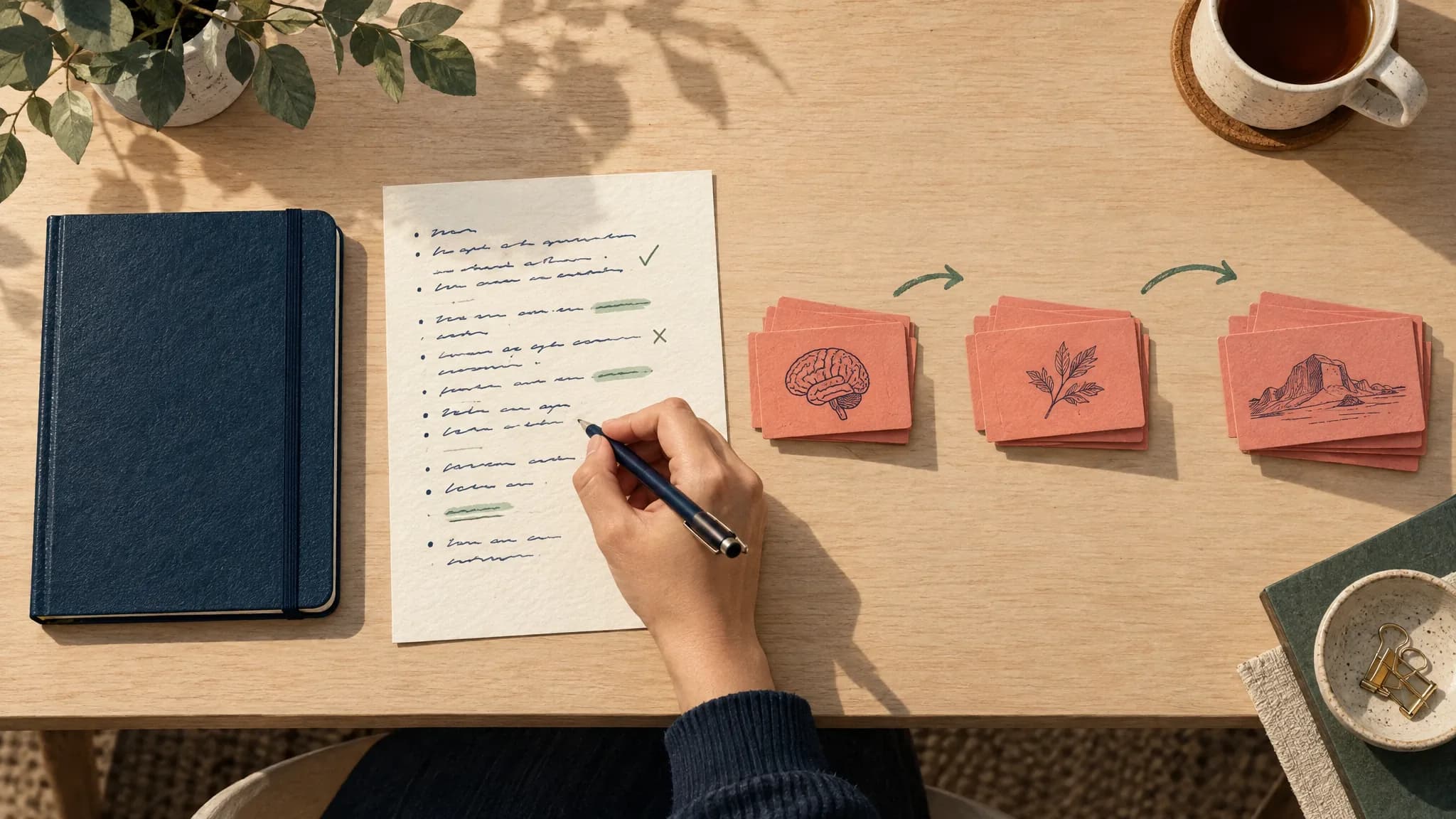
Notes are allowed. The subject report says a student “may use notes at this performance level”, meaning the top band, “but there should be a strong familiarity with the content”. The practical version of that rule: write a full script, because the argument has to be built in writing, then reduce it to cue cards carrying the first words of each section, your evidence and your transitions, and rehearse from the cards until the script is in your head rather than your hand. If your school records the speech, the camera will show the difference between glancing at a card and reading a page.
How many words is an 8-minute speech?
About 1,150 words at a natural speaking pace, and fewer than that if you want to finish with time in hand. The figure comes from speaking rate. Tools for Clear Speech, a program at Baruch College in New York, puts the average English speaker at “about 150 words per minute” and recommends that presenters aim for “about 140 words per minute”, with its own recordings showing intelligible speech at roughly 120 and 165 words per minute. Treat those as a rule of thumb rather than a law: nervous speakers speed up, and a script full of long sentences is spoken slower than one full of short ones.
| Time limit | Slow, about 120 wpm | Natural, about 145 wpm | Fast, about 165 wpm |
|---|---|---|---|
| 5 minutes | 600 words | 725 words | 825 words |
| 6 minutes | 720 words | 870 words | 990 words |
| 7 minutes | 840 words | 1,015 words | 1,155 words |
| 8 minutes | 960 words | 1,160 words | 1,320 words |
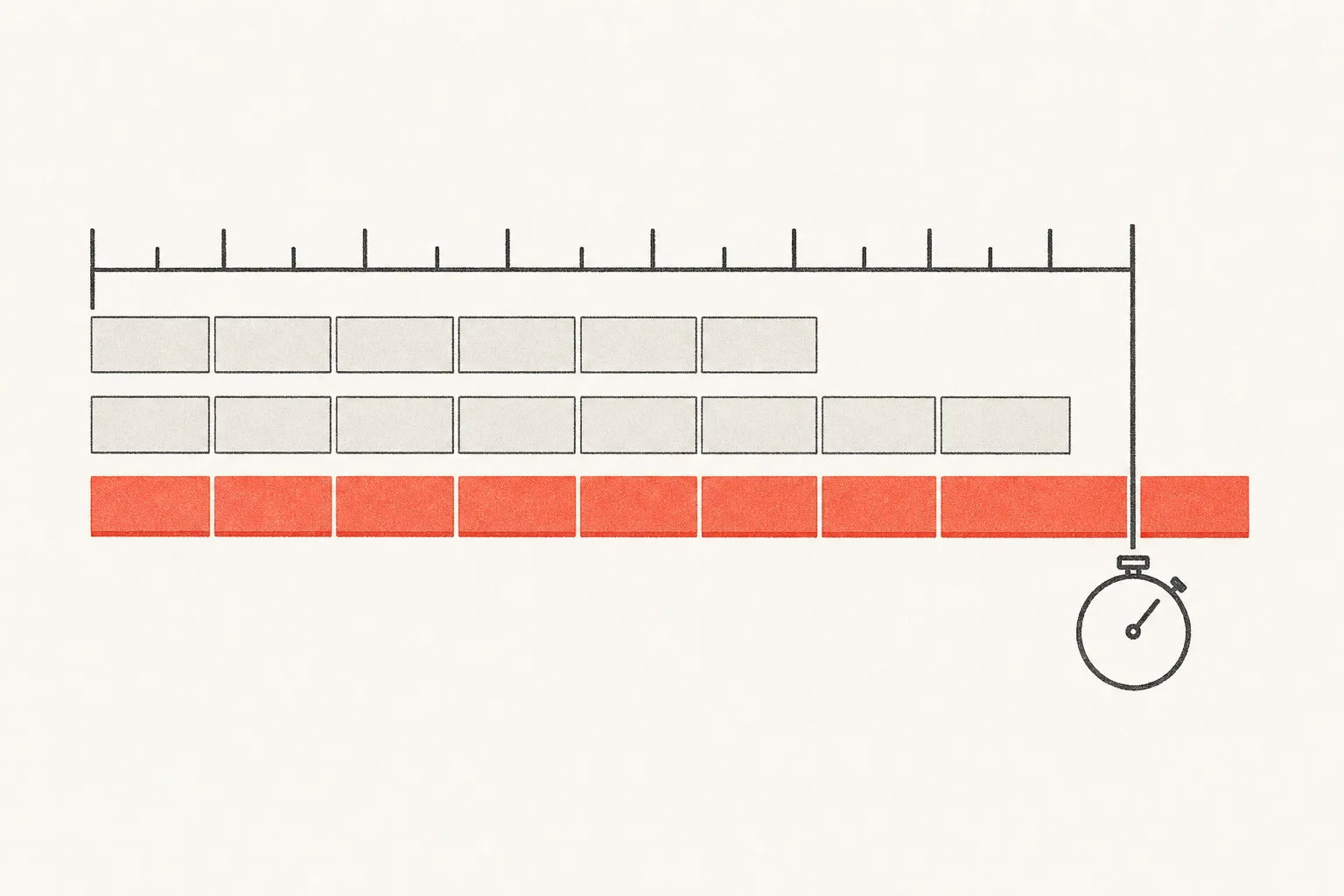
Two adjustments turn those numbers into a target. First, a persuasive speech has pauses built into it, and a live audience adds reactions you cannot script, so plan to finish around seven minutes for an 8-minute limit. Second, any video clip, music or slide sequence you include is counted inside the 8 minutes, so subtract its running time before you count words. For an 8-minute ceiling that lands most scripts between roughly 950 and 1,100 words. Paste your word count into the planner below to see where yours sits against your task sheet's limit at all three paces.
Does your script fit the time limit?
Enter your word count and the limit on your task sheet to see the running time at three speaking paces.
Time limit
Aim for about 930–1,100 words for a 8-minute limit at a natural pace.
Target at a natural pace for a 8-minute limit: 930–1,100 words
- Slow ~120 wpm—
- Natural ~145 wpm—
- Fast ~165 wpm—
Guide only. The time limit on your task sheet and the marker's stopwatch control the answer. Pauses, audience reaction and any slides, audio or video you include all add time that a word count cannot see, so time a full rehearsal before you trust the estimate.
The planner estimates from average rates; the only number that counts is the one on the marker's stopwatch, so time a full rehearsal out loud before you trust it. If it says you are over, cut a whole argument rather than trimming words from every paragraph: the QCAA word count rules guide has an order of cuts that protects what the criteria reward, and it applies just as well to a script.
The final week: rehearsal and recording plan
Four weeks' notice sounds generous until you notice how much of it goes on choosing the issue. Schools usually build in checkpoints; the QCAA's sample instrument, for example, has a topic check in week one, a written draft in week four and “1 minute of spoken draft delivered in class time”. Your teacher can give you feedback on that draft, and it is the only feedback you will get before the mark, so treat it the way why drafts matter before submission describes: hand in something complete, early enough to change the structure, not just the words.
The last seven days are for the delivery. Work through this in order:
- Day 7: Read the whole script aloud with a stopwatch, no audience. Note the time and the places you stumbled; a stumble is usually a sentence written for the eye.
- Day 6: Rewrite every sentence you stumbled on as something you would say. Cut to your target length if the reading ran long. Mark your pauses on the script.
- Day 5: Reduce the script to cue cards: opening words of each section, evidence and sources, transitions, the last line. Rehearse from the cards twice.
- Day 4: Record yourself on a phone, standing, at the distance the audience will be. Watch it once for the argument and once with the sound off for stance, movement and where your eyes go.
- Day 3: Deliver it to one person who will tell you where they stopped listening. Fix that section and nothing else.
- Day 2: Full run with any slides, clip or audio in place, timed end to end. This is the number that has to be under the limit.
- Day 1: One run from the cards, then stop. Check the room, the file format if you are submitting a recording, and how you will start the first sentence.
If the response is recorded rather than live, the same week applies, with one addition: check what your task sheet says about editing before you cut anything together. The syllabus allows editing “when appropriate for their response context and audience”, which covers a podcast's cross-fades and does not cover splicing the best take of every paragraph into a speech that is supposed to sound live.
If you are in a different English
This guide is for General English. The other senior English subjects set persuasion differently, and the difference is worth knowing before you borrow advice across subjects.
In English as an Additional Language, the persuasive task is IA2, Persuasive response, and it is written: up to 1,200 words, with the same three criteria and the same 8, 8 and 9 mark split. The EAL syllabus lists “a script for a persuasive speech or vlog script” among the acceptable forms, alongside editorials, op-eds and letters of advocacy, so much of the structure advice here transfers, while the Textual features criterion is marked on written features rather than delivery. Literature has no persuasive instrument at all; its spoken task is IA2, an imaginative response of up to 8 minutes spoken or 9 minutes multimodal. For the full instrument-by-instrument picture, see General English vs Literature vs EAL, and the English subject page for the current structure of each subject. General English's own external examination, the analytical essay, is covered in what separates the top band in the analytical essay.
The conditions, objectives and marking guide quoted on this page are from the QCAA's English 2025 General senior syllabus and the IA1 sample assessment instrument published with it; the marker commentary is from the English subject report for the 2024 cohort, which assessed the same criteria on the previous syllabus's spoken persuasive task. Speaking rates are from Baruch College's Tools for Clear Speech. Your task sheet is the final word on audience, form and length.