General English, Literature and English as an Additional Language are three of the five subjects in the QCAA English learning area, and all three are General subjects that can satisfy the English requirement for an ATAR. General English combines literary and non-literary texts with persuasive and public communication. Literature concentrates on close literary interpretation and imaginative creation. EAL develops academic English through literary and non-literary texts, for students who meet its language-background eligibility conditions.
Which QCAA English subject suits you?
The strongest first question is not “Which subject is easiest?” It is “Which repeated type of task gives me the best chance to produce strong evidence?” All three subjects report out of 100 and split those marks across four instruments. So pick the kind of work you want to be marked on, and see where each subject actually spends them.
Same 100 marks, split differently
What do you want the marks for?
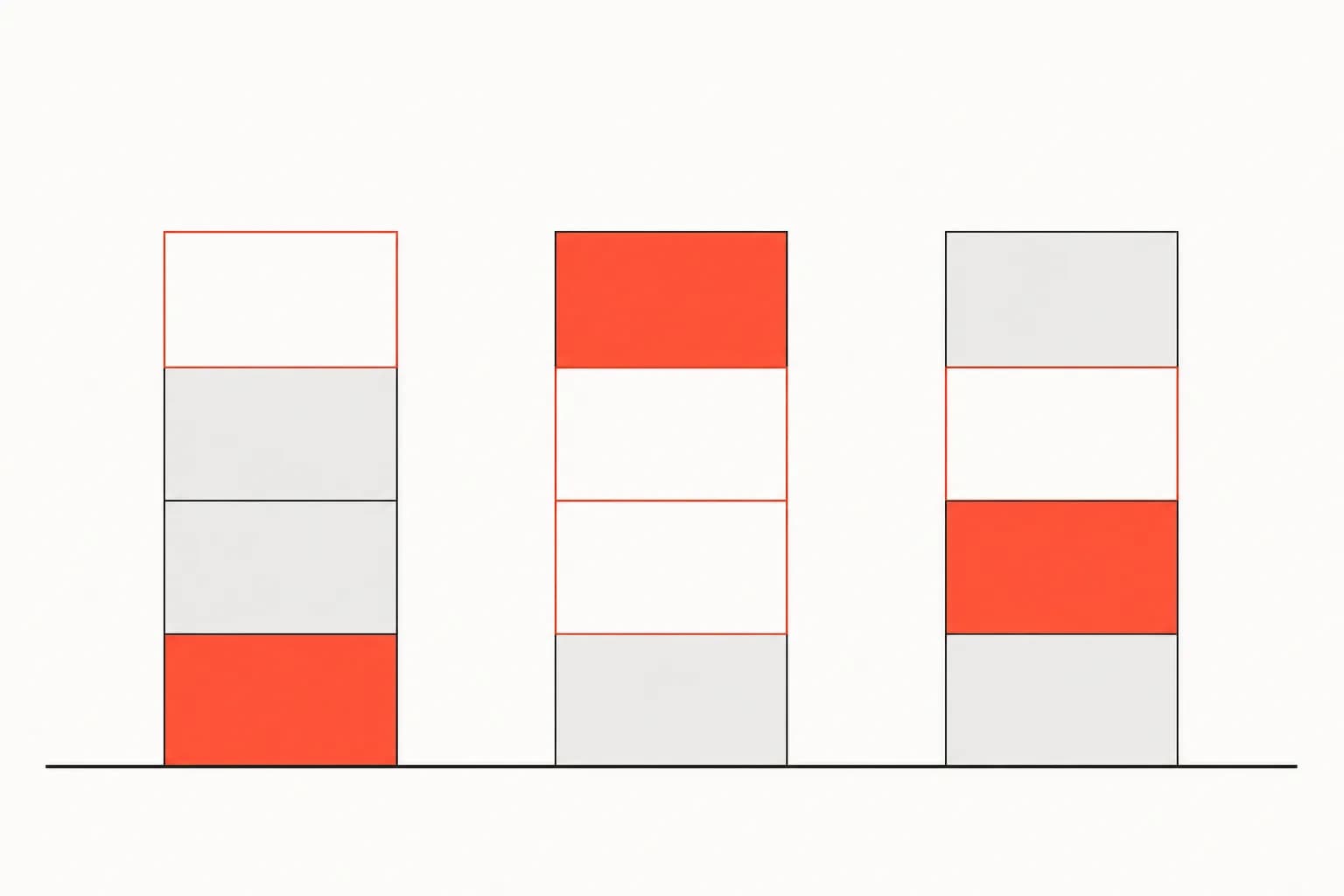
Pick a kind of work. Each bar is the marks that subject awards for it, out of 100, counted from the instruments in the current syllabuses.
I want marks for persuading an audience.
This is the real fork between the three. General English puts half its marks behind persuasion; Literature sets no persuasive task at all.
Marks show where a subject spends its assessment, not how well you will do in it. EAL enrolment is decided by your school against the syllabus eligibility statement.
General English, Literature and EAL compared
The subjects overlap more than their names suggest. The QCAA English syllabuses state it plainly: the five English learning-area subjects share the development of listening, speaking, reading, viewing, designing and writing, and the differences between them lie in the emphasis placed on how those skills are developed and the contexts they are applied in.
| Feature | General English | Literature | English as an Additional Language |
|---|---|---|---|
| Central emphasis | Perspectives, representations, audiences and public communication across literary and non-literary texts. | Close literary study, competing interpretations, aesthetic choices and imaginative transformation. | Language, culture, context and audience while developing control of Standard Australian English. |
| Common strengths | Persuasion, audience awareness, analysis and adapting ideas for public contexts. | Close reading, interpretive argument, literary knowledge and imaginative craft. | Multilingual and cross-cultural insight, language analysis and purposeful communication. |
| Typical misconception | It is only practical writing and contains little literary analysis. | It is simply reading more novels or writing creatively without analytical work. | It is an easier English course open to any student who wants extra support. |
| Eligibility | Subject to school offering and normal enrolment processes. | Subject to school offering and normal enrolment processes. | Restricted to students who meet the QCAA eligibility statement, confirmed by the school. |
How the assessment differs, instrument by instrument
This is where the three subjects genuinely diverge, and it is the part most subject-selection conversations skip. Each subject runs three internal assessments and one external assessment, each worth 25 marks of the 100-mark subject result. What changes is what you produce: whether a task argues or invents, whether you write it or speak it, and how long it may run.
| Instrument | General English | Literature | English as an Additional Language |
|---|---|---|---|
| IA1 (25 marks) | Spoken persuasive response — up to 8 minutes | Examination — extended response, 15 min planning + 120 min working | Examination — extended response, 15 min planning + 120 min working |
| IA2 (25 marks) | Written response for a public audience — up to 1500 words | Imaginative response — spoken up to 8 minutes, or multimodal up to 9 minutes | Persuasive response — written, up to 1200 words |
| IA3 (25 marks) | Examination — extended response, 15 min planning + 120 min working | Imaginative response — written, up to 2000 words | Imaginative response — spoken up to 8 minutes, or multimodal up to 9 minutes |
| External assessment (25 marks) | Examination — extended response, written, 15 min planning + 120 min working | Examination — extended response, written, 15 min planning + 120 min working | Examination — extended response, written, 15 min planning + 120 min working |
Response requirements and conditions are taken from the current QCAA General senior syllabuses — English 2025 v1.3, Literature 2025 v1.3 and English as an Additional Language 2025 v1.3 — published on the official subject pages for English, Literature and English as an Additional Language.
The shape is more similar than the names are. Every one of the three sits exactly two extended-response examinations — one internal, one external, both 15 minutes planning and 120 minutes working — and every one has exactly two tasks you develop over weeks with open access to resources. What changes is what those two open tasks ask you to produce, and when the first exam lands.
- What you argue differs. General English's open tasks are persuasive and public. Literature's are both imaginative. EAL runs one of each. Literature is the only one of the three with no persuasive task at all.
- All three require you to speak, but not about the same thing. General English's spoken task is a persuasive argument; in Literature and EAL the spoken or multimodal task is an imaginative response, delivered in a form such as a monologue, podcast or digital story.
- The internal exam sits at different points. In Literature and EAL it is IA1, so the summative sequence opens under exam conditions. In General English it is IA3, so the internal exam comes late and the sequence opens with a spoken task instead.
- Literature carries the longest written task at up to 2000 words, against 1500 for General English's public-audience response and 1200 for EAL's persuasive response.
Your school still selects the texts, develops endorsed instruments within the syllabus specifications and sets the teaching sequence. Read the task sheet and its ISMG rather than assuming that two analytical responses in different subjects are marked identically. The guide to reading an ISMG explains how to turn subject-specific descriptors into revision decisions.
What General English is like
General English is the broadest of the three in audience and genre. Students examine literary and non-literary texts, analyse how perspectives and representations are constructed, and create responses for public and persuasive purposes as well as examinations.
A good fit if
You enjoy debating an issue, analysing media and public texts, adapting language for an audience and connecting textual choices to social or cultural perspectives.
Watch for
General English still includes demanding literary analysis. The external analytical response rewards interpretation of a studied literary text, not a memorised generic essay.
If General English is your likely choice, the guide to the QCAA English analytical essay shows the difference between identifying a technique and interpreting its effect.
What Literature is like
Literature narrows the lens towards literary texts and the practices used to interpret and create them. Students work with the relationship between text, culture and reading, develop defensible interpretations and produce imaginative responses informed by literary craft.
The assessment shape follows that emphasis. Two of Literature's three internal assessments are imaginative responses — one delivered as a spoken or multimodal piece, one written — in forms the syllabus describes as mode-appropriate for the genre and context, such as a dramatic monologue, a literary pastiche, a podcast or a digital story. The analytical writing is concentrated into the two examinations.
A good fit if
You enjoy rereading closely, finding ambiguity, comparing interpretations, discussing form and style, and making deliberate creative choices in response to studied literature.
Watch for
Plot knowledge is only the starting point, and “imaginative” does not mean unassessed. Both imaginative responses are marked on how well your creative choices demonstrate a defensible reading of the studied text.
Literature is not automatically the “better” subject for a capable writer. It is a better fit when the sustained literary focus matches the way that student reads, argues and creates.
What English as an Additional Language is like
EAL is a General subject designed for students for whom English is not their first or home language. It combines the analysis and creation of literary and non-literary texts with explicit attention to language, context, audience and cultural meaning.
A good fit if
You meet the eligibility conditions and would benefit from a course that recognises additional-language learning while still completing analytical, persuasive and imaginative General-subject assessment.
Watch for
EAL is not a low-demand substitute. It has the same three internal assessments and one external assessment, the same 25-mark weightings, and it opens with a supervised extended-response examination.
EAL eligibility and incompatible subject combinations
The EAL syllabus carries an eligibility statement, and it is narrower than “English is hard for me”. The subject is designed for students for whom English is not their first or home language. The syllabus names Aboriginal students and Torres Strait Islander students for whom Standard Australian English is not the first or home language or dialect; students born in or long resident in Australia who still require significant support for learning English as an additional language; and students who enter senior schooling with limited or disrupted schooling in which English was the medium of instruction.
The syllabus is also explicit about who decides: schools are best placed to identify and confirm the eligibility of students undertaking this subject. A guidance officer, Head of Department or EAL specialist can apply those conditions to an individual situation. Eligibility is not a judgment about intelligence or everyday fluency.
Does Literature scale better than General English?
This is the most common reason students give for switching, and it is the weakest one. QTAC does not award a subject a bonus. It fits a curve to each subject from how that subject's cohort performed across all of their subjects, then maps your raw result through it — so a subject can move you down at one end of the scale and up at the other.
Here is what that looks like for the three English subjects on the 2025 curves, reconstructed from the QTAC ATAR Report figures that also power our ATAR calculator.
| Raw subject result | English | Literature | EAL |
|---|---|---|---|
| 50 | 34.6 | 29.0 | 34.7 |
| 60 | 51.0 | 48.1 | 52.8 |
| 70 | 67.2 | 67.8 | 70.3 |
| 80 | 80.1 | 82.8 | 83.3 |
| 90 | 88.8 | 91.6 | 91.3 |
Read the middle of the table, not the top. A raw 60 scaled to 51.0 in English and only 48.1 in Literature — the subject that supposedly “scales better” scaled that student lower. The two curves cross at about a raw 70. Literature only pulls ahead for students already performing near the top of the cohort, and choosing it for the scaling means betting that you will be one of them in a subject you enjoy less.
The EAL column is in the table for completeness, not as an option to weigh. EAL is not a subject anyone chooses for its curve: enrolment is governed by the eligibility statement above, and its 2025 curve is fitted to a cohort of about 1,000 students against roughly 27,000 in English, so it moves more from year to year.
The curves are also recalculated from each new cohort, so the 2025 figures describe 2025 and are a guide rather than a promise. The Queensland ATAR calculation guide works through the scaling step, the TEA and the rank in full.
Where Essential English and Extension fit
The QCAA English learning area has five subjects, not three. The two this comparison leaves out sit either side of it, and both come up in subject selection.
Essential English
An Applied subject, not a General one, focused on the literacy of everyday, community and workplace contexts.
What it means for an ATAR: it can satisfy the English eligibility requirement, but you count General English subjects or Applied English — not both — and Applied subjects are limited to one of your best five.
English & Literature Extension
A Units 3 and 4 Extension subject taken alongside English or Literature, built on literary theory, complex transformation and an academic research paper.
What it means for an ATAR: it is a sixth subject for most students who take it, and it counts only if it makes the best five. Take it for the work, not the aggregate.
Do all three subjects count for ATAR and English prerequisites?
Yes. An ATAR requires one of the QCAA English subjects — English, English as an Additional Language, Literature, English & Literature Extension, or Essential English — completed at Units 3 and 4 with a result of C or better. General English, Literature and EAL all satisfy it, and all three satisfy the common tertiary prerequisite stated as an English subject at Units 3 and 4, C. An individual course may set different or higher requirements.
Satisfying that rule is not the same as the result counting. Your English result enters the Tertiary Entrance Aggregate only when it is one of your best five eligible scaled results, and a student with a stronger set of maths and science results will often have it excluded. Check current courses directly through QTAC subject selection before choosing around a university prerequisite.
How to make the final choice
Compare real assessment
Open one current sample instrument for each available subject. Ask which task you would rather improve at for two years, not which sample looks easiest in five minutes.
Check your school's offering
Texts, teachers, timetabling and subject availability affect the actual experience. Confirm EAL eligibility and incompatible combinations before finalising preferences.
Check pathway requirements
Use current QTAC course entries for prerequisites. Avoid selecting a subject solely from historical scaling tables, because cohort and subject results change every year.
Choose a repeatable strength
Pick the subject whose recurring reading and response types let you produce your strongest evidence consistently across Units 3 and 4.