The most reliable way to revise is to practise pulling the material out of your head with your notes closed, check what you missed, and repeat on a schedule of days rather than hours. Re-reading and highlighting feel more productive, but in the research below students who re-read remembered less a week later than students who practised recall, and a major review rates highlighting as low value.
This page covers why the comfortable methods mislead you, what four pieces of research found and where each stops, and how to turn them into blank-page recall, a question bank, flashcards and a six-week schedule. It sits underneath QCAA external exam preparation, week by week, which says which papers to sit and when. This page is about keeping the knowledge in your head between sittings.
Why does re-reading feel like it works?
Read a page of notes for the third time and it feels smooth. You recognise every line, and that ease tells you that you know it. Researchers call the gap between that feeling and what you can actually produce an illusion of competence. Recognising a sentence is a much weaker test than producing the idea from nothing, and an exam only asks for the second.
In a classic experiment, undergraduates studied a short passage and then either read it again or wrote down everything they could remember, with nothing in front of them and no feedback. Five minutes later the re-readers did better, recalling 81% of the ideas against 75%. A week later the order had reversed: 56% for the students who had practised recall and 42% for the students who re-read (Roediger and Karpicke, 2006). The paper's second experiment pushed further.
| Learning condition | Read-throughs of the passage | Recalled after 5 minutes | Recalled after 1 week |
|---|---|---|---|
| Four study periods, no tests | 14.2 on average | 83% | 40% |
| Three study periods, one recall test | 10.3 | 78% | 56% |
| One study period, three recall tests | 3.4 | 71% | 61% |
The students who read the passage most also predicted that they would remember it best, and remembered it worst. It is one reason cramming feels good the night before: re-reading really does help for the next few minutes, and the exam is not in a few minutes. The same mismatch appears in flashcard-style experiments on word pairs, where spreading study out beat massing it for 90% of participants, yet after the first session 72% believed massing had worked better (Kornell, 2009).
Re-reading is not worthless, which is why it survives. In one experiment, 80 undergraduates met a 276-word science text under four conditions and took a short-answer test a week later.
Re-reading beat reading once. Recall beat re-reading, and beat the concept map even though the time on the map and the time on recall were matched. The re-readers forecast the highest recall for themselves, and the recall group's forecast was the lowest of the four, though not reliably lower than the forecasts of the study-once and concept-map groups (Karpicke and Blunt, 2011, figures from the supporting materials). The method with the lowest forecast worked best.
What does the research actually show?
Four sources carry the main argument. Each card says what it found and what it cannot tell you.
Roediger and Karpicke (2006)
Recalling a short passage beat re-reading it on tests two days and a week later, and lost on a test five minutes later.
The limit: 300 undergraduates across two experiments, two short passages, delays of a week at most, no feedback.
Karpicke and Blunt (2011)
Retrieval practice produced more learning than building a concept map, including on inference questions.
The limit: short science texts, a one-week delay, and concept mapping as the main rival. The recall group also re-read the text between its two recall attempts.
Cepeda and colleagues (2006)
A meta-analysis of spacing: 839 assessments in 317 experiments. Spreading study over separate learning episodes beat massing it in all but 12 of 271 comparisons, and the best gap grew as the test got further away.
The limit: verbal material such as word lists and short passages, and mostly short delays. In its analysis of gap length, about 80% of comparisons used a delay under a day and only 4% a delay over a month.
Dunlosky and colleagues (2013)
A review of ten study techniques, rated on how widely each one's benefits hold across learners, materials and tests.
The limit: the ratings are the authors' judgement of the evidence in 2013, and the review is not about QCAA subjects or exams.
-
High
practice testing, distributed practice
Both help learners of different ages and abilities, across many kinds of material and test.
-
Moderate
elaborative interrogation, self-explanation, interleaved practice
Promising, but the evidence was too limited for a higher rating.
-
Low
summarising, highlighting, keyword mnemonic, imagery for text, re-reading
In head-to-head comparisons, re-reading has consistently lost to practice testing, elaborative interrogation and self-explanation. Highlighting does little in most situations studied and may hurt on tasks that need inference.
How do you do active recall? Start with a blank page
The experiments above are a recipe: study something briefly, close everything, write down all you can remember, then check. The recall periods in the Karpicke and Blunt study ran 7 to 10 minutes.
Pick a small topic
One syllabus dot point or sub-topic, not a chapter. Start with the crosses and question marks on the checklist from the exam preparation guide.
Study it briefly, then close everything
Ten to twenty minutes is a reasonable start (our suggestion). Recall needs something to retrieve, so a topic you have never met has to be learnt first.
Write everything you know
On a blank page, or aloud to an empty room. Include diagrams, formulae, examples and dates, and keep going until you stall.
Open the notes and mark the gaps
Use a different colour pen. Add what you missed, correct what was wrong, and count the idea units you recalled, as the researchers did. That count is your score for the page.
Do the page again later
Tomorrow or the day after, on a fresh sheet. The schedule below says how wide to make the gap.
In a science, a page might be a process with its definitions, a labelled diagram and its equation. In a humanities subject it might be the causes, key people and turning points of one topic, plus the evidence for each claim. In English it is a text: plot beats, characters, context, and three quotations with the technique and effect of each. Check with your teacher what you may bring into the room. The top-band analytical essay guide shows what to do with quotations once you know them.
Write your own question bank
A bank of questions makes recall the default. For each dot point on your checklist, write two or three questions: one that asks you to state or identify, one that asks you to explain, and one that asks you to apply or evaluate. Keep the model answers on a separate sheet, taken from your notes.
The verb you choose sets the answer you rehearse, and the cognitive verbs guide says what each one asks for. Your syllabus labels the external assessment as short response, combination response or extended response, so check which yours is. For short response, make most bank questions the size of the paper's. For extended response, the bank holds the building blocks (claims, evidence, quotations) and you rehearse assembling them into whole answers under time.
Past papers go into the same bank. The preparation guide covers where to find them and how to sit the first one. After you have sat and marked a paper:
- Cut it into single questions and keep every one where you lost marks.
- Re-attempt those closed-book two or three days later, and again a week after that (our suggested rhythm, not a tested one), rather than counting the paper as done.
- Turn the idea behind each lost mark into a card or a bank question of your own.
Treat past questions as samples of style, not a forecast, because this year's paper is a new one. A bank of trivia trains trivia, so check that your questions use the verbs your paper does.
How do you use flashcards properly?
Flashcards suit discrete facts: definitions, terms, formulae, dates, quotations. Four rules separate recall from flipping through a stack.
- Write the prompt as a question that makes you produce something. A bare term invites a vague "yeah, I know that".
- Commit before you flip. Say or write the answer first. A meta-analysis found that tests requiring recall produced bigger benefits than recognition tests (Rowland, 2014).
- One idea per card, or one short list, so you can mark it right or wrong.
- Mark honestly, and never retire a card after one success.
Weak card
Front: Osmosis.
Back: Movement of water across a membrane.
Easy to flip to "got it" half-knowing it.
Stronger card
Front: A red blood cell is placed in pure water. Name the process that moves water across its membrane, and explain why the cell may burst.
Back: Osmosis: water moves from the dilute outside to the more concentrated cytoplasm, and the cell has no wall to resist the swelling.
The answer has parts you can mark.
Two studies back the last rule. Once students had recalled a word correctly, further testing on it left them recalling far more a week later than further re-studying did, and their predictions of their own performance were uncorrelated with their results (Karpicke and Roediger, 2008). Letting students drop cards they felt they knew made learning slightly but consistently worse (Kornell and Bjork, 2008).
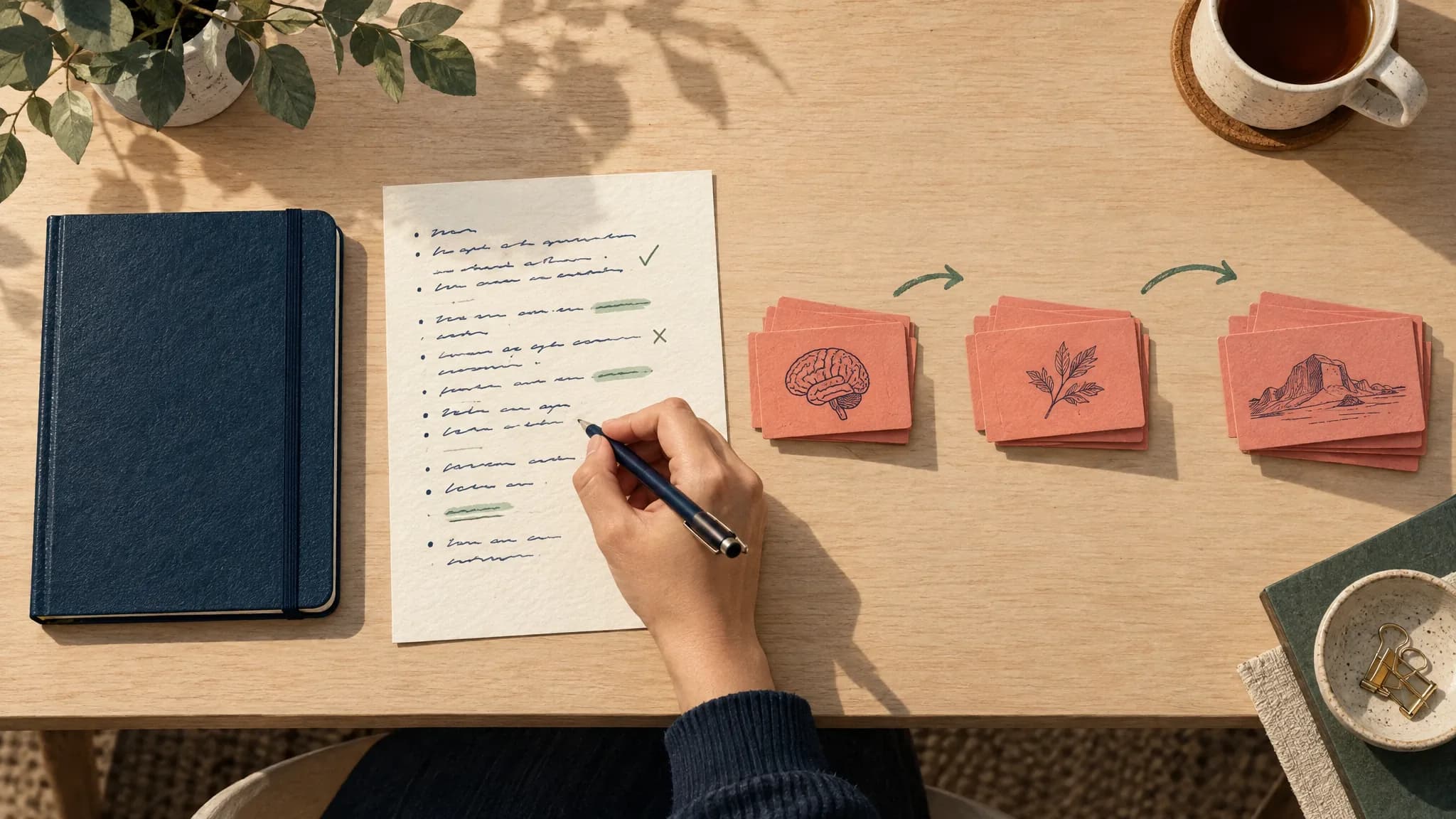
The Leitner box system is a common flashcard method that moves a card instead of removing it. Get it right and it goes up to a box you review less often. Get it wrong and it goes back to box 1, as one university study guide describes it. Its example intervals (daily, every other day, weekly) differ from ours, because the box lengths are a choice. None of the studies above tested Leitner boxes themselves, and the intervals below are our suggested starting point, not research results.
| Box | Review | Right | Wrong |
|---|---|---|---|
| 1 | Every day | Move to box 2 | Stay in box 1 |
| 2 | Every 3 days | Move to box 3 | Back to box 1 |
| 3 | Weekly | Move to box 4 | Back to box 1 |
| 4 | Every 10 to 14 days, and again in the last week | Stay in box 4 | Back to box 1 |
Work through the whole stack of due cards in one go instead of cycling five cards five times: in Kornell's experiments, one large stack, which leaves more time between repeats of each card, beat several small ones. An app that schedules reviews does the same job.
How far apart should study sessions be?
Spaced repetition means retrieving something again at widening gaps. The meta-analysis found that the best gap grows with the delay before the test. Another study, of more than 1,350 people with gaps up to 3.5 months and tests up to a year later, found the best gap shrank as a share of the delay: about 20 to 40% of a one-week delay, falling to about 5 to 10% of a one-year delay (Cepeda and colleagues, 2008). Six weeks sits between those. The study's own five-week and ten-week delays put the best gap for recall at roughly 8 and 12 days (interpolated from the gaps it tested), so for a six-week plan a gap somewhere from a few days to a couple of weeks is a reasonable reading. That is our extrapolation, not a measured optimum: the participants were adults learning trivia facts online, with a single review session, not Year 12 students revising across subjects. The same paper found that a gap longer than the best one cost less than a gap that was too short.
The exact shape matters less than it sounds. The meta-analysis found too little data to say whether widening gaps beat equal ones, and in experiments mainly on word pairs, widening them had little effect on long-term retention. What helped was delaying the first retrieval enough to make it effortful (Karpicke and Roediger, 2007). The gap worth protecting is the first one: the meta-analysis reaffirmed that separating study by at least a day, rather than packing it into one session, is extremely useful for long-term retention.
| Day, counted from first learning a topic | What you do |
|---|---|
| Day 0 | Learn it, then blank-page recall and marking. Make the cards and bank questions. |
| Day 1 or 2 | Cards in box 1 plus three to five bank questions, closed-book. |
| Day 4 to 6 | Second retrieval. Re-attempt anything wrong. |
| Day 10 to 14 | Third retrieval, mixed with other topics, including one exam-style answer. |
| Day 21 or later | Fourth retrieval, then a final pass in the days before that subject's paper. |
Run that clock for every topic and lay it across six weeks. The clock and the timeline are our own suggested shape, not a tested schedule.
- Six weeks out
Build the checklist, the question bank and the first cards, and start the clock on your crosses first.
- Weeks 5 and 4
Each session is mostly retrieval of what is due, with a little new material. If time runs short, drop new material before a due review. Feed the lost marks from every past paper into the bank.
- Weeks 3 and 2
Gaps widen to a week or more and topics get shuffled together. Most of your time is closed-book questions rather than cards.
- Final week
No new cards. Revisit the questions you got wrong and the ones you were sure about but missed, alongside the last-week list in the preparation guide.
To fit this around the exam timetable, count back from each subject's own paper using the dates in the 2026 external assessment timetable. Aim for each subject's last retrieval pass to land a few days before its paper, not on the night. Subjects sitting late in the block get their last pass while earlier papers are being sat, so plan the last week as a rota. If your first paper is under six weeks away, keep the order (learn, blank page, quick repeat, wider gaps) and squeeze the gaps: a day between sessions still beats one long block. The last week, the morning of and sleep are covered in the last-week section of the preparation guide, and the night-before-submission checklist makes the same sleep argument for assignments.
The "mixed with other topics" step from day 10 is deliberate. Learn each topic on its own, then shuffle cards and questions across topics so you have to work out which idea a question calls for. Interleaved practice earned a moderate rating in the 2013 review, with the evidence still thin then. Its strongest case is in mathematics, which how to study for QCAA maths exams covers, along with error logs.
How do you mark yourself honestly?
The whole method rests on the checking. Write the answer first, cover your notes, then mark with a different colour pen and award only what you can point to on the page. "I knew that" earns nothing. Count idea units for a blank page, use the marking guide for any past question (the preparation guide shows how), and log the score with the date.
Then add one number. Before you check an answer or card, write down how sure you are: sure, unsure or guess. After marking, record whether you were right.
| How sure you were | Right | Wrong |
|---|---|---|
| Sure | Leave it for a longer gap. | Your priority. You will not flag this in the exam, so check it again within two days. |
| Unsure or guess | Right but shaky. Keep it on a normal gap and retest it. | Relearn it from the notes, then retest in a day or two. |
Forecasts of memory can miss badly: in Roediger and Karpicke's second experiment the group that was most confident recalled the least a week later. The 2013 review also reports work suggesting that feedback is especially effective at correcting confident errors, so the sure-but-wrong cell is one where marks can quietly leak, because nothing flags it, and one the research suggests is fixable. If you can barely begin a page, study it again before testing it.
Common mistakes
- Peeking. Retrieval with the notes open is re-reading with extra steps.
- Copying notes out. Rewriting is not recall. The page must start blank.
- One enormous session. Five hours on Sunday and nothing until next Sunday is massing.
- Questions that do not match the paper. If the paper asks you to evaluate and your bank only asks you to name, the bank is the wrong size.
- Abandoning the schedule after a bad week. Rejoin at the next due item.
Where is the evidence weaker?
- Laboratory versus classroom. The core experiments used university students and passages of a few hundred words. A meta-analysis of 222 classroom studies with 48,478 students found that quizzing raised achievement to a medium extent (Yang and colleagues, 2021), so the effect travels, though its size varied with test format, feedback and repetitions. None of this research was run on QCAA external assessments.
- Delay lengths. Most spacing studies test after minutes, days or a week. The one that looked at delays of weeks to a year used trivia facts and a single review session. Your horizon is weeks, so our gaps are an informed extrapolation.
- Complex material. Researchers disagree over whether the benefit of recall shrinks as material gets more complex: van Gog and Sweller (2015) argued that it decreases and may even disappear when material is very complex, and Karpicke and Aue (2015) replied that this claim is incorrect and that retrieval practice remains effective with complex materials. Use recall for facts, evidence and structure, and still write whole answers to time.
- Motivation. Recall feels harder, and your first scores will look lower than a re-read would make you feel. A survey of 177 college students found most re-read their notes and relatively few tested themselves (Karpicke, Butler and Roediger, 2009). No study here shows whether Year 12 students keep to a six-week schedule alongside other assessments. If exam stress is making this hard, start with exam anxiety and Year 12 stress in Queensland.