In Years 7–10, cognitive verbs such as identify, explain, analyse and evaluate come from the Australian Curriculum Version 9.0 itself. They are written into each year's achievement standard and content descriptions, and they tell you what kind of thinking your work has to show. There is no single official "Version 9 cognitive verb list". ACARA writes the verbs into the curriculum. In Queensland, the QCAA publishes the support materials: a one-page Categories of common cognitive verbs for Prep to Year 10, information sheets on 15 common verbs for Years 7–10, and an overview for each learning area showing where each verb appears.
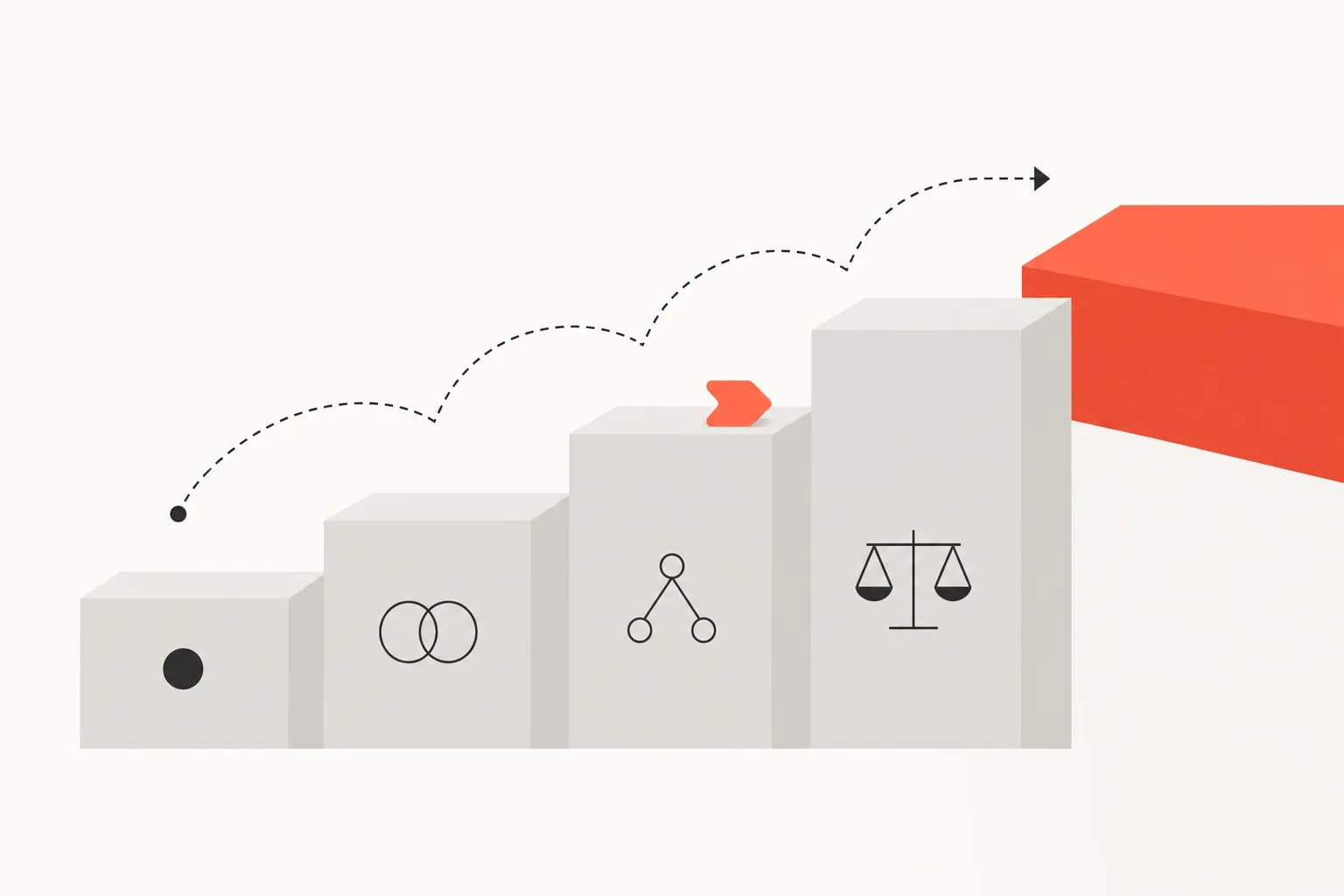
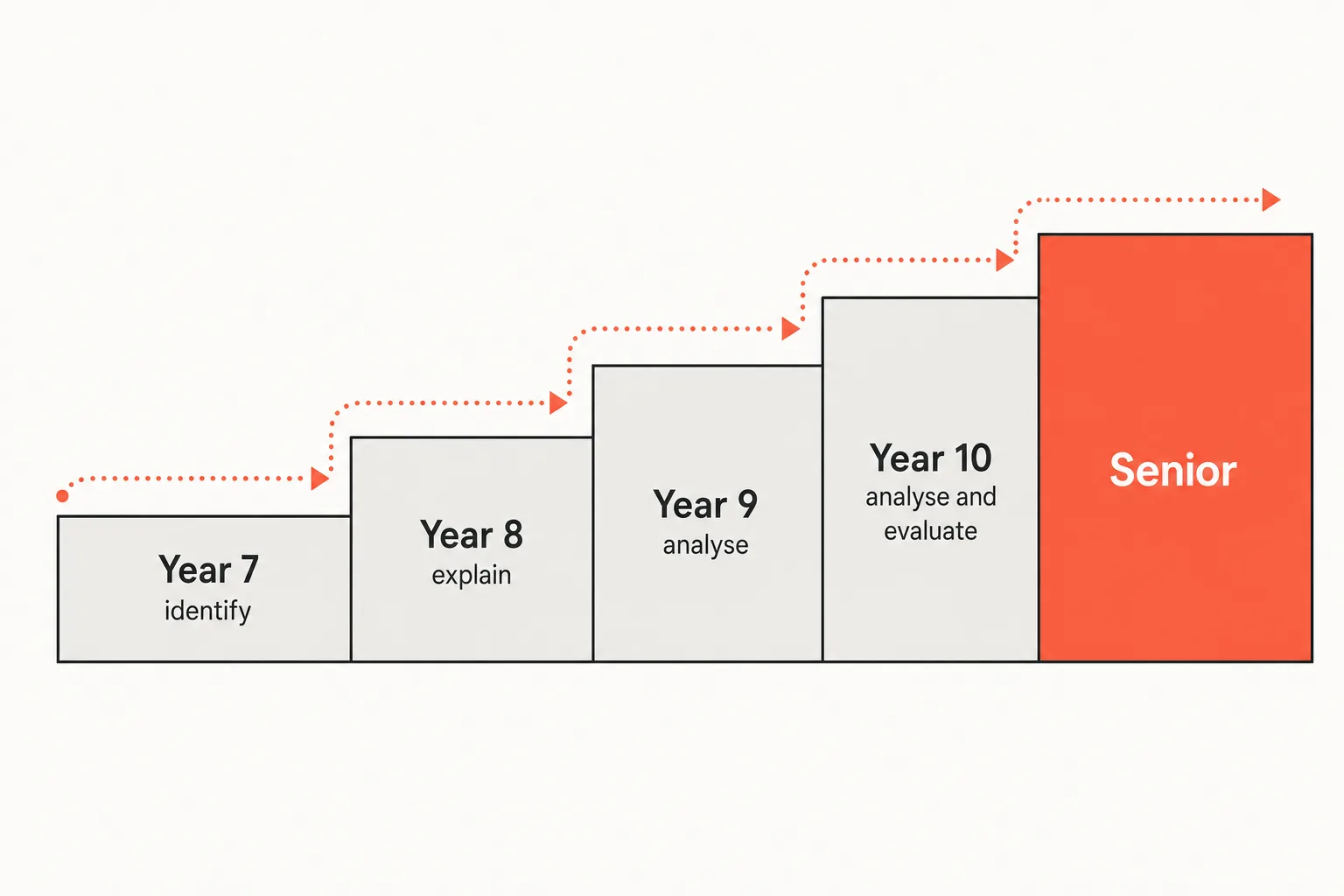
The most useful thing to notice is that the verb climbs. In English, the reading and viewing part of the achievement standard asks Year 7 students to identify, Year 8 to explain, Year 9 to analyse and Year 10 to analyse and evaluate. This guide follows that climb through English, Science, Maths and History. It also shows how your A–E grade reads the verb, and what changes in Year 11, when the senior QCAA cognitive verb framework takes over.
Where the Years 7–10 verbs come from
Two organisations are involved. ACARA writes the Australian Curriculum, and Version 9.0 is the current version. Every subject has an achievement standard for each year level or two-year band, which starts "By the end of Year 9, students …", and a set of content descriptions, each with its own code. The verbs live in those sentences. When your teacher writes a task, the verb on the task sheet usually comes from the standard for your year.
The QCAA then supports Queensland schools to teach and assess that curriculum, and it publishes the cognitive verb resources. Its Years 7–10 implementation schedule allowed schools to start on Version 9.0 in 2024, and it says all learning areas must be fully implemented by the end of 2027, so a few units at your school may still have been written against the older version.
These are the four QCAA resources worth knowing. The first three are linked from its Cognitive verbs in Version 9.0 page. The standard elaborations are on each learning area's assessment page.
Categories of common cognitive verbs
One page covering Prep to Year 10. It sorts 37 common verbs into four categories of thinking.
Use it for: seeing how demanding a verb is compared with the others.
Years 7–10 information sheets
One sheet each for analyse, apply, compare, decide, describe, develop, evaluate, examine, explain, identify, infer, interpret, represent, select and understand, with a definition, the steps and curriculum examples.
Use it for: the steps of a verb you have to perform.
Cognitive verb overviews
One grid per learning area, showing which verbs appear in each year from Prep to Year 10.
Use it for: finding the verbs your subject actually uses this year.
Standard elaborations
An A–E matrix for each subject and year, built from the achievement standard. QCAA says teachers can use it to develop marking guides for individual tasks.
Use it for: seeing what separates an A from a C on the same verb.
The four categories QCAA uses for Prep to Year 10
The Categories of common cognitive verbs sorts verbs using Marzano and Kendall's (2007) four elements of the cognitive system. Each category is a kind of thinking, from remembering something to using what you know to get a job done. These are its lists, with its description of each category.
Retrieval
demonstrate, identify, recognise, select, use
QCAA's description: "Activation and transfer of knowledge from permanent memory to working memory". In plain terms, getting what you know out of your head and onto the page.
Comprehension
communicate, comprehend, describe, explain, model, represent, understand
QCAA's description: storage of "the critical features of information in permanent memory". You show you understand something well enough to put it in your own words.
Analysis
analyse, apply, classify, compare, connect, consider, examine, generalise, identify, infer, interpret, reflect on
QCAA's description: "Generation of new information not already possessed by the individual". You work something out that was not handed to you.
Knowledge utilisation
create, conduct, decide, determine, develop, discuss, elaborate, evaluate, investigate, justify, predict, propose, solve, synthesise
QCAA's description: use of knowledge processes "to accomplish a specific task". You use what you know to reach a judgement, solve a problem or make something.
Three things in that table matter more than the rest.
- Explain sits with describe. Both are comprehension. Explaining asks for more, because it adds the how or the why, but it is the same kind of thinking. The jump to a new category is analyse.
- Identify appears twice. Identifying a feature is retrieval. Identifying a pattern or an error is analysis. What comes after the verb changes how hard it is.
- The top category is where senior lives. Evaluate, justify, discuss and synthesise are the verbs that most senior tasks are built around.
How the verb climbs from Year 7 to Year 10
Read a subject's four achievement standards side by side, and the same skill keeps showing up while its verb changes. QCAA's "sequence of achievement standards" documents put Years 7 to 10 in one table, so the change is easy to see. English shows it most clearly. This is the reading and viewing part of each standard, from QCAA's Years 7–10 English sequence.
- Year 7: identify
"They identify how ideas are portrayed and how texts are influenced by contexts."
- Year 8: explain
"They explain how ideas are represented and how texts reflect or challenge contexts."
- Year 9: analyse
"They analyse representations of people, places, events and concepts, and how texts respond to contexts."
- Year 10: analyse and evaluate
"They analyse and evaluate representations of people, places, events and concepts, and how interpretations of these may be influenced by readers and viewers."
The topic barely moves: how texts represent ideas and contexts. The verb does all the work. A Year 7 response that points out a representation meets the Year 7 standard. The same response handed in for Year 10 is three steps short, because it still has to analyse the representation and then judge it.
What the verb asks in Year 9 and 10, subject by subject
The same climb happens in Science, Maths and History. Each table below quotes ACARA's achievement standard for one skill, and each example sets a response that stops at a lower verb beside one that does the Year 10 verb. The examples are ours, not QCAA's.
English: analyse, then evaluate
In Year 9, analyse means showing how a text's choices build a representation. That means the word, image or structure, and the effect it has on the reader. Year 10 adds evaluate, and the Year 10 standard points it at "how interpretations of these may be influenced by readers and viewers". So you judge the representation, and you consider who might read it differently.
Stops at explain
"The writer describes the main street as empty and the shops as boarded up, which shows that the town is struggling."
Analyse and evaluate
"By opening on boarded-up shops and a single passing car, the writer represents the town as already finished, which positions readers to see leaving as the only sensible choice. That works on a city reader, but a reader from a small town may notice who is missing: nobody who stayed is given a line."
In senior English, the analytical essay's Knowledge application criterion is a ladder of these same verbs. See what separates the top band in the QCAA analytical essay.
Science: from identifying errors to evaluating validity
The Science skills standard from QCAA's Years 7–10 Science sequence moves like this for methods and conclusions:
| Year | What the standard asks |
|---|---|
| Year 7 | "identify possible sources of error in methods" |
| Year 8 | "identify assumptions and sources of error in methods and analyse conclusions and claims" |
| Year 9 | "analyse the impact of assumptions and sources of error in methods and evaluate the validity of conclusions and claims" |
| Year 10 | "evaluate the validity and reproducibility of methods, and the validity of conclusions and claims" |
Year 9 science students searching for their verbs should notice that evaluate is already there. Year 8 evaluates claims, and by Year 9 the methods sentence itself asks you to evaluate validity. QCAA's Years 7–10 sheet says evaluating "involves making a judgment using criteria". In Science, the criteria are named for you: validity and reproducibility.
Stops at identify
"A source of error was the stopwatch, because it was hard to tell when the fizzing stopped."
Evaluate
"The method was reproducible: three trials at each temperature agreed closely. Its validity is weaker. Judging the end point by eye adds a reaction delay to every time, so the 2-second gap between 50 °C and 60 °C is inside that uncertainty and cannot support the claim that the rate keeps rising."
In senior Biology, Chemistry and Physics, this becomes the Interpreting and Evaluating criterion of the student experiment. The QCAA student experiment, criterion by criterion covers it.
Maths: from using a model to evaluating it
It is easy to assume cognitive verbs belong to essay subjects. The modelling sentence in QCAA's Years 7–10 Mathematics sequence shows otherwise:
| Year | What the standard asks |
|---|---|
| Year 7 | use mathematical modelling to solve practical problems, "justifying choices of representation" |
| Year 8 | use mathematical modelling to solve problems using linear relations, "interpreting and reviewing the model in context" |
| Year 9 | use mathematical modelling to solve practical problems, "evaluating the model and communicating their methods and findings" |
| Year 10 | use mathematical modelling to solve practical problems, "evaluating and modifying models, and reporting assumptions, methods and findings" |
A correct answer from the model is no longer the end of the task. Evaluating a model means testing it against the situation, saying where it breaks down and changing it if it needs to change.
Uses the model
"The model is S = 30w + 100, so the canteen will sell 400 drinks in week 10."
Evaluates and modifies it
"S = 30w + 100 fits weeks 1–4 to within 5 drinks, but it predicted 250 for week 5 and sales were 228, then 231 in week 6. A straight line assumes sales rise every week, which cannot hold when only about 240 students buy from the canteen. I modified the model to level off near 240 and report that cap as an assumption, because the week 10 prediction depends on it."
That paragraph is a small version of a senior problem-solving and modelling task (PSMT), which is marked on Formulate, Solve, Evaluate and Communicate. The PSMT write-up, criterion by criterion shows where each move earns marks.
History and HASS: from identifying to evaluating sources
History has the steadiest climb of all. This is the sources sentence from QCAA's Years 7–10 History sequence:
| Year | What the standard asks |
|---|---|
| Year 7 | "identify the accuracy and usefulness of sources as evidence" |
| Year 8 | "compare sources to explain the accuracy, usefulness and reliability of sources as evidence" |
| Year 9 | "compare sources to determine the accuracy, usefulness and reliability of sources as evidence" |
| Year 10 | "evaluate the accuracy, usefulness and reliability of sources as evidence" |
Historical interpretations follow the same path. Year 9 students "analyse different and contested historical interpretations", and Year 10 students "compare and evaluate" them. The key point about evaluating a source is that usefulness depends on the question you are asking.
Stops at identify
"The poster is a primary source from 1942, so it is accurate and useful."
Evaluate
"For how the government tried to shape civilian attitudes in 1942, the poster is highly useful, because persuasion was its purpose and that purpose is the evidence. For how Australians actually felt about rationing it is far less reliable: it shows the response the government wanted, not the one it got. Letters or diaries from the period would test that."
Geography, Economics and Business, and Civics and Citizenship have their own cognitive verb overviews on QCAA's mapping page. In senior History, this work becomes the investigation, marked on Analysing, Evaluating and Synthesising among other criteria: see the humanities investigation, criterion by criterion.
How your A–E grade reads the verb
In Years 7–10, Queensland schools usually report your result on a five-point A–E scale. QCAA's standard elaborations explain how the verb connects to that grade: "In Queensland, the achievement standard represents the C standard". The C column repeats the standard, and the other columns describe better or weaker versions of it. This is the reading and viewing row from the Year 9 English standard elaborations:
- A
considered analysis
The same verb as C, done with more care and precision.
- B
effective analysis
Analysis that works well and lands its points.
- C
analysis
The achievement standard itself: the verb, done.
- D
explanation
The verb has dropped a level, from analyse to explain.
- E
statement/s about
Points are stated, not explained or analysed.
Two lessons follow. First, A and B are the same verb as C, done better. To move from a C to an A you analyse with more care, not more length. Second, D and E weaken the verb. Either it is done only partly ('partial evaluation' in Year 10 Science), or a lower verb replaces it ('explanation' in Year 9 English). A clear, accurate explanation still sits in the D column of a task that asked you to analyse, however good it is. The Year 10 Science standard elaborations show the other version for methods: "considered evaluation" at A, "informed evaluation" at B and "evaluation" at C, then "partial evaluation" at D and "description" at E.
Your school writes its own marking guides, so your task sheet may use different words. When the grade a teacher gives you does not make sense, look at what changes between the columns. Senior ISMGs work the same way, with qualifiers such as discerning, effective and adequate. How to read an ISMG shows that pattern in Year 11 and 12 marking guides.
What changes when you reach Year 11
Many of the words carry straight over, but the system around them changes.
Years 7–10
Verbs come from: ACARA's achievement standards and content descriptions.
QCAA's reference: Categories of common cognitive verbs, plus 15 information sheets.
Categories: four.
Judged by: A–E judgements, often from marking guides built on the standard elaborations.
Counts towards an ATAR: no.
Years 11–12
Verbs come from: QCAA's senior syllabuses and assessment tasks.
QCAA's reference: the Cognitive verb framework, 117 terms, dated August 2025.
Categories: three, because retrieval and comprehension are combined.
Judged by: an ISMG for each internal assessment, with marks for each criterion.
Counts towards an ATAR: yes, through your senior subject results.
The P–10 categories document says this itself: senior syllabuses draw on the same four processes, but the senior Categories of cognitive verbs "uses an adapted model combining Retrieval & Comprehension".
The definitions change too. The same verb is worded differently in the two sets of documents:
Evaluate, Years 7–10 sheet
"To evaluate is to examine and make judgments about the merit of ideas, artworks, systems, methods or solutions. It involves making a judgment using criteria."
Evaluate, senior framework
Used to "make a judgment about the value, quality or significance of something".
The ideas match, and the Years 7–10 version gives you the criteria habit early. The senior definitions are the ones your Year 11 and 12 tasks are written against. When you get there, how to answer the QCAA cognitive verbs works through the senior verbs with examples, and the QCAA assessment glossary explains the new vocabulary of ISMGs, IAs and EAs.
Do Year 9 and 10 results count towards your ATAR?
No. QTAC calculates the ATAR from your senior subject results, and nothing from Years 7–10 is part of it. How the Queensland ATAR is calculated walks through the steps.
Year 9 and 10 still matter for two reasons. Your Year 10 results feed into the subject choices you make for Year 11, which choosing Year 11 subjects in Queensland covers. And the verbs at the top of the Year 10 standards, analyse and evaluate, are the ones senior tasks build on from the first week. If you can already evaluate a source or a model in Year 10, the first senior task asks for something you have practised.
For teachers: getting the most from the P–10 verb resources
- Match the task verb to the verb in the standard for that year. Asking Year 8 students to evaluate when the standard says explain moves them up a level without the teaching to support it.
- Use the process steps on each Years 7–10 information sheet as a scaffold. The evaluate sheet starts with "determining the purpose and criteria for the evaluation".
- When you write a marking guide from the standard elaborations, look closely at the D and E columns. That is where the verb itself changes, and where students most need to see the difference.
- Keep senior wording for senior. QCAA publishes the P–10 and Years 11–12 verb resources separately, and the definitions are not the same.
- Check that a resource says Version 9.0. Older Version 8 materials still circulate, and their year-level wording does not always match Version 9.0.
Key takeaways
| Point | Details |
|---|---|
| There is no single "v9 verb list" | ACARA writes the verbs into the achievement standards and content descriptions. QCAA publishes the Queensland support resources |
| Four categories in P–10 | Retrieval, comprehension, analysis and knowledge utilisation. Explain sits with describe, and analyse is the step up |
| The verb climbs each year | English reading goes identify, explain, analyse, then analyse and evaluate. Science, Maths and History reach evaluate by Year 10 |
| C is the standard | A and B are the same verb done better. D and E weaken the verb: done partly, or swapped for a lower one |
| Senior uses a different framework | From Year 11, the 117-term Cognitive verb framework and three categories apply, and internal assessments are marked on ISMGs, criterion by criterion, though the final subject result still includes an A–E |
Where to go next
In Years 7 to 9, the most useful habit is to find the verb in each task and check it against your year's standard. Bookmark this page for when you start choosing senior subjects.
In Year 10, start on the senior pages: the complete list of QCAA cognitive verbs and what an ISMG is. The free ATAR calculator and subject result calculator show how senior marks add up, and the QCAA subject guides show what each subject assesses.