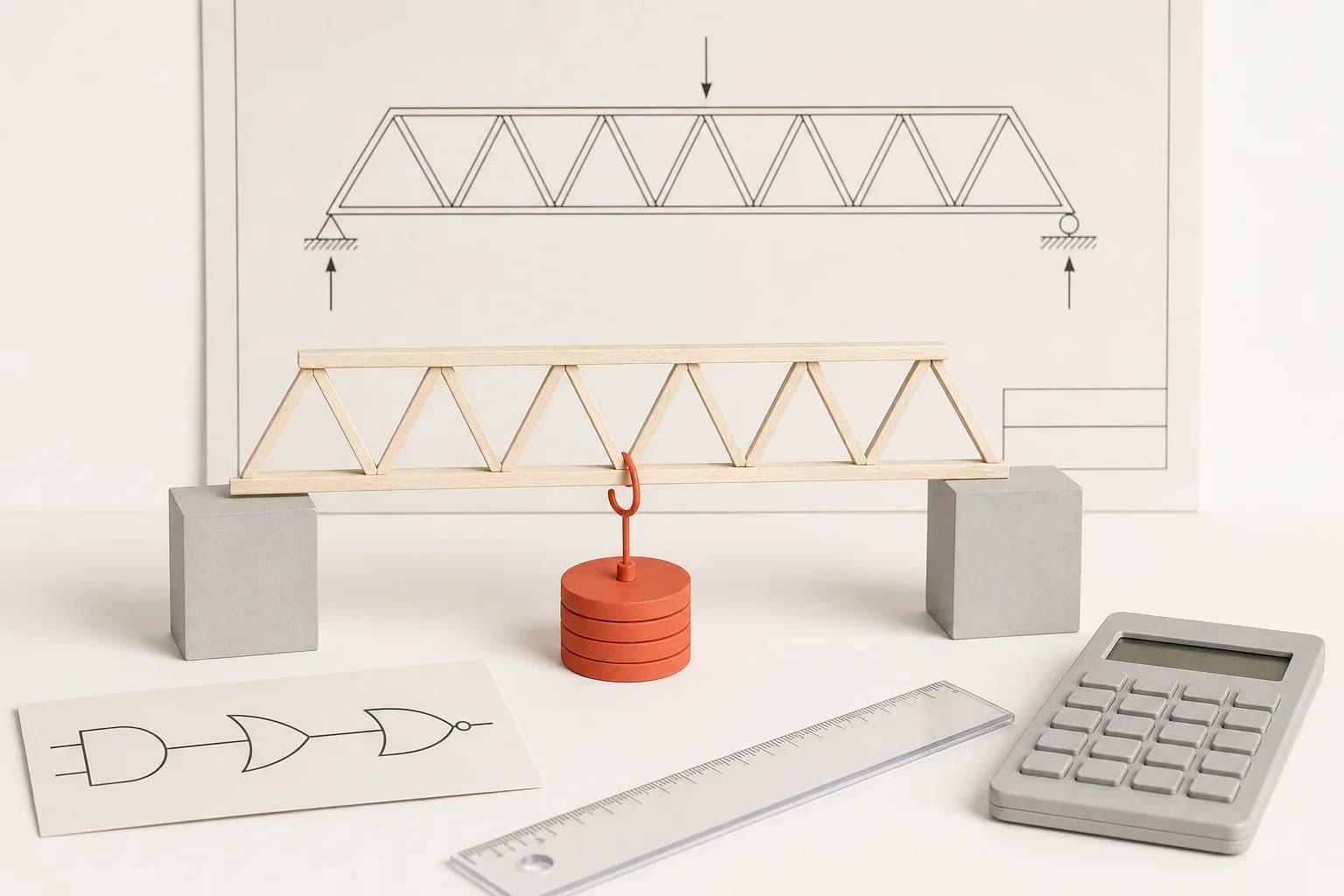
Two success criteria for the same truss footbridge. First: "The bridge must be strong and safe." Second: "Under its scaled working load of 150 newtons, the prototype carries at least 1.5 times that load before any member or joint fails, measured in a destructive test." The first could sit in any engineering task. The second gives your prototype test something to prove, and that is what the 9-mark Determining and Generating criterion is built on.
This guide covers every internal assessment in Units 3 and 4 of QCAA's General Engineering syllabus: the two engineered solutions (IA1 and IA3) and the Unit 3 exam (IA2). For each one it gives the conditions, the criteria and their marks, and what the top band asks for in the ISMG's own words. It also lists the mistakes QCAA's 2025 Engineering subject report names, and how the internal work sets you up for the external exam. It is written for students starting Year 12 in 2027, when IA1 arrives in Term 1.
The four Engineering assessments at a glance
Engineering has four summative assessments in Units 3 and 4, each worth 25 marks. Your school sets and marks the three internal ones, and QCAA sets and marks the external exam. The internals make up 75 of your 100 marks.
| Assessment | What it is |
|---|---|
| IA1: Engineered solution, 25 marks | Unit 3, civil structures. A real-world-related structural problem set by your teacher. Up to 10 A4 pages and up to 2000 words, written in class time and your own time. |
| IA2: Examination, combination response, 25 marks | Unit 3 only. 5 minutes perusal and 120 minutes working, with the QCAA formula book provided. |
| IA3: Engineered solution, 25 marks | Unit 4, machines and mechanisms. Same length and conditions as IA1, and the solution must include logic control technology. |
| External assessment, 25 marks | Unit 4 only. Set and marked by QCAA. 5 minutes perusal and 120 minutes working, with the formula book provided. |
IA1 and IA3 share one ISMG layout: the same three criteria, the same marks and nearly the same wording. Learn it once for IA1 and you have learnt most of IA3. To see how four results of 25 combine into one subject result, use the subject result calculator or read how your QCAA subject result is built.
The problem-solving process, and the phase you don't write up
Both engineered solutions ask you to "document the application of the problem-solving process". The syllabus describes that process in four phases. It is iterative, so you move back and forth between them as the data comes in.
Explore
Investigate the needs and constraints, research similar problems and existing solutions, test or calculate the fundamentals, and determine success criteria. This is groundwork for the task rather than pages of the response.
Develop
Synthesise mechanics, materials science and research into ideas, sketch and annotate them, test materials, calculate the limits, evaluate ideas against the success criteria and propose a solution.
Generate
Produce drawings to basic drawing standards, calculate predicted prototype and real-world performance, and build a physical or virtual prototype that gives valid performance data.
Evaluate and refine
Test the prototype, resolve uncertainties, reanalyse the results, evaluate the real-world solution against the success criteria and prototype data, and make and justify recommendations.
The 2025 subject report says it directly: "Objectives 1 and 3 are not assessed in IA1 in the 2025 syllabus, so students are not required to document the explore phase." It says the same about IA3. That does not make the explore phase optional. The report says Determining is assessed on how well you considered "the information from the explore phase (prior to assessment)" when deciding which needs, constraints or requirements matter most. Do the exploring, then let it show up as sharp success criteria instead of five pages of background research you have no words left for.
IA1: the engineered solution for a structural problem
IA1 sits in Unit 3, Civil structures. Your teacher provides "an appropriate real-world-related structural problem context", and Unit 3's subject matter asks for a "complex open-ended structural problem involving truss structures", so expect a truss.
Both limits apply at once. Ten pages caps the drawings, photos and graphs, and 2000 words caps the writing, including your annotations. QCAA's report makes the point with a real student sample: a text box holding the formula for stress "does not constitute processed data, and as such the text in the box would be counted in the word length". If your school counts words differently, its task sheet wins, but plan for every word you type to count. The QCAA word count rules explain what is usually left out.
The marks split across three criteria:
- Symbolising and Communicating7 marks
- Determining and Generating9 marks
- Synthesising and Evaluating9 marks
The next three sections take each criterion in turn, with an illustrative IA1 running through them. It is our own example, not a QCAA task: a council needs a 12-metre pedestrian truss bridge over a creek that floods most wet seasons, and the class builds 1:20 balsa prototypes on a 600-millimetre span.
Symbolising and Communicating: 7 marks
This criterion marks how you show and explain your thinking: the sketches, drawings, tables, graphs and diagrams, and the quality of the written explanation around them.
-
6–7
adept and discerning
"adept symbolisation and discerning explanation of ideas and a solution in relation to structures with sketches and drawings, tables and graphs, diagrams and/or schemas"; "discerning decision-making about, and proficient use of written and visual features to communicate about a solution, language for a technical audience, grammatically accurate language structures, referencing conventions"
-
4–5
effective and considered
"effective symbolisation and considered explanation of ideas and a solution in relation to structures with sketches and/or drawings, tables and/or graphs, diagrams and/or schemas"; "effective decision-making about, and fluent use of" the same features, language, structures and conventions
-
2–3
competent and appropriate
"competent symbolisation and appropriate explanation of some ideas and a solution"; "appropriate decision-making about, and use of written and visual features to communicate about a solution, suitable language, grammatically accurate language structures, referencing conventions"
-
1
inconsistent
"inconsistent symbolisation or superficial explanation of aspects of ideas or a solution in relation to structures"; "inconsistent decision-making about, and inconsistent use of written and visual features, grammar and language structures, referencing conventions"
Read the joining words. The top band asks for sketches and drawings, and tables and graphs. The band below accepts sketches and/or drawings, and tables and/or graphs. A response with polished CAD drawings but no hand sketches of how the idea developed, or test results in a table with no graph, has handed the marker a reason to stop at 5.
- Sketch the development. Annotated sketches of the ideas you rejected and why, not only the final truss.
- Draw to a standard. The specifications ask for "basic drawing standards (hand or CAD)". In QCAA's 2025 report, a top-band folio from the last old-syllabus cohort included a title block and a parts list for building the prototype.
- Annotate the prototype before and after testing. The specifications ask for annotated photographs or screen captures at both stages, so the failure is shown as well as described.
- Graph the test data. Load against deflection, or predicted against measured failure load, so a reader can see the result before reading about it.
- Write for a technical audience. Name members, forces and properties precisely: "the top chord at midspan is in compression", not "the top bit gets squashed".
- Reference every source. Material properties, standards and existing bridges you researched all need in-text citations and a reference list.
Keep annotations short. QCAA's advice to schools is that "Annotations on sketches and diagrams should be targeted and brief to ensure the Engineered solution is within the word limit." An arrow and six words beat a paragraph beside every sketch.
Determining and Generating: 9 marks
This criterion joins two things that depend on each other: the success criteria you set, and a prototype that produces data good enough to test them.
-
8–9
astute and proficient
"astute determination of essential success criteria for the structural problem"; "proficient generation of a structural prototype solution"; "provide valid performance data to critically determine the feasibility of the structural real-world solution"
-
6–7
reasoned and effective
"reasoned determination of effective success criteria for the structural problem"; "effective generation of a structural prototype solution"; "provide valid performance data to effectively determine the feasibility of the structural real-world solution"
-
4–5
logical and adequate
"logical determination of appropriate success criteria for the structural problem"; "adequate generation of a structural prototype solution"; "provide relevant performance data to determine the feasibility of the structural real-world solution"
-
2–3
reasonable and partial
"reasonable determination of some success criteria for the structural problem"; "partial generation of a structural prototype solution"; "provide elements of performance data to partially determine the feasibility of the structural solution"
-
1
statements
"statements about some success criteria for the structural problem"; "generation of elements of a structural prototype solution."
Success criteria that go beyond the brief
The step from 4–5 to 6–7 on data is one word: relevant data becomes valid data. On success criteria the step is from "appropriate" to "effective", then to "essential". The subject report explains what that looks like. Success criteria "should extend beyond the parameters stated in the assessment instrument", and ones "that include measurable attributes in relation to loading and dimensions can then be used to assess the success of the proposed real-world solution." For IA3 it is blunter: "student responses must go beyond statements made in the task context and specifications."
Restates the brief
"The bridge must span 12 metres, carry pedestrians and survive floods. It should be strong, cheap and look good."
Essential and measurable
"1. The prototype carries at least 1.5 times its scaled working load of 150 newtons before any member or joint fails, in a destructive test of three prototypes. 2. Midspan deflection at 150 newtons is no more than 3 millimetres, a limit justified from research on footbridge stiffness. 3. Every steel member and connection in the real-world bridge has a corrosion protection method suited to repeated flooding."
The second version gives each criterion a number or a test, adds stiffness and corrosion, which the brief never mentioned, and drops "look good". Reviewing tasks for the last old-syllabus cohort, QCAA's 2025 report warned schools that Design-subject language can lead students into "cultural or aesthetic features". Aesthetics sit outside the Engineering syllabus, so "look good" can't be an essential success criterion here.
A prototype that produces valid data
For Generating, the report says students are assessed on "the quality of the production of their prototype and how useful it is in producing valid performance data when tested", and on how well they compare that data "to the measurable attributes of the success criteria." Valid data actually tests what your success criteria and calculations claim. Load the prototype at the point your calculation assumed, measure with something calibrated, and repeat. Build to the scale your task sets. QCAA's sample IA3 for the 2025 syllabus, for example, says to "use a scale of 1:1 for virtual prototypes and 1:10 for physical prototypes".
Synthesising and Evaluating: 9 marks
This is where the calculations, the materials science and the test results meet. It rewards combining them into a solution, then judging that solution honestly against your success criteria.
-
8–9
coherent, critical and astute
"coherent and logical synthesis to propose a possible structural solution of ideas and the relevant engineering mechanics, materials science, technology, research information"; "critical evaluation of ideas and a solution using success criteria"; "discerning refinement of a solution using success criteria to make astute recommendations for enhancements justified by data and research evidence"
-
6–7
logical, reasoned and considered
"logical synthesis to propose a possible structural solution of ideas and the relevant engineering mechanics, materials science, technology and/or research information"; "reasoned evaluation of ideas and a solution using success criteria"; "effective refinement of a solution using success criteria to make considered recommendations for enhancements justified by data and research evidence"
-
4–5
simple, feasible and fundamental
"simple synthesis to predict a possible structural solution of ideas and engineering mechanics, materials science, technology and/or research information"; "feasible evaluation of ideas and a solution using some success criteria"; "adequate refinement of a solution using some success criteria to make fundamental recommendations for enhancements justified by data and research evidence"
-
2–3
rudimentary and superficial
"rudimentary synthesis to propose a structural solution of partial engineering mechanics, materials science, technology or research information, or ideas"; "superficial evaluation of ideas or a solution using some success criteria"; "superficial refinements of a solution to make elementary recommendations for enhancements"
-
1
unclear
"unclear combinations of information or ideas"; "identification of a change about an idea or the solution."
The same joining-word trap appears again. The top band lists technology and research information, while 6–7 accepts "technology and/or research information". At 4–5 the evaluation uses "some success criteria". Evaluating against every criterion you set, not just the strength one you passed, is what moves you up.
Calculate before you build
The syllabus asks you to "calculate to determine the limits for solution development" in the develop phase, before the prototype exists. In the footbridge example, the first idea fails on paper, and that is evidence for the refinement:
The first idea was a Warren truss of equilateral triangles with 150-millimetre sides, so 130 millimetres deep, using single 5 by 5 millimetre balsa members throughout. Under a single point load at midspan, a method of sections cut at midspan gives the top chord force as 1.15 times the applied load. Our compression tests on 150-millimetre lengths of the class balsa, the same length as a top chord member, gave a mean failure stress of 8.0 megapascals, so a 25-square-millimetre member fails at 200 newtons and the truss at about 173 newtons. With that failure stress standing in for a yield stress, the factor of safety is about 1.16 against the 150-newton working load, below the 1.5 in success criterion 1, so the top chord was doubled before anything was glued. The laminated chord lifts its failure load to about 347 newtons, the same load at which the single diagonals reach their limit, a factor of safety of 2.3.
Why this scores: it combines Unit 3 mechanics (method of sections), materials science (the student's own compression test) and a success criterion into a refinement with a reason. That is synthesis, not a calculation dropped in to show working.
Evaluate with the test data
The prototype test then checks the prediction. Here are the illustrative results:
| Prototype | Failure load, newtons | Where it failed |
|---|---|---|
| Predicted, refined design | 347 | Top chord or a compression diagonal fails |
| Test 1 | 288 | Glued support joint |
| Test 2 | 301 | Glued support joint |
| Test 3 | 279 | Glued support joint |
| Test 4, gusset plates added | 356 | Top chord |
| Test 5, gusset plates added | 344 | Compression diagonal |
The first three prototypes failed at a glued support joint at a mean of 289 newtons, about 17% below the 347 predicted. The calculation assumed joints that never fail, so the joints, not the members, were the unresolved uncertainty. The prototypes still met success criterion 1, a factor of safety of 1.9, but the 22-newton range between tests showed the joints varied with the glue. Balsa gusset plates at the four support joints moved the failure into the members at a mean of 350 newtons, within 1% of the prediction, which is evidence that the method of sections and the material test can be trusted for the real-world calculation.
Why this scores: it compares measured with predicted data, explains the gap, resolves the uncertainty with a refinement, retests, and says what the agreement allows you to claim. That is "critical evaluation" and "discerning refinement" in practice.
Recommendations justified by data and research
The report reminds schools that "justified enhancement recommendations to the real-world solution are required in the 2025 syllabus." The top band wants them "justified by data and research evidence", which means both kinds:
For the 12-metre bridge, I recommend bolted steel gusset plates at every support connection, because the prototypes failed at their joints before their members. Because the site floods most wet seasons, every member and plate should be hot-dip galvanised, which protects steel against repeated wet corrosion. The prototype can't confirm the real bridge's strength directly: balsa isn't steel and the model is 1:20, so the real-world claim rests on repeating the verified calculation with steel properties.
Why this scores: one recommendation comes from the test data and one from research on corrosion protection, which is Unit 3 subject matter. The last sentence evaluates the reliability of the prototype itself, which the specifications ask for and most responses skip.
IA2: the Unit 3 examination
IA2 is a supervised exam on Unit 3 only. The report's note to schools is plain: "The IA2 instrument must only assess students' knowledge of Unit 3 subject matter."
Questions may ask you to answer in multiple choice, single words or sentences, to sketch or draw graphs, tables and diagrams, to calculate using Unit 3 concepts, and to respond to seen or unseen stimulus. The syllabus weights the marks by how familiar and how complex each question is, within 2% either way:
QCAA's sample IA2 has 26 questions worth 78 raw marks, in two sections. The first holds multiple choice, single-word and sentence items. The second holds short-paragraph and calculation items. Your school's paper will differ: QCAA's May 2026 endorsement report told schools to write questions "distinct from the publicly available QCAA sample materials", so do the sample as practice but don't expect to see it again.
How a raw score becomes a mark out of 25
There is one criterion, Engineering knowledge and problem-solving, worth all 25 marks. Your teacher marks the paper with a marking scheme, then converts your percentage using cut-offs printed in the ISMG. A selection:
| Your exam percentage | IA2 mark |
|---|---|
| more than 96% | 25 |
| more than 89% | 23 |
| more than 82% | 21 |
| more than 75% | 19 |
| more than 68% | 17 |
| more than 60% | 15 |
| more than 50% | 12 |
Each mark out of 25 covers about 3 to 5 percentage points. On a 78-mark paper like the sample, that is roughly 3 raw marks, often one dropped label or one rounding slip. Cut-offs like these turn a raw score into an ISMG mark, not a grade, as what your ISMG mark means explains. The top descriptor asks for performance "across the full range of simple familiar, complex familiar and complex unfamiliar situations", including "insightful and accurate analysis of problems and information".
What the marking scheme rewards
QCAA's sample marking scheme shows where the marks sit in a structures calculation, and they are not all in the final number.
- The force diagram earns its own mark. Draw it, with every force shown, even when the question doesn't insist.
- Tension or compression is a separate mark. So is the direction of a support reaction. A correct magnitude with no sense attached gives that mark away.
- Follow-through marks are allowed. If you get an early value wrong, later steps that use it correctly can still score, but only if the working is on the page.
- The formula book gives formulas, not methods. It won't walk you through the method of joints or sections, or a shear force and bending moment diagram. Check what it does cover in the Engineering formula and data book guide.
Unit 3's calculation topics are beam reactions at pin and roller supports for vertical, horizontal and angled forces, simple trusses by the method of joints and sections, shear force and bending moment diagrams for vertical point loads at the end or middle, and stress, strain, Young's modulus and factor of safety. The rest of Unit 3 can be examined as well: material properties and stress–strain diagrams, corrosion, material life cycles, and civil engineering sub-disciplines and innovation.
IA3: the engineered solution with logic control
IA3 repeats IA1's shape in Unit 4, Machines and mechanisms. The conditions, the 10-page and 2000-word limit and the three criteria worth 7, 9 and 9 are the same. The problem changes, and so do three things in the ISMG.
- Logic control is required. The task is a problem "that requires an engineered solution that includes logic control technology", and the report repeats that "logic control technology must be included". A mechanism with no logic control leaves out part of what the task asks for.
- Control technologies join Synthesising, at every band from 2–3 up. Its top band lists "engineering mechanics, materials science, control technologies, technology, research information".
- Recommendations are for modifications. In the syllabus, the top-band IA3 wording is "astute recommendations for modifications justified by data and research evidence", aimed at "future modifications to a real-world machine and/or mechanism solution".
The mechanics changes too. IA3's calculations draw on Unit 4: mechanical advantage and velocity ratio for levers, pulleys, screws, belts and gears, efficiency, work, power and energy, friction and inclined planes, and series and parallel circuits. Most of that is also on the external exam.
An illustrative IA3 logic circuit
Another example of our own: a produce store needs an inclined belt conveyor to raise 20-kilogram sacks 1.2 metres onto a truck tray. One success criterion is that the motor can never run with the safety guard open or the stop button pressed. With a sack sensor S, a guard switch G and a stop button E, the motor output X runs only when S AND G are on AND E is NOT pressed. That is a NOT gate on E feeding a three-input AND, or two two-input ANDs.
| Sack sensor S | Guard closed G | Stop pressed E | Motor X |
|---|---|---|---|
| 0 | 0 | 0 | 0 |
| 0 | 0 | 1 | 0 |
| 0 | 1 | 0 | 0 |
| 0 | 1 | 1 | 0 |
| 1 | 0 | 0 | 0 |
| 1 | 0 | 1 | 0 |
| 1 | 1 | 0 | 1 |
| 1 | 1 | 1 | 0 |
Label every input and output on the circuit diagram with what 1 and 0 mean, such as "G = 1: guard closed". QCAA's 2025 report asks teachers to help students build logic circuits "that include clearly annotated inputs and outputs" that "align with provided truth tables", and that skill is marked in the external exam too.
Carry the unrounded number
Sliding tests gave a coefficient of static friction of 0.65 between a sack and the belt, so the angle of repose is the inverse tangent of 0.65, about 33 degrees. A 25-degree incline keeps a margin and needs a belt run of 1.2 ÷ sin 25 degrees = 2.84 metres. Lifting one sack takes 20 × 9.8 × 1.2 = 235.2 joules. Over 6 seconds that is 235.2 ÷ 6 = 39.2 watts of useful output. The 24-volt motor draws 3.0 amps, an input of 72 watts, so the efficiency is 39.2 ÷ 72 × 100% = 54.4%.
Why this scores: each step uses the previous result unrounded, which is how the efficiency stays at 54.4%. Rounding 39.2 to 39 first gives 54.2%. QCAA's 2025 report tells schools to make sure students "leave rounding until the end of the calculation".
What QCAA's 2025 Engineering subject report tells you to fix
The 2025 Engineering subject report (January 2026) reviews the last cohort on the 2019 syllabus, when IA1 and IA3 were project folios. For each IA it added notes on the 2025 syllabus, and those notes are the useful part for 2027. Each one is a mistake a student can avoid.
- Success criteria that only restate the task. They should "extend beyond the parameters stated in the assessment instrument", with "measurable attributes in relation to loading and dimensions".
- Annotations that eat the word limit. Keep them "targeted and brief". Text in a formula box was counted as words in the report's own example.
- Calculations from outside the unit. For IA1, focus on Unit 3 mechanics: "Calculations conducted on content outside Unit 3 may hinder students' ability to adhere to the task-length specifications".
- A long write-up of the explore phase. Students "are not required to document the explore phase" in IA1 or IA3. Spend the words on developing, generating and evaluating.
- No recommendations, or unjustified ones. Justified recommendations for the real-world solution "are required in the 2025 syllabus".
- Weak evaluation at the top. At the upper level, the success criteria should be used "to judge the merit or worth of the real-world solution", with enhancements "supported by the result of testing the prototype and research".
- An IA3 without logic control. It "must be included in the engineered solution".
- Design-subject habits. Reviewing old-syllabus tasks, the 2025 report warned that Design-subject language leads students into cultural and aesthetic features outside the syllabus. QCAA's May 2026 endorsement report for the 2026 cohort, the first on the new syllabus, told schools to use syllabus terms "such as 'develop' and 'generate'" in place of "design".
One more number, with a caveat. When QCAA confirmed the 2025 cohort's marks, the last on the old syllabus, it agreed with the school's provisional IA1 folio marks at 83.18% of schools (89 of 107) and its IA3 folio marks at 73.83% (79 of 107), against 100% of schools for the IA2 exam. Where QCAA disagreed with a school's folio marks, the confirmed marks were almost always lower. Those folios were marked on the old four-criterion ISMG, so the figures don't predict how the new engineered solutions will be confirmed. They do show that a mark on an extended task can come down at confirmation, which is a reason to check every top-band claim against evidence on the page.
How the IAs connect to the external exam
The external assessment is a single paper on Unit 4, worth 25 marks. It has 5 minutes perusal and 120 minutes working, with the formula book provided and the same calculator, protractor and ruler rules as IA2. It "may ask students to respond using multiple choice, single words, sentences or paragraphs (up to 150 words per question)", to sketch, draw, graph or create tables and diagrams, to calculate "using formulas drawn from across Unit 4 subject matter", and to "interpret unseen stimulus materials". The question mix is the same 60, 20 and 20 per cent as IA2.
So each internal does a different job for the exam. IA2 rehearses the conditions: the formula book, the timing, the question mix and the way marks are split across a calculation. IA3 rehearses the content, because its mechanisms, friction, efficiency and logic circuits are Unit 4. A conveyor you calculated for IA3 is exam revision you have already done once.
The 2025 report's external assessment section was written for the old syllabus, but its advice on Unit 4 skills carries straight over:
- Underline key points, note the cognitive verb and note the marks before answering. The QCAA cognitive verbs guide explains what each verb asks for.
- Explain the difference between static and kinetic friction, and "clearly label force vectors, including arrows in free-body diagrams".
- Build logic gate circuits with labelled inputs and outputs that match the truth table.
- State the reasoning inside a calculation, such as "MA=VR when 100% efficient".
- Leave rounding to the end, and round correctly: QCAA's own example is that "0.776 should be rounded to 0.78, not 0.77".
- Use the 5 minutes of perusal to learn the paper's structure, since you can't write during it.
For context, the 2025 grade boundaries on the final mark out of 100 were 83 for an A, 67 for a B and 46 for a C. They were set under the old syllabus and can change. The 2026 Engineering exam, the first on this syllabus, is on 11 November 2026, and QCAA publishes each paper and its marking guide the following year. Dates and weightings are in the 2026 QCAA external assessment guide, and a revision plan is in how to prepare for the QCAA external exams.
A Year 12 Engineering timeline for 2027
Your school sets the dates, so treat this as the usual order and check it against your assessment calendar. The checkpoint weeks come from QCAA's sample instruments.
- Now to January
Revise the Units 1 and 2 statics you'll build on: force components, moments and equilibrium. Download the formula book and read QCAA's sample IA1 so the first task sheet holds no surprises.
- Term 1
IA1 is issued once Unit 3 starts. QCAA's sample IA1 sets a draft checkpoint in Week 7, covering success criteria, the development of ideas and a proposed solution. Your teacher can give feedback on one draft, so make it a complete one.
- Late Term 1 or Term 2
IA2, the Unit 3 exam. Sit QCAA's sample paper under time with a clean formula book, and mark it against the sample marking scheme.
- Terms 2 and 3
IA3 in Unit 4. QCAA's sample IA3 sets its draft checkpoint in Term 3, Week 3. Fix whatever cost you marks in IA1's ISMG first, because IA3 is marked on the same three criteria.
- Term 4
The external exam on Unit 4. QCAA publishes the 2027 timetable during the year.
If two subjects pile up in the same weeks, managing clashing assessment deadlines has a way to sort them, and why drafts matter before submission explains how to use the one round of teacher feedback.
Key takeaways
Engineering's internals reward a chain of evidence: success criteria, calculation, prototype, data, evaluation, recommendation.
- Make success criteria measurable and go beyond the brief. Loads, dimensions, factors of safety and tests, not "strong and safe".
- Calculate before you build. A prediction is what gives your test data meaning.
- Explain the gap between predicted and measured. Then refine, retest and say what the prototype can't tell you.
- Read the "and/or". The top bands need sketches and drawings, tables and graphs, technology and research.
- Justify recommendations with data and research. They are required, not optional.
- Treat IA2 as exam practice and IA3 as content practice. Together they prepare you for the external exam.
Official QCAA sources
Every QCAA rule, descriptor and figure in this guide comes from these QCAA documents, current as of November 2026. Download the current version from QCAA before you start, because the syllabus has been revised four times since its release.
- Engineering 2025 v1.4 General senior syllabus (March 2026), with the assessment specifications, conditions and ISMGs
- Engineering subject report, 2025 cohort (January 2026)
- Subject report: Endorsement, Engineering 2026 cohort (May 2026)
- Sample instruments for IA1, IA2 and IA3, and the IA2 sample marking scheme
- Engineering 2025 formula and data book (June 2026)
- The QCAA Engineering syllabus page, which collects past papers and the latest versions
ISMG descriptors and report wording are quoted from these documents, with the ISMGs' bullet breaks run together using commas and semicolons. They are © State of Queensland (QCAA) 2025–2026, licensed under CC BY 4.0; see the QCAA copyright notice. The footbridge and conveyor examples are our own illustrations, not QCAA tasks or student work.