When three or more assessments land in the same fortnight, stop treating them as equal. List each one with its marks, its stage and its draft date, do the task with the earliest real deadline first, give the longest-lead task a small start now, and give the heaviest task your best hours. A low weighting changes how much polish a task gets; it never changes whether you hand it in or whether it is your own work.
This page is a method for the crowded fortnight: a short audit, three triage rules, a worked 14-day plan built on invented tasks, and the habits that keep a plan standing once the week gets loud. It assumes you can already run one task from start to finish, which the internal assessment timeline covers. This is what to do when several of those timelines collide.
Why is a clash different from one busy week?
A busy week is one task with a lot of work in it. A clash is several tasks, each with its own stages, competing for the same evenings. The danger is that the nearest final due date starts to look like the only deadline, so everything else slides, and the draft is the easiest thing to let slide.
That is expensive. The handbook's drafting rule, quoted in our guide to teacher feedback on drafts by state, is: "Teachers provide feedback on one complete or near-complete draft, which must be in the mode required by the syllabus." One pass, on something near-complete. A thin draft handed in because you were swamped spends that pass on problems you could have found yourself, and a missed draft date can cost you the pass entirely. In a clash the real deadlines are the earlier ones: draft dates, test days and exam days.
Step 1: How do you audit everything that is due?
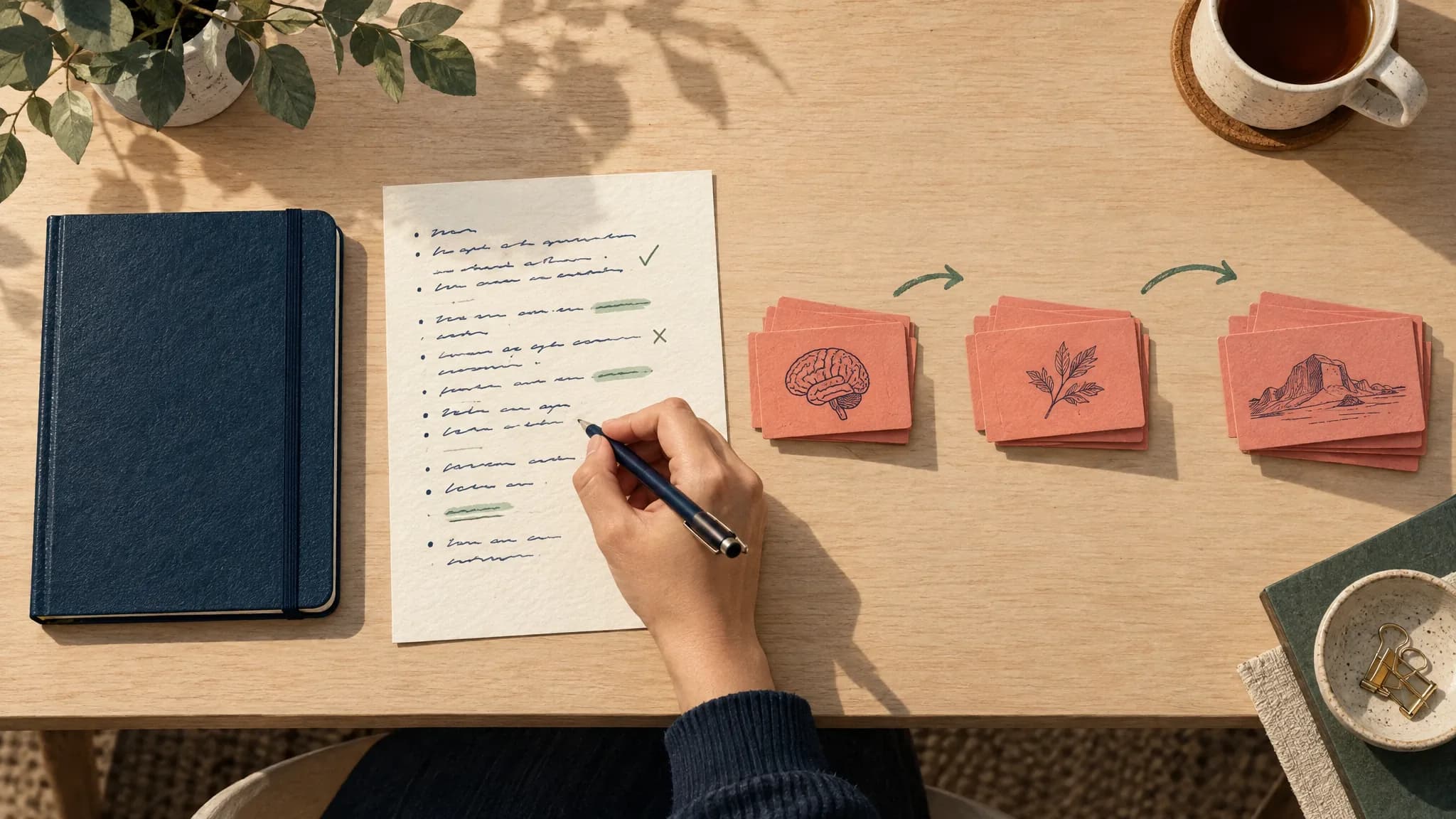
Open one blank page and write a line for every task due in the next fortnight, plus anything with a draft date inside it. For each line, record five things.
- The task and its subject. "Modern History investigation", not "the essay".
- Its marks. How many of that subject's 100 marks it carries (next section).
- Its stage. Not started, researching, outlined, drafted, revising, or ready to check. For a test or exam: not started, revised once, or practised on real questions.
- Its real deadline. The draft date for a written or practical task. A test or exam has no draft, so the day itself is the deadline.
- Its final due date. Both dates go into your phone calendar.
The dates come from your task sheets. Your school's assessment policy should also tell you when assessment is due (handbook section 8.4 lists that among the things a policy should tell students, as our late and non-submission guide explains), and if your school hands out an assessment planner or calendar, start there. If you cannot find a date, ask for it today.
Are all your assessments worth the same?
No, and the spread is wider than most students expect. In the structures behind the ISMGenius subject result calculator, which were read from the QCAA syllabuses, each school-set instrument in the General subjects it covers is worth between 10 and 35 marks of the 100-mark subject result. Here is the range, with a real task at each step:
- Biology IA1, data test10 marks
- Mathematical Methods IA2, short-response exam15 marks
- Biology IA2, student experiment20 marks
- English IA2, written response for a public audience25 marks
- Visual Art IA3, project (inquiry phase 3)30 marks
- Music IA3, project35 marks
Of the 138 school-set instruments in that data (46 subjects, three each), 68 are worth 25 marks and 39 are worth 20. The three Senior External Examination subjects in the data are examined by QCAA only, so they add none. Applied subjects and a small number of General Extension subjects are not in the data, so if you take one, read your syllabus.
Compare weights directly only inside one subject. Across subjects they are a rough guide, because each subject result is scaled separately for your ATAR (how the Queensland ATAR is calculated explains that step). The external exam is the other 25 or 50 marks, as how your QCAA subject result is built lays out. The calculator loads the real numbers for whichever subjects you add.
How do you prioritise assessment deadlines? Three rules
With the audit done, sort the list with three rules, applied in this order.
The nearest real deadline goes first
Sort by real deadline, not final due date. If two tasks are tied, the one at the earlier stage goes first, because it has further to travel.
The longest-lead task gets a small start now
Lead time is how long a task takes to do properly, and how much of that cannot be squeezed. Gathering evidence, building a draft and practising a skill are slow; tidying references and checking length are quick. If a heavy task is days away and nothing is started, give it one early block, even 45 minutes, to reach "outlined".
The heavier task wins the contested block
When two tasks want the same evening, the one with more marks gets the longer, fresher block. Weight also sets your polish budget: a 25-mark investigation earns a second revision pass that a 10-mark test does not.
A small case: a 25-mark draft is due in eight days and a 10-mark test is in three. Rule 1 puts the test first. Rule 2 gives the unstarted draft one early block tonight. Rule 3 gives it the long blocks once the test is over.
A worked 14-day example with four invented tasks
Sam's audit, on the first Monday (Day 1):
| Task (hypothetical) | Marks | Stage on Day 1 | Real deadline | Final due |
|---|---|---|---|---|
| Modern History investigation (IA2) | 25 | Notes and outline done, no prose | Draft, Day 5 (Fri) | Day 12 (Fri) |
| English written response (IA2) | 25 | Task sheet read, nothing planned | Draft, Day 8 (Mon) | Day 15 (Mon) |
| Mathematical Methods short-response exam (IA2) | 15 | Revision not started | The exam, Day 10 (Wed) | Same day |
| Biology data test (IA1) | 10 | Revision not started | The test, Day 9 (Tue) | Same day |
Sam's fixed commitments are a Saturday shift (Days 6 and 13), Tuesday training (Days 2 and 9), a family dinner on Day 14, and lights out by 10:30 on school nights. Sam has about 90 minutes on a normal school evening, an hour on training nights and after a shift, and a few hours on Sundays. Those are assumptions; yours will differ.
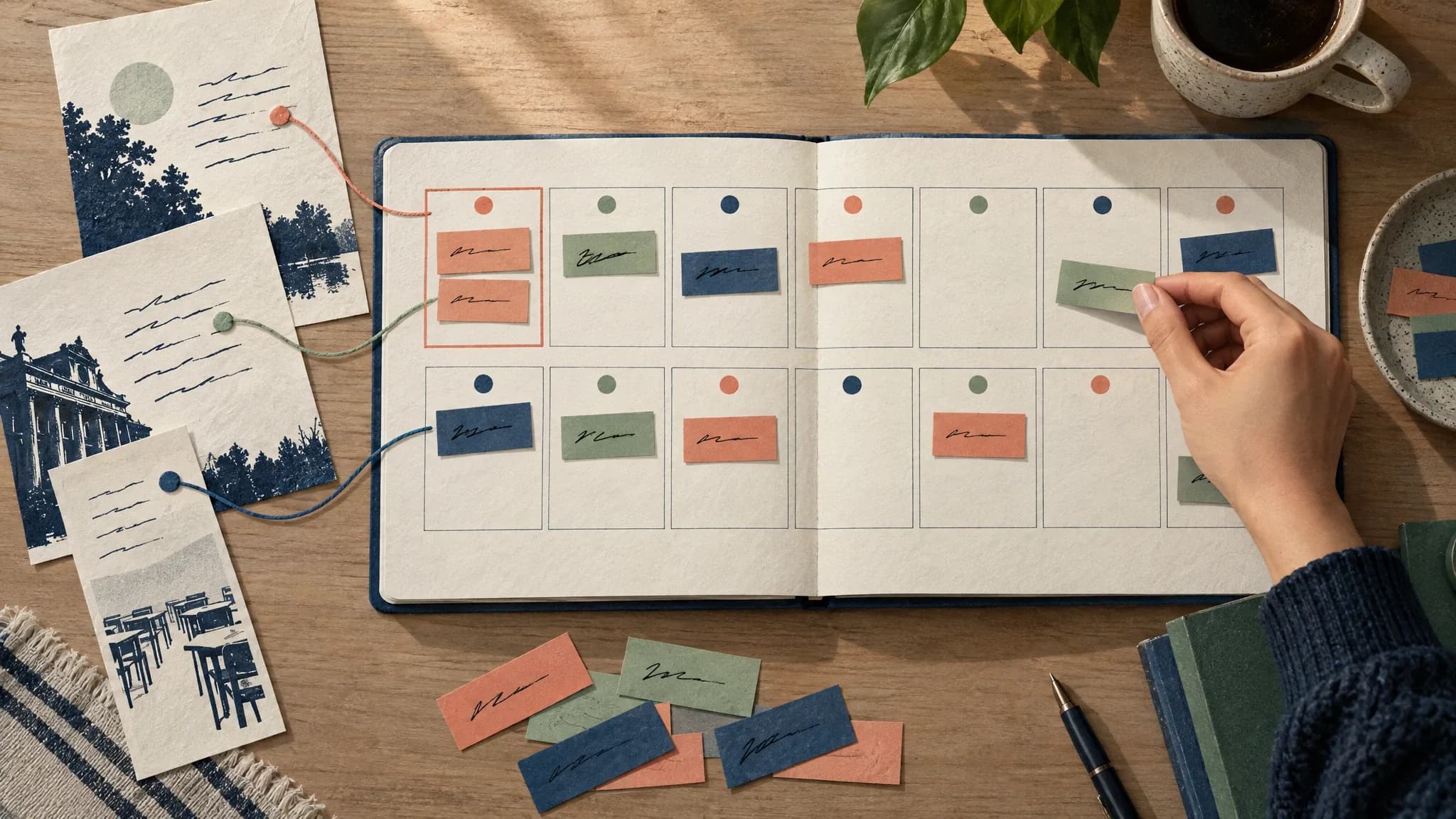
Sam builds the plan backwards from the right-hand side of the calendar. The fixed things go in first, then the two days that cannot move (Days 9 and 10), then the two draft dates and the days feedback might return. Sam does not know those, so asking is a Day 1 job; the plan assumes the History feedback returns on Day 8 and the English feedback on Day 11. Counting back from each draft date, the History draft has the earliest deadline and the most writing left, so it takes Days 1 to 4. Two blocks are left empty as buffer. Read forwards, the plan is:
- Day 1, Monday
Twenty minutes for the audit, the calendar entries and a message to each teacher asking when draft feedback comes back. Then the first History section, written from the outline.
- Days 2 to 4
Three weeknight blocks finish a complete rough History draft: a section for every criterion, reference details recorded as Sam goes, no polishing. Wednesday also holds a first 30-minute Biology block. The last half-hour of Thursday goes to a one-page English plan: audience, purpose, form, and the criterion each section serves.
- Day 5, Friday
Hand in the History draft and show the English teacher the plan. Evening off.
- Days 6 and 7
Saturday: shift, then a 45-minute block left empty as the week 1 buffer (if nothing slipped, it becomes Biology practice on real questions). Sunday: the complete rough English draft in two blocks, plus 45 minutes of Maths.
- Day 8, Monday
Hand in the English draft. In the evening, read the History feedback and sort the comments by criterion, then 45 minutes of Biology practice.
- Days 9 and 10
Biology test on Tuesday, training as normal, an hour of Maths practice. Maths exam on Wednesday. That evening stays light: one hour to pick the single biggest change the History feedback points to, and start it.
- Days 11 and 12
Thursday: finish the History change, then one batch of mechanical checks. Friday morning: submit History. The evening is off.
- Days 13 and 14
Saturday after the shift: read the English feedback and pick one big change. Sunday: make it, run the mechanical checks, read the piece aloud once, and keep the last 45 minutes empty. The family dinner stays. Day 15 is an upload, nothing more.
Two things stand out. Week 1 produces finished rough drafts, not perfect ones, because the drafts are the real deadlines. And the exams sit between the History feedback and the History final, which is why Sam needed the return date on Day 1.
Why your plan will run late, and what helps
Two findings from psychology shape this plan. Both are general findings about people and goals, not studies of Queensland senior assessment, so treat them as reasons to try a habit, not guarantees.
The planning fallacy: pad your estimates
In a 1994 paper, Roger Buehler, Dale Griffin and Michael Ross asked psychology students near the end of their honours thesis when they expected to finish. The 33 who had finished predicted 33.9 days on average, and the thesis took 55.5. Fewer than a third (29.7 per cent) finished in their best-estimate time, and fewer than half (48.7 per cent) by the date they gave for everything going as badly as possible. The paper's other studies found predictions too optimistic across a variety of academic and non-academic tasks. In one, students who were prompted to connect relevant past experiences with their forecast showed no average optimism, though their individual predictions were no more accurate, and students who only recalled past tasks stayed optimistic; that task was a short computer assignment, not a thesis.
The practical use is small. Before you size a block, write down how long the last similar task actually took and how this one could run just as long, and leave unassigned blocks, as Sam did on Days 6 and 14, so a slow evening has somewhere to land.
If-then plans: decide when and where to start
A 2006 meta-analysis by Peter Gollwitzer and Paschal Sheeran pooled 94 independent tests of "implementation intentions": plans that spell out the when, where and how of a goal in advance, in the form "if this situation arises, then I will do that". It found a positive effect of medium-to-large size (d = 0.65) on goal attainment, including on starting goal-directed action and shielding it from unwanted influences. That is an average across many studies, and an if-then plan does not create hours. It removes the decision about when to begin.
The papers: Buehler, Griffin and Ross (1994), "Exploring the 'planning fallacy': Why people underestimate their task completion times", Journal of Personality and Social Psychology, and Gollwitzer and Sheeran (2006), "Implementation intentions and goal achievement: A meta-analysis of effects and processes", Advances in Experimental Social Psychology.
Which commitments should you protect first?
Everything that cannot move goes into the calendar before any study block: exam and test days, shifts, training, family events and sleep. A plan built on hours you do not really have fails in week 1, and you conclude the method does not work when it was the arithmetic.
If your Year 12 externals are part of the pile, put them in first: the 2026 external assessment timetable lets you star your subjects and download your own dates as a calendar file. If a shift or a trip collides with a draft date, sort it out early. The late and non-submission guide explains why matters of your own choosing, such as a family trip, are not extension grounds.
When should you talk to your teacher, and what is worth asking?
Talk to them the day you finish the audit. A message with a week in hand is a planning question; the same message the night before a due date is a request for a favour.
Schools set due dates, so your teacher may not be able to move anything. The handbook's suggested content for a school assessment policy (section 8.4) does include processes for setting due dates that give students enough working time to complete the task, so it is fair to say, politely and specifically, that you cannot see how you will get that time across several tasks. The best questions are the answerable ones:
- When does feedback come back? Your backward plan needs that date more than any other.
- Is there a checkpoint before the draft? The handbook describes checkpoints such as "developing an outline or discussing their approach with the class teacher", so ask whether your task has one.
- Which criterion should my draft protect most? That is a question about the task, not a request for a mark; our feedback guide notes that asking for a mark is the one thing the Queensland wording rules out.
- Will you take the draft early? It can stop feedback for two subjects landing on the same afternoon.
Hi Ms Lee, my English draft is due next Monday, and in the same fortnight I also have a History draft and two tests. I will hand in a complete draft. Could you tell me when feedback usually comes back, so I can plan my revision week? And if you look at plans before the draft date for this task, could I show you my one-page plan on Friday? I am not asking to move any dates.
Why this works: it names the dates, says what you are doing, and asks two questions a teacher can answer in a sentence each. It asks for neither a mark nor an extension.
If something outside your control does happen, such as illness, that is a different process, so tell your school as soon as you can, because schools set their own application timelines. The late and non-submission guide sets out how extensions work, and the AARA guide covers the eligible and ineligible grounds. A crowded fortnight on its own is a planning problem, so plan as though no extension is coming.
What counts as "good enough" for a low-weight task?
Give a low-weight task a stop time, not a standard of perfection. Cut polish, never corners.
A corner you cannot cut
Skipping the reference list because the task is only worth 10 marks. Using a source you have not read. Handing in work in the wrong mode. Leaving a criterion with nothing on the page. Submitting nothing.
Polish you can cut
Stopping after one revision pass. Using the sources you already have instead of hunting for better ones. Leaving a sentence that is clear but not elegant. Skipping the third rewrite of the introduction.
A task is good enough when it meets this list:
- Every criterion in the ISMG has something visible on the page. Open the ISMG and tick each one.
- It is in the required mode and inside the length condition, counted the QCAA way.
- Every source you used is acknowledged, and every source you acknowledge is real. The referencing guide covers how.
- It is your own work, and any help you used is within what your school allows. Read the academic integrity guidelines before using any AI tool on assessment work.
- It is handed in on time, as the right file, in the right place.
Anything beyond that list is polish, bought with spare time only. For a short test, set the target in questions (one timed set per topic) rather than hours of rereading.
How do you batch the checks and book feedback early?
Some work needs your best thinking: argument, analysis, structure. Some needs only attention: the mechanical checks. Keep them in separate blocks, and run the mechanical ones in one sitting per task, after the last structural change:
- Referencing: every in-text acknowledgement has an entry, every entry is used, the style is consistent. See the referencing guide.
- Length: counted against the task sheet's condition using the word count rules.
- Format and submission: headings, file name and type, correct place, receipt kept.
The last evening of each task has its own rules, and the night-before submission checklist covers them.
Book feedback early too: ask for return dates on Day 1, hand drafts in complete rather than polished, and when comments arrive, use the annotated draft feedback walkthrough to turn them into a short list of changes. If you want a read on a draft before it goes to your teacher, ISMGenius reads it against your task's own ISMG and shows where each criterion sits and what the next band up asks for. It is an informed estimate to guide your revision, not your official grade, and it does not write the work for you.
How do you keep sleep and stress under control?
Treat sleep as a fixed commitment, not a buffer you can borrow from. In Sam's plan, lights-out is the first thing placed in the calendar. What tired attention does to proofreading is set out in the night-before checklist. Build in an evening off each week, and set a finish time on every block.
A busy fortnight feels like stress, but stress can become bigger than a busy fortnight: you cannot sleep, you cannot start, or you feel unwell most days. Talk to a school counsellor or guidance officer if your school has one, or to your GP. Kids Helpline (kidshelpline.com.au, 1800 55 1800) says it is there 24/7 to talk about anything on your mind. Our guide to exam anxiety and Year 12 stress in Queensland goes further, and the AARA guide explains that mental health conditions are among the barriers the process covers.
Recommended reading
- What to do after a low mark: diagnose the lost marks and plan a specific change for your next task.
- Working through annotated draft feedback: prioritise the comments that matter most before the next deadline.