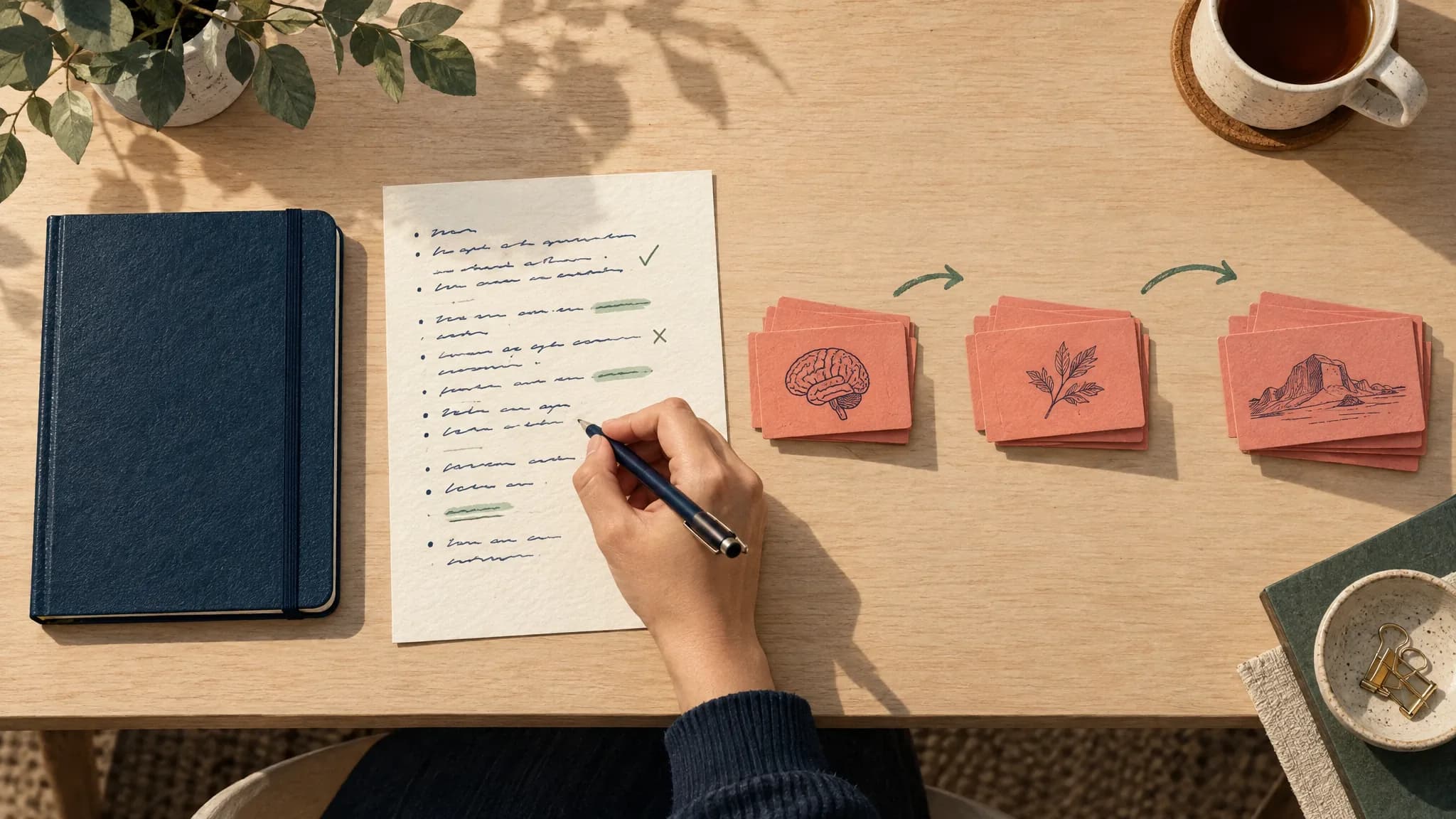
Some nerves before a Year 12 exam are normal, and a racing heart does not mean you are about to do badly. Stress is worth taking seriously when it lasts, spills into your sleep, eating, friendships or study, or makes you want to avoid the exam altogether. A few habits have some research behind them, though the effects are small and not always repeated, and a school counsellor, a GP or a free phone line can help with the rest.
This page separates normal exam stress from stress that is getting in the way, then covers six habits with research behind them (and the honest limits of that research), what to do if you panic mid-paper, what does not help, and who to talk to. It is not medical advice or a diagnosis, and it cannot promise you a calm exam. For the study side, start with the week-by-week plan for external exam preparation; this page is about the nerves.
Is this normal exam stress, or is it getting in the way?
headspace lists a racing heart, faster breathing, shaking, sweating, dizziness and “butterflies” among the physical signs of anxiety. They are also what a body does when it is getting ready for something that matters, so feeling them before an exam is not a fault in you.
The useful question is what the anxiety is doing. Kids Helpline describes normal anxiety as temporary, something that may “come and go” and mostly does not interfere with your everyday life. It says anxiety might be a problem for you if it lasts a long time, feels very intense or overwhelming, or interferes with your everyday life, for example when you avoid seeing friends because you feel anxious. headspace says that if changes in sleep, mood, motivation or energy have been happening for a few weeks or more and are starting to have a bigger impact on relationships, work or study, you might be heading towards what it calls the “difficulties” area of its mental health spectrum, and that it helps to look after yourself and enlist the support of family and friends. Only a GP, psychologist, psychiatrist or other medical professional can diagnose an anxiety disorder, so nothing on this page (or any online quiz) can tell you which side you are on. What you can do is notice the pattern.
Normal exam stress
Nerves build before a paper and ease once you start or once it is over. You sleep badly some nights but mostly sleep. You can still eat, see people and get some study done, even if it feels harder than usual. A good day follows a bad one.
Stress that is getting in the way
It stays for weeks and does not ease after a practice paper or a finished exam. Sleep has changed a lot, too little or too much. You cannot concentrate even on easy tasks, you are avoiding study, school, friends or the exam, or you feel overwhelmed most days.
These two descriptions are a rough guide, not a test, and there is no number of weeks you have to wait. If it already feels like too much, talk to someone now.
Signs of burnout in Year 12
Burnout describes what long overload feels like, and we cannot diagnose it. Beyond Blue defines it as feeling emotionally, physically and mentally exhausted from excessive demands (its page is written for work). A Finnish study of 658 ninth graders measured school burnout as exhaustion at school, cynicism (roughly, “what is the point?”) and feelings of inadequacy. headspace adds that if someone cannot concentrate, is sleeping too much or too little, or feels overwhelmed, stress may have become a problem. The list below adapts Beyond Blue's list of burnout signs and that school research to Year 12; it is a guide, not a test.
- You feel exhausted or drained, and your usual energy or motivation has gone.
- Subjects you used to care about now feel pointless, or you feel inadequate however much you do.
- Your sleep has changed, or you are getting headaches or body aches that arrive with the workload.
- You are more irritable than usual, putting things off in a way that is new for you, or pulling back from friends and family.
One or two of these in a hard fortnight is a hard fortnight. A cluster that sticks around is a reason to talk to someone, and the people to start with are listed below.
Six habits with some evidence behind them
Much of the research below was done on adults or university students, most effects are small, and some have not held up when repeated. None of it is a cure or replaces talking to someone. The limits sit beside each habit so you can decide how much weight to give it.
“…we urge caution … to avoid a miscalibration between hype and evidence.”
Treat the nerves as energy, not a warning
What to do. When your heart speeds up, tell yourself something like “this is my body getting ready to perform” and mean it, in the weeks before as well as at the door. Size the paper correctly too: in most General subjects the external exam is a quarter of your subject result and in the maths and sciences it is half, so one paper is never your whole result (how your QCAA subject result is built has the split).
The evidence. A small 2010 study recruited 60 students preparing for the GRE (a graduate admissions test); the 28 who sat the real test in the following three months were analysed. Those told that arousal can help performance outscored a control group on the maths section, in a practice test and in the real GRE one to three months later. There was no difference on the verbal section. A 2012 laboratory study of 49 adults (average age about 22) under a stressful speech-and-arithmetic task found more efficient cardiovascular responses in those taught the same idea than in two control groups. In a 2016 classroom study, 93 community college developmental maths students (average age about 29) taught to reappraise stress improved more from one maths exam to the next than a placebo group told to ignore stress.
The limits. A 2024 meta-analysis of 35 randomised studies (5,638 people, average age about 23, none from a clinical population) found a small average improvement in task performance. It shrank when the authors adjusted for studies that might be missing, and they wrote that more evidence is needed to confirm a true effect. A 2026 replication of the 2016 classroom approach across 12 university science courses at seven institutions found it did not change test anxiety or marks. None of the studies described here involved Australian school students or QCAA exams, and the research is no reason to tell yourself you should feel fine when you do not.
Practise under conditions that feel like the real thing
What to do. Sit full past papers by hand, to full time, at your exam's time of day, phone out of reach, planning window included, and mark them against the guide. A paper you have sat three times is not a stranger on the day. The guide to active recall and spaced practice covers how to make the content stick.
The evidence. In three laboratory experiments, pressure hurt performance on maths problems only when they were unpractised and heavy on working memory. Problems practised until the answers could be retrieved directly (50 times each in one experiment) held up. A meta-analysis of 238 studies linked test anxiety with lower results, and linked tests seen as difficult and high-stakes with higher test anxiety.
The limits. Those were adults doing arithmetic-style problems, and the meta-analysis shows association, not cause. We did not find a study of full mock papers and anxiety in Year 12 students. The closest we found is a self-report survey of 1,408 US middle and high school students, 72% of whom said classroom retrieval practice (practising recalling what they had learnt) made them less nervous for unit tests and exams. That is about recall practice, not full papers, and it shows how students felt, not how they scored. So treat “it will feel familiar” as sound reasoning rather than a tested result. If a full paper makes you panic, start with one section under time.
Slow your breathing
What to do. Practise for a few minutes when you are calm, such as before bed, so the skill is there when you are not. Kids Helpline's version is to breathe naturally, evenly and at a speed that feels comfortable, sending the breath down towards your belly, for five slow, even breaths. It warns that very deep breaths can make you hyperventilate. Some people like a slightly longer breath out, such as four counts in and six out; that is our example, not something taken from the studies below. If it feels forced, or you feel lightheaded or tense, go back to even, natural breathing. If breathing exercises make you feel worse, or you have a breathing condition, stop and check with your GP.
The evidence. A meta-analysis of 12 randomised trials with 785 adults linked breathing exercises with a small-to-medium drop in self-reported stress. A 2018 systematic review of 15 studies of healthy people linked slow breathing (under ten breaths a minute) with more relaxation and fewer symptoms of arousal and anxiety.
The limits. Most trials in the meta-analysis were at moderate risk of bias, and its authors urge caution about hype. The review found no randomised or longitudinal designs and called its evidence “interesting albeit limited”. The closest study to Year 12 we found was a five-week pilot with 43 US 12th graders: anxiety scores did not change significantly and fewer students did the exercises as the weeks went on. A pilot built to test whether something is workable proves nothing either way. Think of slow breathing as something to do while your mind races, not a treatment.
Protect sleep and move your body
What to do. Australian health guidance for 14 to 17 year olds, as summarised by Healthy WA, is 8 to 10 hours of uninterrupted sleep a night and at least 60 minutes of moderate to vigorous activity a day. In the exam block, hold a steady bedtime and wake time and fit in a walk or run. The night-before checklist explains what a tired brain loses first, and planning clashing deadlines helps you spot a pile-up before sleep is what gets cut.
The evidence. In a diary study of 535 US high school students, those who gave up sleep to study more than usual had more trouble understanding class material, and more trouble with an assignment or test, the next day. An umbrella review of 97 reviews found physical activity had medium average effects on anxiety symptoms in adults, compared with usual care.
The limits. The diary study shows an association, not proof of cause. The exercise review covered adults (18 and over), including people with diagnosed conditions, and measured symptom scales, not exam marks; most of the 97 reviews were rated critically low in quality. Neither shows that one bad night will wreck a paper.
Try a short writing exercise, but do not rely on it
What to do. Before you leave for the exam (not in the exam room), spend about ten minutes (our suggestion) writing freely about how you feel and what you are afraid might happen. Stop if it winds you up.
The evidence. Ramirez and Beilock (2011), in Science, reported two laboratory and two randomised field experiments in which writing about the upcoming test, immediately before it, improved exam scores, especially for habitually test-anxious students.
The limits. This is the weakest-supported habit here, and replication has been mixed. In a 2021 study across four real exams in a university psychology class, expressive writing did not reduce test anxiety or improve exam performance. O'Meara and Lovett's 2026 meta-analysis, “Single-session expressive writing interventions for test anxiety” (Anxiety, Stress, & Coping, online September 2025 and in the January 2026 issue), pooled 21 studies with 1,457 participants. It found only a negligible effect on anxiety. A very small gain in test performance stopped being statistically significant once one extreme result was removed. The authors concluded that the research literature fails to support single sessions of expressive writing as a treatment for test anxiety, and that other treatments have more supportive evidence. Try writing if you like it; skip it if you do not.
Give worry a time slot
What to do. Pick a fixed slot in the early evening, for example 15 to 30 minutes, a few hours before bed. When a worry turns up at another time, jot two or three words on a list and tell yourself it waits for the slot. In the slot, write one next step beside each worry that has one, and “nothing I can do” beside the rest. The slot length and the next-step part are our suggestions.
The evidence. The technique is called worry postponement. A 2023 meta-analysis (in print 2024) pooled 7 randomised trials with 999 participants, from primary-school children to adults and mostly students, and found small reductions in how long and how often people worried compared with people who only recorded their worries. The techniques were practised for between a week and a month.
The limits. The effects were small, worry was self-reported, none of the studies followed people up afterwards, and none measured exam stress or exam marks. For people diagnosed with generalised anxiety disorder the results are mixed: a 2024 trial paper notes an earlier study of patients with that diagnosis that found no effect, then reports its own therapist-delivered version lowering worry in 47 adults with that diagnosis compared with a waitlist. It is cheap to try for a week. If worry will not wait for its slot and keeps taking over your evenings, talk to someone rather than trying harder.
A calm exam-day routine
The aim on the day is fewer decisions, not a perfect mindset. For the reading and planning time at the start of each paper, see the external exam preparation plan rather than working it out in the room.
- The night before
Stop at a sensible hour and keep the evening ordinary. The case for stopping and sleeping in the night-before checklist carries over from assignments to exams.
- The morning
Keep your usual routine, including your normal breakfast (headspace's advice). Check what you are permitted to bring, and go to the toilet before the paper starts (Kids Helpline's advice).
- Before you go in
Arrive in good time, do two or three minutes of slow breathing, say your “getting ready” line, and do the writing exercise now if you use it. If conversations outside the room wind you up, step away.
- In the room
Kids Helpline suggests reading the paper carefully, underlining key words and instructions, working out how long you have for each section, and starting with the questions you find easiest, because you do not have to go in order. That is general advice. The exam preparation plan says the planning window at the start of a QCAA paper is for reading and thinking, not writing, so save the underlining for when writing time begins, and follow your supervisor's instructions.
- When you walk out
The mark is fixed, so line up something unrelated to the exam before the next one. The exam preparation plan makes the same case: reconstructing the paper with friends is unreliable, and the main thing it changes is your confidence going into the next exam.
What should I do if I panic during an exam?
Panic mid-paper can feel like a blank mind, a pounding heart, a tight chest or shaky hands. Kids Helpline explains anxiety through the fight, flight or freeze response and notes that once you are safe and calm, your brain returns to normal. headspace says panic attacks can feel overwhelming but are usually short (about 10 minutes) and do pass. Nobody can promise it will stop on cue, but these moves give you something to do while it passes. They are practical suggestions, not research findings, and the breathing, re-reading and easiest-first moves follow Kids Helpline's exam advice.
- Put your pen down and plant your feet. Both feet flat on the floor and your hands flat on the desk gives your body something solid to notice.
- Slow your breathing. Breathe evenly and comfortably, at a speed that feels natural. Some people like a slightly longer breath out. Do not force big gulps of air.
- Name it. Tell yourself something like, “this is my alarm system, and it passes.”
- Go to what you can do. Re-read the question, underline the key words and instructions, then move to the easiest question. You do not have to answer in order.
- Get something on the page. Write anything you know about the question, such as a formula, a definition or a heading, to get moving again.
- If it does not settle, put your hand up. Tell the supervisor how you are feeling. What they can do inside the room is set by the exam rules, so we cannot list it for you.
Afterwards, tell your school the same day, whether or not you finished. The illness and misadventure article says to tell your school's external assessment coordinator, and explains that an application can cover students who begin an exam and are forced to abandon it, or who finish but consider their performance was significantly and adversely affected. If panic like this happens outside exams too, or you are scared of the next one, see a GP or talk to Kids Helpline.
What does not help
- Demanding that you feel calm. Wanting to feel calm is understandable, but in Brooks's 2014 studies of karaoke singing, public speaking and maths, people who reappraised their anxiety as excitement (for example by saying “I am excited” out loud) performed better than people who tried to calm down. That compared two strategies, in adults, and has the limits described under the first habit, so it is a reason to have a plan for the nerves, not proof that calming techniques fail.
- Trading sleep for study. The diary study above found the opposite of what students hoped: less sleep, more trouble the next day.
- Going quiet about it. Kids Helpline says talking with someone can really help when you are anxious or stressed, and its homepage describes the service as there to chat about anything on your mind.
- Measuring yourself against everyone else's study hours. A 17-year-old member of headspace's Youth National Reference Group, quoted in a 2022 headspace media release, said it is important to “run your own race” at exam time and look after yourself.
- Waiting for one trick to fix it. The research behind each habit above shows small or mixed effects. Use what suits you, and move on to a person if it is not enough.
Who to talk to, and what to say
The sooner you ask, the more options you have. The 2026 external assessment block runs from 26 October to 17 November (the timetable article has every subject), so a conversation this week beats one in the middle of it.
Your school. Queensland state schools have guidance officers, specialist teachers who give advice and counselling on personal, family, mental health and wellbeing issues, alongside other wellbeing staff such as psychologists and social workers. You arrange a meeting through the school. At a non-state school, ask your year coordinator or the front office who the counsellor or wellbeing contact is. You do not need a speech. This is enough: “I have not been sleeping properly for a few weeks, I cannot concentrate, and I am dreading the exams. I want help working out what to do.”
A GP. According to healthdirect, a doctor who helps with mental health should be able to assess you, provide support and treatment, organise ongoing care and refer you to other mental health professionals. It often takes more than one visit, it helps to book a long appointment, and you can ask to bring a family member or friend. Ask what the options are and what they cost.
headspace and the phone lines. headspace supports young people aged 12 to 25, and its website lists centres in over 150 communities across Australia. The numbers for the phone lines are in the box near the top of this page.
Formal adjustments
If anxiety or another health condition is affecting how you can sit the exams, there is a formal route: access arrangements and reasonable adjustments, and for something that happens around the exam itself, illness and misadventure. Your school lodges these for you, with evidence and deadlines. The AARA and illness and misadventure guide covers who approves what and when. As of early October 2026, it lists several of the deadlines for the external assessments as already passed, and explains that a missed date means the QCAA cannot guarantee an application is processed in time, not that the door is closed. Eligibility depends on how a condition affects you in a timed assessment, and approval is not automatic, so raise it with your school this week.
For parents: helping without adding pressure
- Ask what would help, then listen before you offer a fix. Kids Helpline notes that exams are something your child has to do on their own, but you can support them.
- Protect the basics: sleep, regular meals, movement and a good balance between study and the rest of life, as Kids Helpline and headspace both suggest.
- Keep expectations realistic and avoid pushing too hard. headspace suggests reassuring your child that their worth does not depend on their results.
- After each exam, listen to their concerns and avoid criticising them, as Kids Helpline advises.
- Watch for a cluster that lasts: changed sleep or appetite, irritability, losing touch with friends, trouble concentrating. If it persists, or exam stress seems to be paralysing them, Kids Helpline suggests seeking help through your local doctor or the school counsellor.
- Look after yourself too. eheadspace takes calls and webchats from family and friends worried about a young person aged 12 to 25.
The parent's guide to QCAA senior assessment explains how Queensland's senior system works and how much help is appropriate at the kitchen table.
Sources and how we checked
Service details were read on each service's own website on 2 October 2026, and we read the abstract or full text of each study at the link beside it. The guidance attributed to headspace, Kids Helpline, Beyond Blue, Education Queensland and healthdirect comes from: headspace on exams, headspace on anxiety, headspace on mental health difficulties, headspace on the 2025 eheadspace changes, headspace on school stress, Kids Helpline on exam stress, Kids Helpline on helping with exam stress, Kids Helpline on coping strategies, Kids Helpline on the anxious brain, Kids Helpline on anxiety, Beyond Blue on burnout, Education Queensland on student support and healthdirect on talking to a GP. If something here does not match what a doctor or counsellor tells you about your own situation, trust them over this page.