Study for a QCAA maths exam by solving problems, not rereading solutions: learn each topic from worked examples, attempt problems cold, mix topics in the same practice set so you have to choose the method, and log every mistake by type so next week's drill targets the errors you actually make.
This guide is for Year 12 students in General Mathematics, Mathematical Methods and Specialist Mathematics. It covers why maths revision differs from revising a content subject, what the research on mixed practice and worked examples found and where it stops, how to run an error log, how to pace a paper, and a three-week drill. Retrieval and spacing in general are in active recall and spaced practice for QCAA exams. This page is about revising a method rather than a fact.
Why is revising maths different from revising a content subject?
In a content subject you can revise by writing a fact or an argument out from memory. Maths adds three problems.
- You can recognise a solution you could not produce. Each line of a worked solution follows from the one above, so reading one feels like understanding. The IES practice guide on study techniques calls this the "illusion of knowing": learners tend to overestimate what they have mastered when they finish studying.
- Choosing the method is half the problem. A textbook exercise heading names the method before you read the question. An exam question rarely does. Researchers describe nearly every problem as two steps, choosing a strategy and carrying it out, and note that students often find the choosing harder.
- Much of the answer is a written chain, not a number. Where a question asks you to show working, your paper is marked by someone reading the page you hand in, so the reasoning has to be on it.
The exam deserves a method. The figures below come from the QCAA timetable as of October 2026 and the subject structure (how your subject result is built). Planning time is for reading and thinking, not writing. Dates are in our 2026 external assessment guide.
What is mixed (interleaved) practice, and does it work?
Blocked practice is a set of questions that all use the method from the lesson you have just had. Mixed practice, which researchers call interleaved practice, shuffles topics so you decide the method every time. In the wording of the 2020 trial below, an interleaved assignment is arranged so that "no 2 consecutive problems require the same strategy".
Blocked set
Ten questions, all on one technique (say, the product rule). After a few you can stop reading and start copying the pattern. You never practised choosing the method.
Mixed set
Ten questions from ten topics, no two neighbours alike. Every question starts with the job you face in the exam: read it, decide which method it needs, then use it.
| Study | What was done | Result | Limits |
|---|---|---|---|
| Rohrer and Taylor (2007) | College students learned to find volumes of unusual solids, practising blocked by type or randomly mixed. | Mixed was substantially better on a test one week later. | A laboratory study, one family of problems. |
| Rohrer, Dedrick and Stershic (2015) | 126 seventh-graders at one Florida school, the same problems on graphing lines and slope, blocked or interleaved over three months. | Interleaved scored 80% against 64% a day later, and 74% against 42% after 30 days. | One school, two skills. Test problems matched the practice format. |
| Rohrer, Dedrick, Hartwig and Cheung (2020) | 54 seventh-grade classes in Florida (787 students), randomly assigned, about four months. | Interleaved scored 61% against 38% on an unannounced test a month later. | Young students, a few problem types. The authors say important caveats remain. |
| Brunmair and Richter (2019), accepted manuscript | Meta-analysis of 59 studies of interleaved against blocked learning, across many materials. | Moderate overall. Small for maths tasks (g = 0.34). Blocking won for words. | Maths results were mixed, some showing no effect or a blocking advantage. |
Read the table for what it leaves out. The three maths studies come from one research group, and none of the three used senior secondary students, Australian courses or QCAA papers. The 2015 authors say it is unknown whether the effect holds with more material, teachers and students, and that interleaving also spaces practice, so the effect probably reflects spacing too. The meta-analysis authors say its small average for maths does not mean interleaving is ineffective there: effects varied widely between studies and depended on how it was implemented, how learning was measured and what the material was. Mixed practice is a reasonable bet, not a guarantee.
Three things follow for your revision.
- Start a topic with a short block, then mix. The 2015 authors say a small block of problems may be best right after students are introduced to a kind of problem, and the 2020 authors list too little early blocked practice as a possible weakness of interleaving. Neither says to avoid blocks entirely.
- Put look-alikes side by side. Across all the materials in the meta-analysis, mixing helped more when the categories being mixed were similar to one another (the paper is titled "Similarity matters"); it did not test that for maths alone. Illustrative pairs: simple or compound interest and a linear or an exponential model in General Mathematics, product rule or chain rule in Mathematical Methods. In Specialist Mathematics, list the techniques in your own course that you confuse under time pressure. Take every pair from the Unit 3 and Unit 4 subject matter in your syllabus.
- Check your textbook. A 2020 count of six US seventh-grade textbook series found every one heavily blocked, with more than eight blocked problems for each interleaved one on average. Yours may differ. If last week's exercise used one method throughout, build mixed sets yourself.
How do you build a mixed set from material you already have?
A mixed set is a rearrangement of questions you already have: past papers, textbook chapter reviews, returned school exams.
- Pull one question from each of eight to ten topics, and cover the exercise headings so "Exercise 6C" cannot give the method away.
- Order the questions so no two neighbours share a topic, with at least one look-alike pair side by side.
- Before you calculate, write the method and why it fits: "Chain rule, because the function sits inside another function." If you cannot write that line, you have found a gap before the exam did.
- Check against the solutions and log every miss (see the error log below).
How do worked examples fit in, and when do you stop using them?
A worked example is a complete solution with the reasoning shown. Sweller and Cooper's 1985 paper from the University of New South Wales reported five experiments on algebra. In the four worked-example experiments, which used Year 8 and Year 9 students from Sydney high schools, studying worked examples took considerably less time than solving problems, later problems of the same structure were solved faster, and students made fewer errors. The catch: the gains were specific to problems identical in structure to the examples, which is one reason (our inference) to pair worked examples with mixed practice.
A 2023 meta-analysis of 55 studies found a medium average benefit of worked examples on maths performance (g = 0.48), from primary school to university, and found that correct examples alone did better than incorrect ones. That finding is about the examples students study, not their own errors, so our reading is to take your models from correct solutions (your teacher's, your textbook's, a published QCAA marking guide) and use your own mistakes for diagnosis. The IES practice guide rates alternating worked solutions with problems you solve yourself as moderate evidence, below its top grade. It also describes fading: giving the early steps and requiring more of the later steps as expertise grows. Kalyuga, Ayres, Chandler and Sweller (2003) call the underlying pattern the expertise reversal effect: examples help most when a topic is new, and once you are fluent, solving problems does more.
One topic climbs a four-rung ladder, and you climb only as far as you need.
Study one worked example
Pick a topic you cannot yet do. Reveal a solution one line at a time, saying what the next line will be and why before each reveal. Then cover it and rewrite it from memory.
Finish a half-solved problem
Take a similar question with the first lines written and finish it. Next time give yourself only the first line, then only the question. This is the fading step.
Solve a similar problem cold
No notes, no solution open. If you stall, go back one rung, not to the start of the chapter.
Move the topic into mixed sets
As a rule of thumb (ours, not from a study), once you have got it right cold on two different days, it stops having its own block and appears one question at a time in every mixed set.
Why should you attempt problems cold before checking the solution?
"Cold" means closed book, a full written solution, and no peeking at the answer. The IES guide reports that learners judged their own mastery accurately when they did so after a delay and without the answer in front of them (the studies asked them to judge whether they could answer a question or term, not to write a full solution), but too optimistically straight after studying. It rates this as low evidence, because the studies were mostly laboratory work with college students and children on material such as vocabulary, so treat it as sensible rather than proven for maths. The wider case for retrieval is in the retrieval and spacing guide.
- Set a time limit from the marks (see the pacing section below).
- Write the full solution on paper, as you would in the exam, not in your head.
- If you stall, write down the exact line where you stopped before you look at anything. That line goes in your log.
- Check against the solution and give yourself only what you can point to on your own page. If you needed the first line as a hint, log it as a worked example, not a cold attempt.
- Redo any miss, cold, on a later day, in a different version of the same type.
How do you keep an error log that changes what you practise?
An error log is one row for every question you got wrong, abandoned or finished only with a hint. It works only if it records why you lost the marks, because "be more careful" and "learn the content" need different fixes. Sort each miss into one of five categories.
Concept
You did not know what an idea means or when it applies. Example: simple interest used on a balance that grows on its own interest.
Weekly drill: back to the first rung of the ladder for that topic, then two similar questions inside your next mixed set.
Procedure
You knew the idea but ran the steps in the wrong order or left one out. Example: differentiating the outer function and forgetting the inner derivative.
Weekly drill: write the steps in your own words, do three or four questions back to back, then return the topic to the mix.
Algebra or arithmetic slip
Right method, wrong line: a dropped minus sign, a copying error, rounding too early.
Weekly drill: not more content. One operation per line, substitute back or estimate to check, and tally the slip type so the pattern shows.
Misread question
You solved a different question: the wrong quantity, a missed "exact", no units, one part undone.
Weekly drill: underline the command word and the quantity asked for before you start, and reread the question after your last line. The cognitive verbs list has the official definitions.
Technology
The method was right and the tool let you down: the wrong mode, a mistyped number, a graph window that hid the answer. What you may use is set by your subject, so check your teacher and the QCAA exam instructions.
Weekly drill: practise the exact key sequences you are permitted to use, cold and against the clock.
Keep the log to a table you can fill in within a minute. These rows are made-up examples.
| Day | Source | Topic | Category | What went wrong | Fix | Redone cold |
|---|---|---|---|---|---|---|
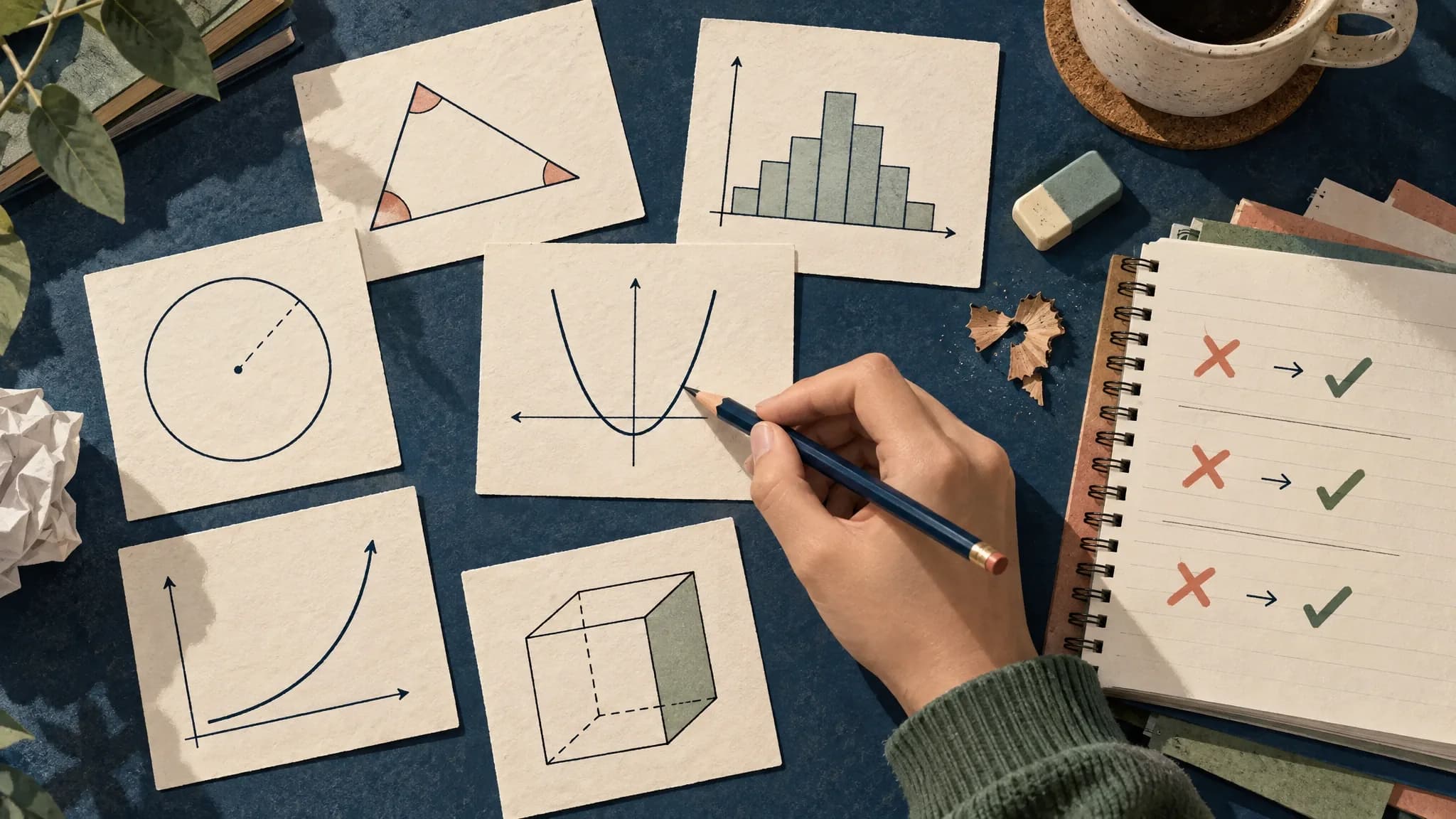
| 2 | Past paper, Q4 | Compound interest | Concept | Used simple interest on a growing balance | Wrote the difference in my own words, then two more questions | Day 4 wrong, Day 9 right |
The log earns its keep in the weekly drill.
- Tally the week by category and by topic, then pick the top two categories or the top topic. Fixing everything at once fixes nothing.
- Write a ten-question drill. Four questions are logged misses, redone cold in a fresh version of the same type. Six are new questions from other topics, shuffled in.
- Do it cold, mark it, log it. Retire a logged item only after you have got it right cold on two different days (a rule of thumb of ours, not a tested rule).
Be clear about the evidence. This guide does not cite a trial of an error log as a package. Its parts have support: the IES guide recommends closed-book quizzes with feedback that identifies incorrect answers, to show students what they have not yet mastered, and rates that as low evidence because the studies used college students and text or vocabulary. Treat the log as a sensible routine, and drop any part that stops paying for its time.
How do you pace a 90-minute paper by marks per minute?
A past paper shows how many marks each question carries and the total for the paper. Marks per minute is the paper total divided by 90, and minutes per mark is 90 divided by the paper total. That number is how long a question may cost before it starts costing you marks elsewhere. The total differs by subject and paper, so read it off the latest QCAA past paper for your subject, not from a website, this one included.
- Use the planning window for the paper's shape. You may not write during the 5 minutes, so skim every question and decide which you will do first and which you will leave.
- Practise against the budget. In timed work, write the actual minutes beside each question's budget. A question that cost double its budget goes in your log even if you got it right, because the cost is the error.
- Rehearse the day you will actually have. As of October 2026, the QCAA timetable has General and Specialist Mathematics sitting Paper 1 in the afternoon of one day and Paper 2 the next morning, and Mathematical Methods sitting both papers on one day. If you sit Methods, rehearse both papers in a single day at least once, with the equipment your exam instructions allow.
How do you practise showing your reasoning so your working can earn marks?
Whether a partly correct solution earns anything is set out in each QCAA marking guide, and we have not quoted those rules here. What you control is whether your reasoning is on the page where a marker can find it. Read two or three published marking guides question by question, note which lines they credit, and ask your teacher about the rest. The question below is made up for this guide and is not a QCAA question.
A laptop bought for $2400 loses 15% of its value each year. Find its value after 5 years, to the nearest dollar.
Each year the laptop keeps 85% of its value, so its value is multiplied by 0.85 every year. After 5 years: V = 2400 × 0.855 = 1064.89… ≈ $1065. The laptop is worth about $1065 after 5 years.
Why this is worth practising: the marked sentence is the reasoning. It says why the calculation is a multiplication by 0.85, so a reader who never saw the question could follow it. The last sentence puts the answer back in context with its unit. Whether a line like this earns credit is a question for the marking guide, not for us.
- Name the method before you substitute, then take one step per line, each following from the one above. Write "so" and "therefore" only where they are true.
- Put the reason in words when the verb asks for it. Our verbs list defines "calculate" as "determine a numerical value or quantity through mathematical operations" and "justify" as "show or prove something to be right, reasonable or valid". By those definitions a justify question wants the reason on the page, not just a number. The cognitive verbs guide goes further.
- End with a sentence that answers the question in its own context, with units where the question has them.
- Write one question a session in full exam standard. Swap it with a friend and ask only: could you follow this without the question in front of you? Self-marking against the guide is covered in QCAA external exam preparation.
What does a three-week drill pattern look like?
Count back from your first maths paper. If it is further away, treat this as the final three weeks and spend the earlier time on the ladder for your weakest topics. If it is closer, keep the mixed sets and the log and drop worked-example sessions for topics you can already do cold. The sessions are a sample, so scale them to your timetable.
- Week 1: build and start the log
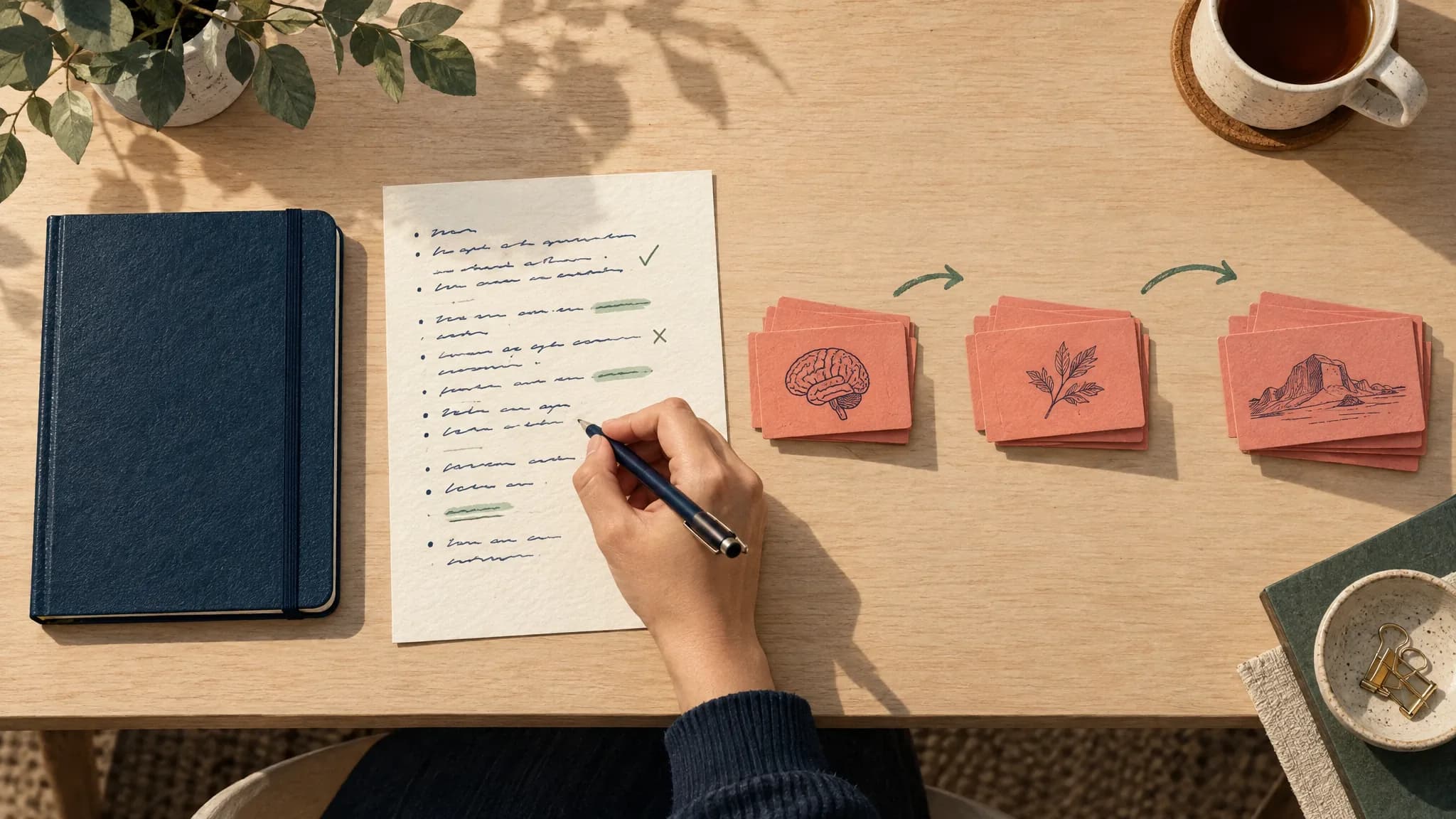
Two sessions on the ladder for your weakest topics, picked with the tick, question mark and cross checklist from our exam preparation plan. Two mixed sets, done cold with the method named first. Log every miss, then tally the log and pick your top two categories.
- Week 2: mix more and start the clock
Run the first weekly drill from the log. Time the mixed sets against your minutes-per-mark budget. Redo the Week 1 log items cold in fresh versions. Finish with one full past paper to time, marked against the published guide, with every miss logged.
- Week 3: rehearse and repair
Run the second weekly drill and sit the other paper to time. If you sit Methods, do both papers in one day once. Tally the log a final time, and spend the last two days on the oldest unresolved items and one light mixed set, with no new topics.
Every topic should come back at least once a week inside a mixed set, which interleaving does for you. Spacing helps maths in its own right: in two experiments with 216 college students in all, splitting 10 practice problems across two sessions a week apart nearly doubled four-week test scores (though not one-week scores) compared with doing all 10 at once, while doing 9 problems in a sitting instead of 3 made no difference. It was one procedure and university students, so the guide to retrieval and spacing covers how long the gaps should be.