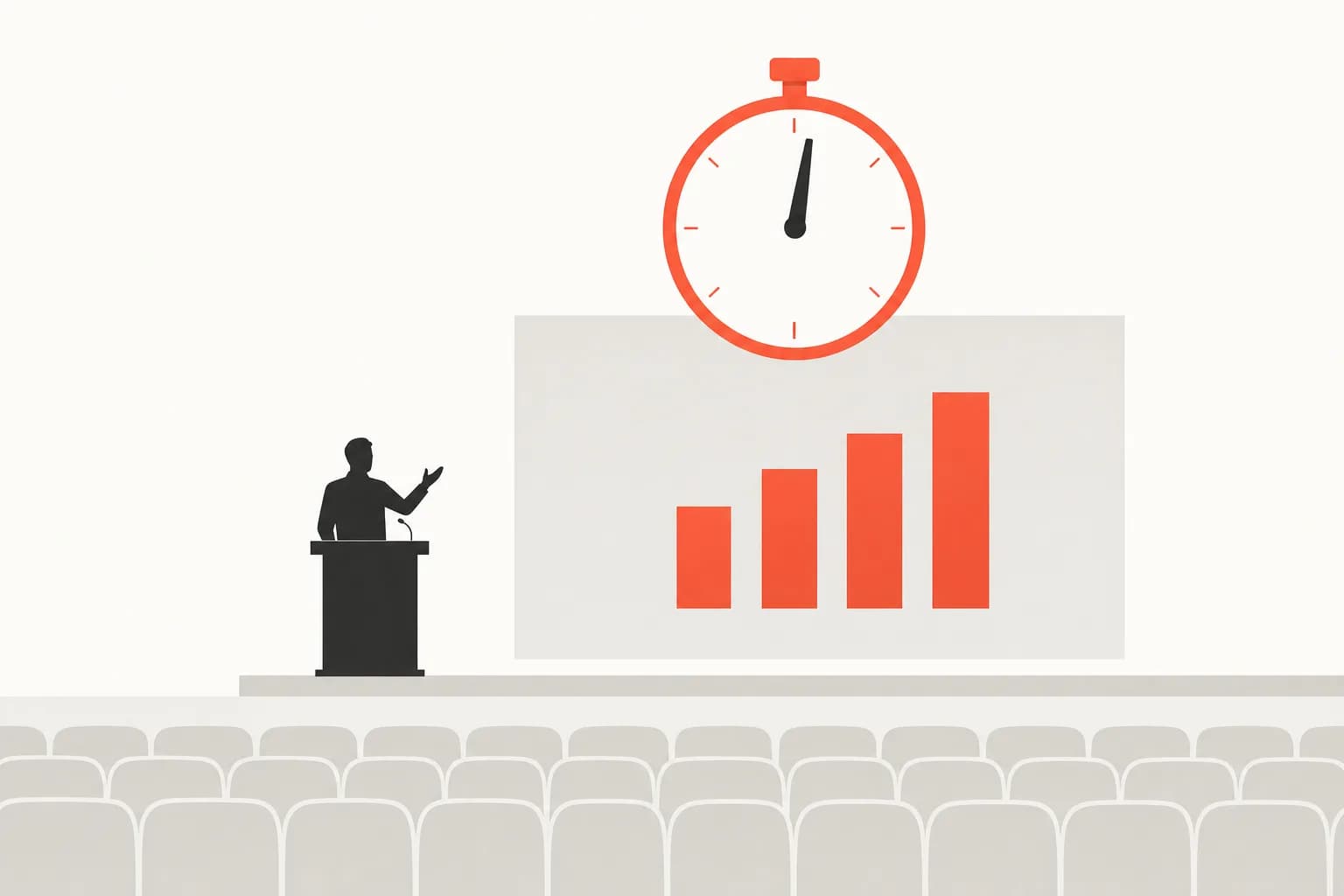
A written assignment tells you its limit in words. A spoken or multimodal task tells you its limit in minutes, and most students read that as a softer rule — a guideline, a rough target, something a sympathetic teacher waves through at eight minutes and forty seconds. It is not softer. It is the same rule with a stopwatch attached, and the way schools are required to handle an over-length response makes going over more expensive here than almost anywhere else in senior assessment.
There is no penalty. That is the part worth understanding properly. Your school cannot dock you two marks for running long, cannot grant you a ten per cent tolerance, and cannot change the ISMG to accommodate you. What it does instead is mark your response up to the point where it reaches the required length and exclude everything after that point as evidence. Nothing is deducted. The last ninety seconds simply never happened.
What "multimodal" actually means
The word gets used loosely in classrooms to mean "a talk with slides". The QCAA's definition in the senior syllabus glossaries is narrower, and the narrow part is what separates a response that meets the conditions from one that does not:
Three conditions are doing work in that sentence. At least two modes — the recognised modes are written, spoken or signed, nonverbal such as gesture and facial expression, visual, and audio. Delivered at the same time — a video you play, then stop, then discuss is a sequence, not an integration. And each mode contributes significantly, which is the one that catches people.
A slide carrying your spoken sentence in bullet form is not a second mode contributing significantly. It is your first mode, transcribed. The visual mode earns its place when it carries something your voice cannot: the graph you are interpreting, the still you are analysing, the map of the site, the annotated frame. If a marker could close their eyes and lose nothing, the response is a spoken task wearing slides.
What the clock includes
Section 8 of the QCE and QCIA policy and procedures handbook sets out exactly what counts inside the duration of a non-written response, and it is more than the time you spend talking.
Inside the clock
Any item that forms part of the response and was chosen by you for inclusion — including introductory slides, and excerpts such as video or music. Any required referencing of texts or citations you chose to include, for example as a note on a slide.
Outside the clock
Extraneous recording before the response begins: setting up microphones, waiting for an audience to settle, talking about the set-up. The exclusions that apply to written responses — reference lists, title pages, appendixes — do not carry over, because they are not relevant to a timed response.
Read the inclusions again with a real response in mind. The title slide you leave up for eight seconds while you settle: inside. The forty-second video clip you embedded: inside, all forty seconds, even though you are silent through it. The citation you flash on screen because your teacher asked for referencing: inside. A student who plans a "six-minute" response as six minutes of talking, then adds a title slide, a clip and a reference slide, has built a response closer to seven and a half.
Video and audio excerpts are where this bites hardest, because they feel like free time. They are the most expensive seconds in the response — you are spending your duration and demonstrating nothing of your own while it plays. A clip earns its place only when what you say over it or immediately after it is stronger for having shown it.
What happens if you run over
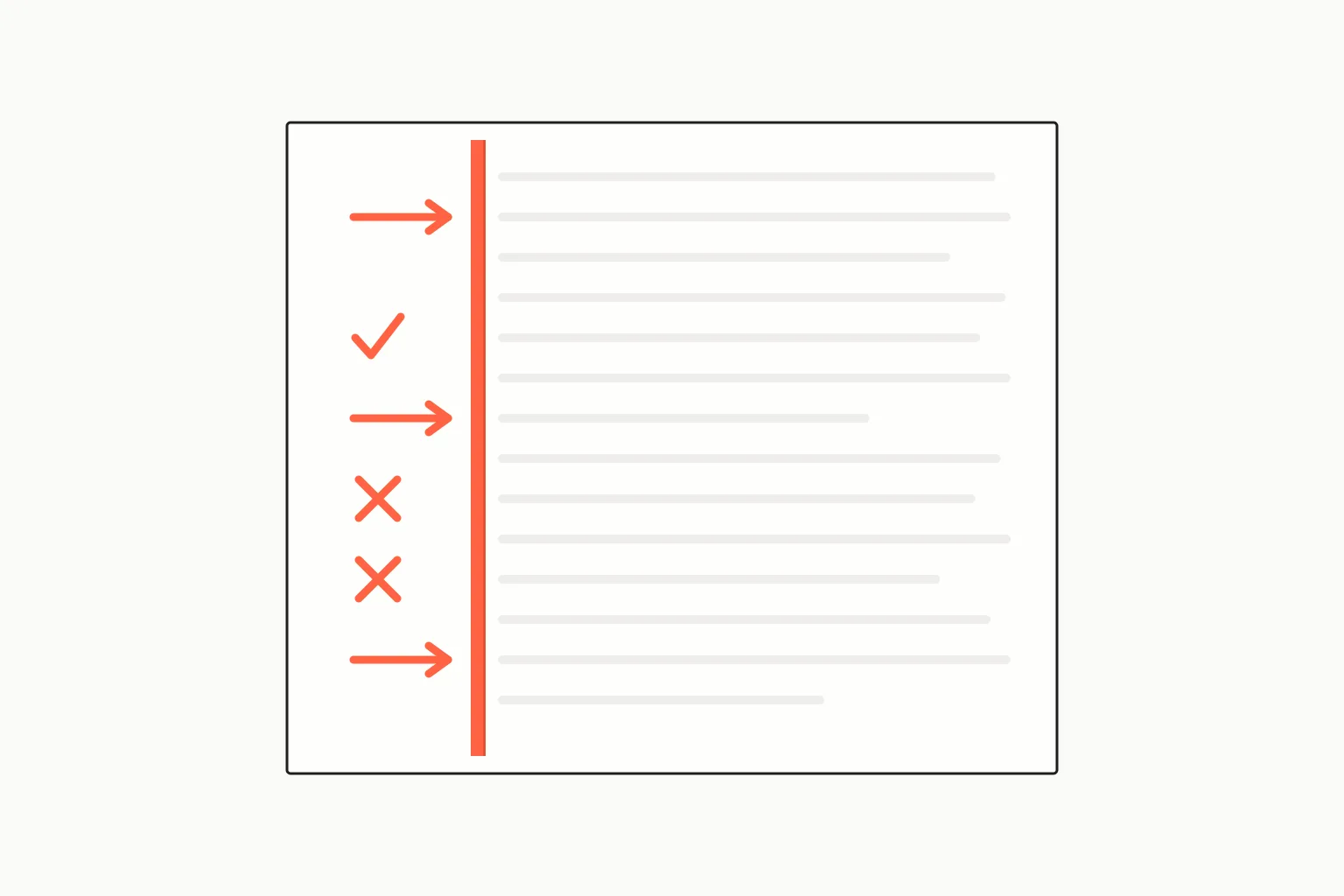
Schools are required to have a policy for marking responses that exceed the required length, and the handbook constrains what that policy may contain. The available strategy for a timed response is to mark from the beginning up to the point where the response meets the required length, and to exclude the evidence after that point.
The other strategy in the handbook — letting a student redact their own response to length before a judgement is made — is explicitly ruled out for a continuous response such as a presentation or a recording. Teachers are not permitted to redact your work for you either. For written assignments, the redaction route is a genuine second chance; for a spoken or multimodal task, there is no second chance available. Whatever you deliver is cut at the limit.
When part of a response is not used, the teacher annotates the response or the ISMG to record which evidence the judgement was made on. That annotation travels. If your sample is selected for confirmation, the QCAA confirmers review only the evidence your teacher marked, so the excluded material is invisible at every level after the room you delivered it in.
The back-loading trap
Being cut at the limit would matter less if presentations were uniform. They are not. Almost every student builds the same shape: context and description early, judgement and evaluation late. The cognitive verbs that carry the top band — evaluate, justify, synthesise — sit in the final ninety seconds, after the groundwork is laid. That is a sound rhetorical instinct and a costly assessment habit, because the material at risk of being cut is the material the highest performance levels describe.
Last 90 seconds, as usually built
"So overall, as you can see, the data does support my hypothesis, and this suggests that the model is reliable in most conditions, and therefore my recommendation would be that the council adopts the second option, thank you for listening."
Last 90 seconds, protected
Evaluation already made at the four-minute mark, with the limitation named and weighed. The closing seconds restate the judgement and its strongest ground. If the response were cut here, the marker has still seen you evaluate.
The defensive move is to stop treating your evaluation as a conclusion. Make the judgement early enough that it is safely inside the limit, then use the ending to consolidate rather than to reveal. It reads better anyway: a response that states its position at the four-minute mark and defends it has more argumentative spine than one that withholds until the end.
How long is mine, exactly
There is no single QCAA duration for spoken or multimodal responses. Syllabuses express response length either as a range — for example 5–8 minutes — or as a maximum, and the figure differs by subject, by learning area, and between General and Applied subjects. Your task sheet is the authority, and it must match the condition in your syllabus.
General English gives a useful worked example. Its extended persuasive spoken response is set at 5–8 minutes and carries 25 per cent of the subject result. The condition includes two notes students often miss: while the task is spoken, you may use multimodal or digital components to support the development of the response, and the response may be delivered live or pre-recorded. If that is your task, the guide to the English persuasive speech goes through its criteria and structure in detail.
Turning a script into a duration
Most students write a script, then discover its length by delivering it. Working the other way is faster. A clear, unhurried delivery runs at roughly 130 to 150 words a minute; nerves push people faster on the day, which trims a little but costs clarity. A 6-minute response is therefore somewhere near 800 to 900 spoken words — before you subtract the seconds your visuals, clips and citations consume.
If you want that converted for a specific limit rather than estimated, the persuasive speech guide has a speech length planner that turns a duration into a word target.
Build the budget before the script. For a 6-minute multimodal, a workable allocation looks like this:
- Opening and position30 sec
- Context and stimulus60 sec
- Analysis, with visuals150 sec
- Evaluation and judgement90 sec
- Close30 sec
Then write to each block and time each block separately. A section that runs forty seconds long is easy to find and fix; a response that runs ninety seconds long as a whole is not, and students who discover the overrun the night before tend to fix it by speaking faster, which is the one repair that costs marks in the communication criterion without saving much time.
If you are choosing between cutting and compressing, cut. Removing a whole example is cleaner than shaving three words from every sentence, and the same principle applies here as in a written draft — the guide to what counts inside a QCAA response length covers the written side of the same rule.
The one draft you get, and the mode it has to be in
This is the requirement most spoken and multimodal students never hear stated plainly. Teachers provide feedback on one complete or near-complete draft, and the handbook is specific about its form: the draft must be in the mode required by the syllabus.
For an essay, that is a document. For a spoken task, it is not a script emailed on Sunday night. The handbook's own example is a student practising the presentation of a spoken task in class and receiving feedback on the draft in the mode of the response. A written script handed to your teacher is not a draft of a spoken response — it is a draft of a written one, and feedback on it cannot reach the things the ISMG actually assesses in your delivery.
Which means the single most valuable hour in the whole task is the one where you stand up in front of your teacher and deliver it badly, early, with the slides running and a timer going. That hour is where you find out that slide four is unreadable from the back, that the clip is thirty seconds longer than you remembered, and that you finish at seven minutes twelve.
Two weeks out
Time budget written, visuals chosen for what they carry rather than what they decorate. Any clip or excerpt timed to the second and added to the budget.
One week out
Full run-through, in mode, timed from the first slide. This is the draft. It should be complete or near complete, because you only get feedback on one.
After feedback
Cut to bring the total inside the limit with fifteen seconds of headroom. Move any evaluation that sits in the last minute forward.
Two days out
Two timed run-throughs on the real equipment, in the real room if you can get it. Record one and watch it back.
The general rules about drafting apply here as they do to written work — one complete draft, feedback that is consultative rather than a marking process — and the piece on why drafts matter before submission covers what teachers can and cannot tell you at that point.
Before you deliver
- Time a full run from the first slide appearing, not from your first word.
- Add the running time of every clip, excerpt and animation to your total.
- Finish fifteen to twenty seconds inside the upper limit — a live delivery runs longer than a rehearsal.
- Check that your judgement or evaluation is complete before the final minute.
- Confirm every slide carries something your words do not.
- Put required citations on screen early, where their seconds are already budgeted.
- Test the file, the room and the audio on the equipment you will actually use.
- Have a plan for the technology failing that does not cost you your opening minute.
The rules on this page come from Section 8 of the QCAA's QCE and QCIA policy and procedures handbook, in particular Section 8.2 on integrating learning and assessment, together with the senior syllabus glossary definition of multimodal and the QCAA's published assessment techniques and conditions for the English learning area, used under a Creative Commons BY 4.0 licence. Durations and conditions differ by subject and are revised between syllabus versions; your task sheet and your current syllabus are the authority for your own task.
Recommended
- what counts inside a QCAA word count, and what does not
- the English persuasive speech, criterion by criterion
- what QCAA cognitive verbs like evaluate and justify are asking for
- how to read an ISMG and find the marks you are leaving behind
- why drafts matter before submission
- the IA timeline, from task sheet to submission