You upload a rubric and a draft. What comes back is a mark on each criterion, the evidence behind it, and what to fix. This article is about the part in between: what ISMGenius actually does with your work, where a real marker's judgement still differs, and the one design decision that matters most. The estimate is split between a language model and plain, testable code, and the model is not the part that chooses your number. Showing that working is the point. A feedback tool that hides how it reaches a mark is asking for trust it has not earned.
What happens to your draft
The flow is deliberately short. There is no rubric database and no bank of pre-marked exemplars your work is compared against.
Your ISMG is read as-is
The rubric you upload is sent to the AI as the actual document, not retyped or looked up. It reads your task's own marking guide.
The criteria are pulled out
The AI identifies each criterion by its exact title, its band labels ordered highest to lowest, and the assessable elements inside it.
Your work is matched, evidence first
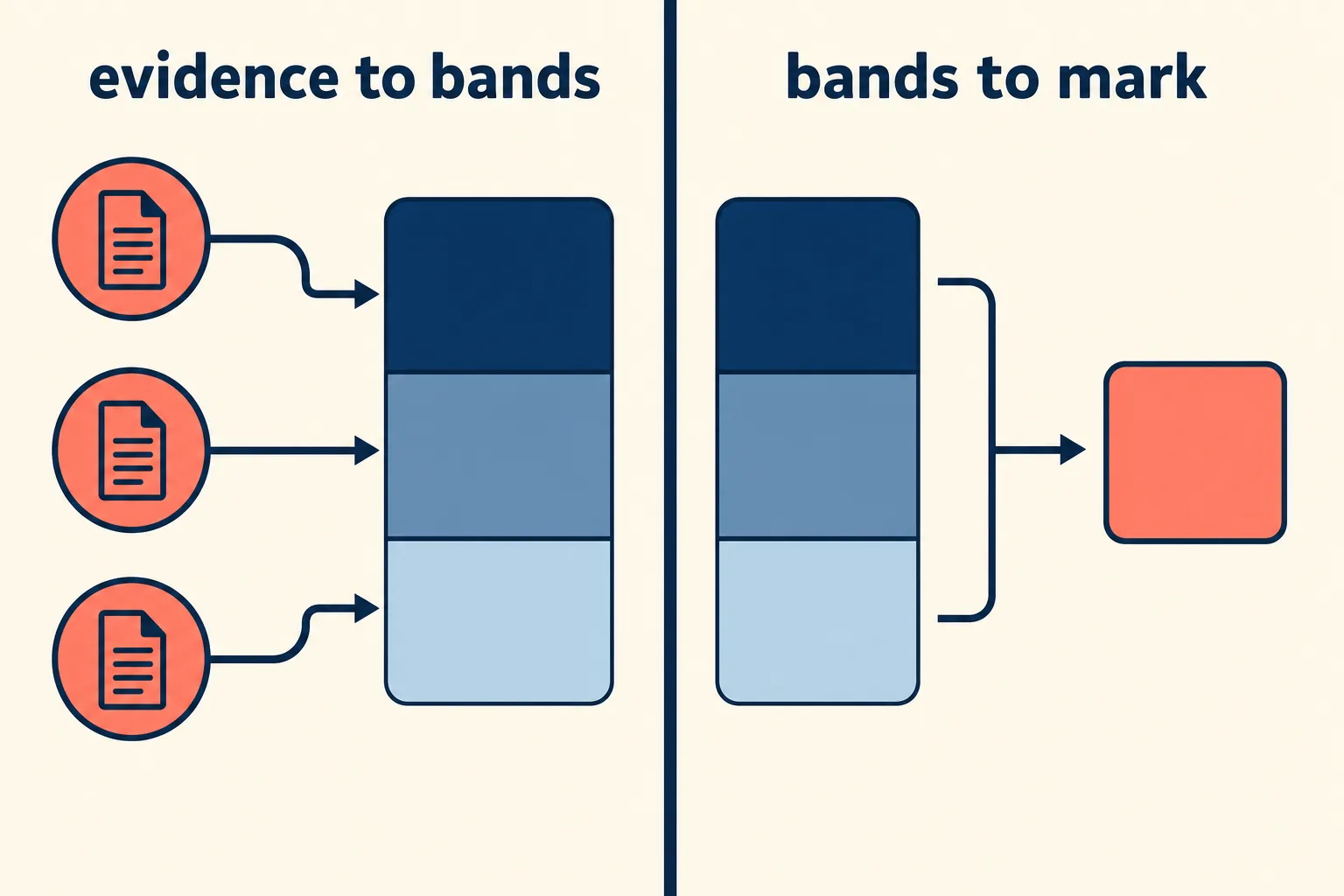
For each element the AI records the evidence in your draft, then places it at the highest band whose wording your work clearly satisfies. It is required to name the evidence before it names a band.
The mark is computed, not guessed
Plain code, not the AI, turns those band placements into the criterion mark and the overall total.
That last step is the one worth dwelling on, because it is where most people assume the AI is doing something it is not.
The AI finds the evidence, code decides the number
QCAA marking is best fit by the spread of descriptors, never an arithmetic average. ISMGenius is built the same way, and it enforces that split in a specific place.
The AI's job
Read the descriptors. Find evidence in your draft. Decide which band each element's evidence sits in. This is judgement about language, which is what a language model is for.
The code's job
Take those placements and apply the QCAA best-fit rule to produce the mark: award the band the placements are dominant in, ties fall to the lower band, and the overall total is the sum of the criteria.
This matters because a model asked to output a number directly can contradict itself, placing work in the "2–3" band and then writing "5" beside it. In ISMGenius the number is derived from the band, in code, so that contradiction cannot reach you. The internal comment on that code is blunt: structured output "guarantees syntactically correct JSON, not semantically correct marking", and the deterministic layer exists to enforce the marking rule. The AI decides where the evidence sits. The code decides what that means as a number.
What you get back per criterion
For every criterion the report shows four things, in this order: the evidence from your own draft, the descriptor wording it matched, the band that evidence reaches, and what would lift it. The order is deliberate, evidence first and judgement second, so the mark is always anchored to something you actually wrote.
If you already sit in the top band of a criterion, it says so and leaves the "to improve" space empty rather than inventing a flaw. That honesty runs the other way too: when your draft improves between versions, the next report credits only the improvements the new text actually earns, and names what is still missing.
What it will not do
The limits are not fine print. They are the reason the feedback is safe to act on.
- It will not mark work it cannot mark. If the rubric is unreadable or does not match the assignment, it returns no criteria and says why, rather than inventing a report. The screen reads "We couldn't mark this submission".
- It will not fake a result when something fails. If the AI call fails, the job is marked failed, not filled with a fabricated placeholder mark.
- It will not write your assignment. It reviews work you have already written; it does not produce work for you to submit.
- It will not replace your teacher. The result is an informed estimate to guide revision, not your official grade. Every assessment decision is made by your school and teachers.
That last point is the honest core of it. A real marker applies an on-balance judgement across your whole response, and can weigh things a tool reading one draft cannot. ISMGenius is built to get you close and to show its reasoning, so you can act before the marker sees the work, not to stand in for the marker.
What happens to your work
Two things are worth stating plainly, because they are decisions in the code rather than promises in a policy. When your draft is sent to the AI provider, it is sent with retention switched off, because student work must not be kept as the provider's own data. And when a document is longer than the analysis limit, the AI is told exactly where it was cut, so it never marks a truncated draft down for "missing" a section that was simply beyond the cut-off.
Key takeaways
The design that makes the estimate trustworthy is the split between what the AI decides and what the code decides, and the limits it refuses to cross.
| Point | Details |
|---|---|
| It reads your actual ISMG | No rubric database or exemplar bank; your task's own marking guide is read directly. |
| Evidence comes before the band | The AI records evidence from your draft, then places each element at the band its evidence reaches. |
| Code computes the mark | Deterministic code applies the QCAA best-fit rule, so a band and its number can never contradict each other. |
| It refuses rather than fakes | Unmarkable rubrics return a reason, not a report; failed jobs fail rather than fabricate a mark. |
| It is an estimate, not a grade | The output guides your revision before submission; your teacher's confirmed mark is the official one. |
Why we show the working
The temptation with a marking tool is to present the number and hide the machinery, because a confident number feels more impressive than an explained one. I think that is exactly backwards for something a student is meant to trust with their assessment.
A mark you cannot interrogate is a mark you cannot learn from. If the tool cannot show you the evidence it read and the rule it applied, you have no way to tell a good estimate from a lucky one, and no way to argue with it when it is wrong. So the report leads with evidence, the code that turns bands into numbers is testable rather than hidden inside the model, and the limits are stated up front.
None of that makes the estimate perfect. It makes it honest, and honest is the version you can actually use.
See your own report with ISMGenius
The clearest way to understand any of this is to run a draft through it and read the report against your own writing. ISMGenius analyses your assignment against your task's ISMG criteria and shows you exactly where to improve before you submit, and it never writes the assignment for you.
You can generate a feedback report on a draft, read how the ISMG rubric works, understand the ISMG the same way it does, and read how it treats academic integrity and AI.