PSMT planner andself-check
General Mathematics, Mathematical Methods and Specialist Mathematics · IA1
Plan your problem-solving and modelling task stage by stage, then check the draft against every top-band descriptor in the ISMG before you hand it in.
9-page PDF · 599 KB. Needs a free ISMGenius account, with nothing to pay. Already have one? Sign in
Every page has a job
An A4 PDF that prints cleanly in black and white, or fills in on a tablet. Here is what each part does.
The marks map
Where the 20 marks sit, the response conditions, and your task details in one place.
Work-back timeline
Every stage from the task sheet to submission, with a log for your three hours of class time.
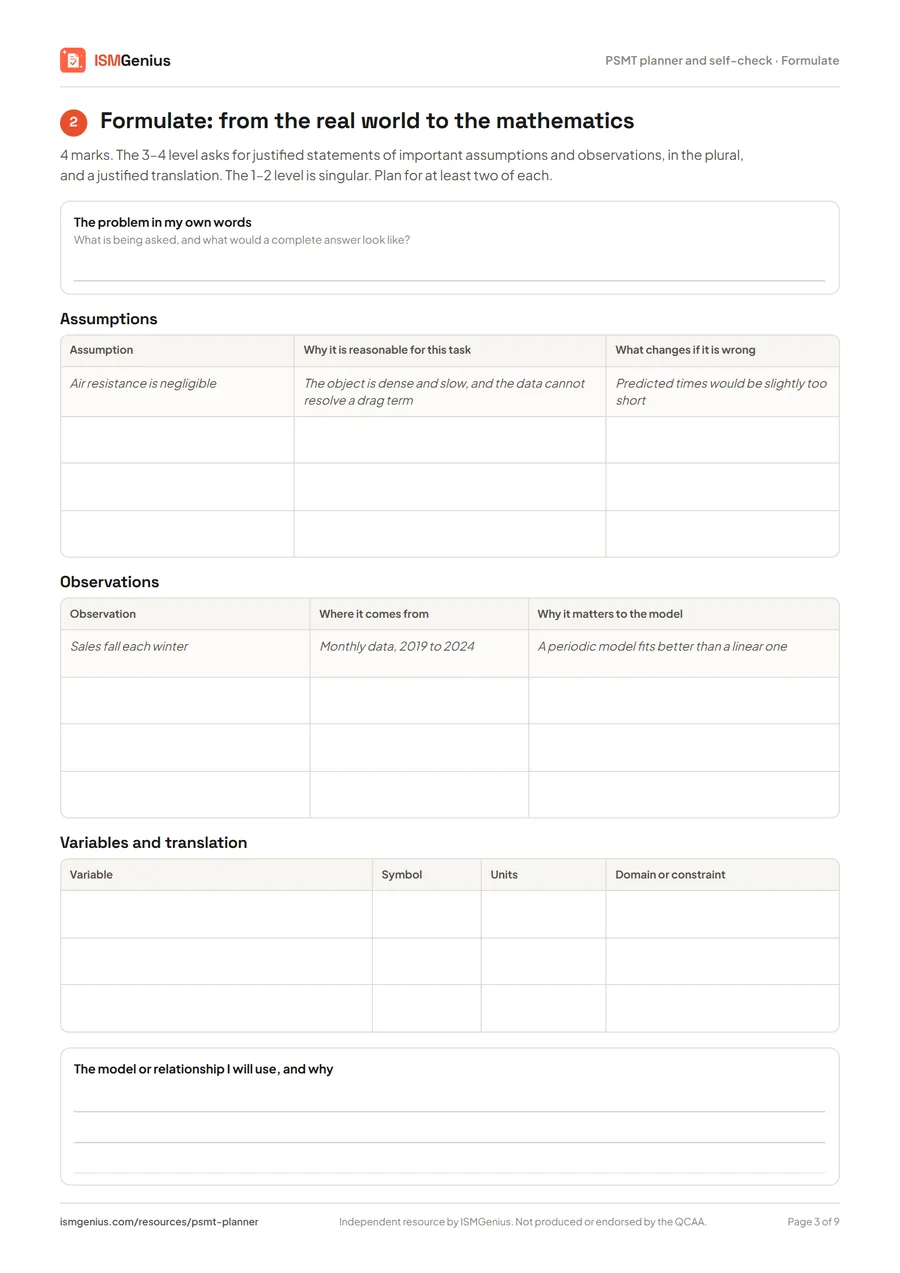
Formulate worksheet
Assumptions and observations with room to justify each one, and your variables and translation.
Solve worksheet
Your method step by step, and a technology log that gives the sentence your report needs.
Evaluate worksheet
Verification, reasonableness against each assumption and observation, strengths and limitations.
Communicate and structure
A report outline with a word budget, and a language check a marker would run.
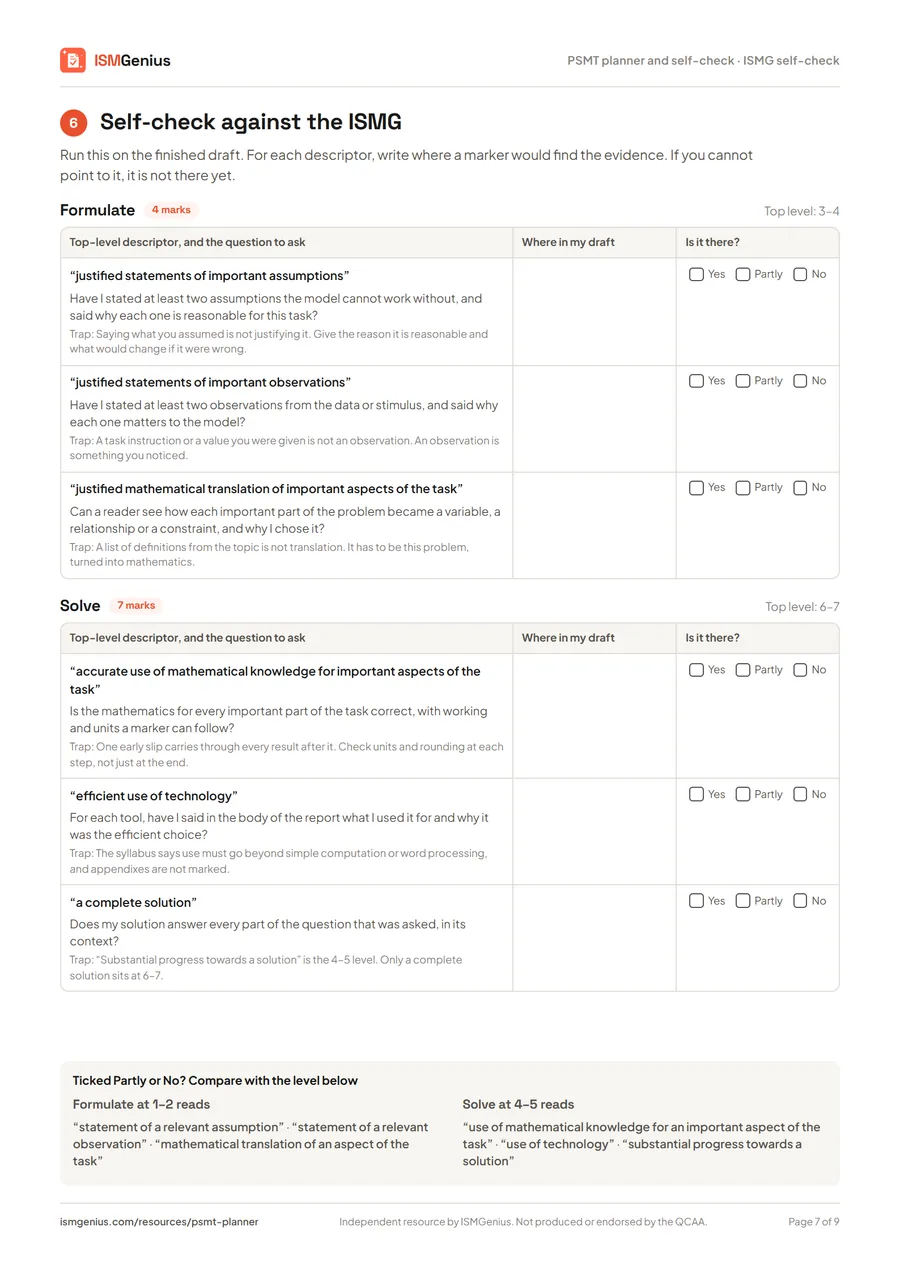
ISMG self-check
All 14 top-band descriptors, quoted from the syllabus, with where your draft shows each one.
Before you submit
Length, appendixes, technology evidence and the last checks, plus how best fit decides your mark.
A look inside
3 of the 9 pages, as they print, and part of the content below.
From page 1
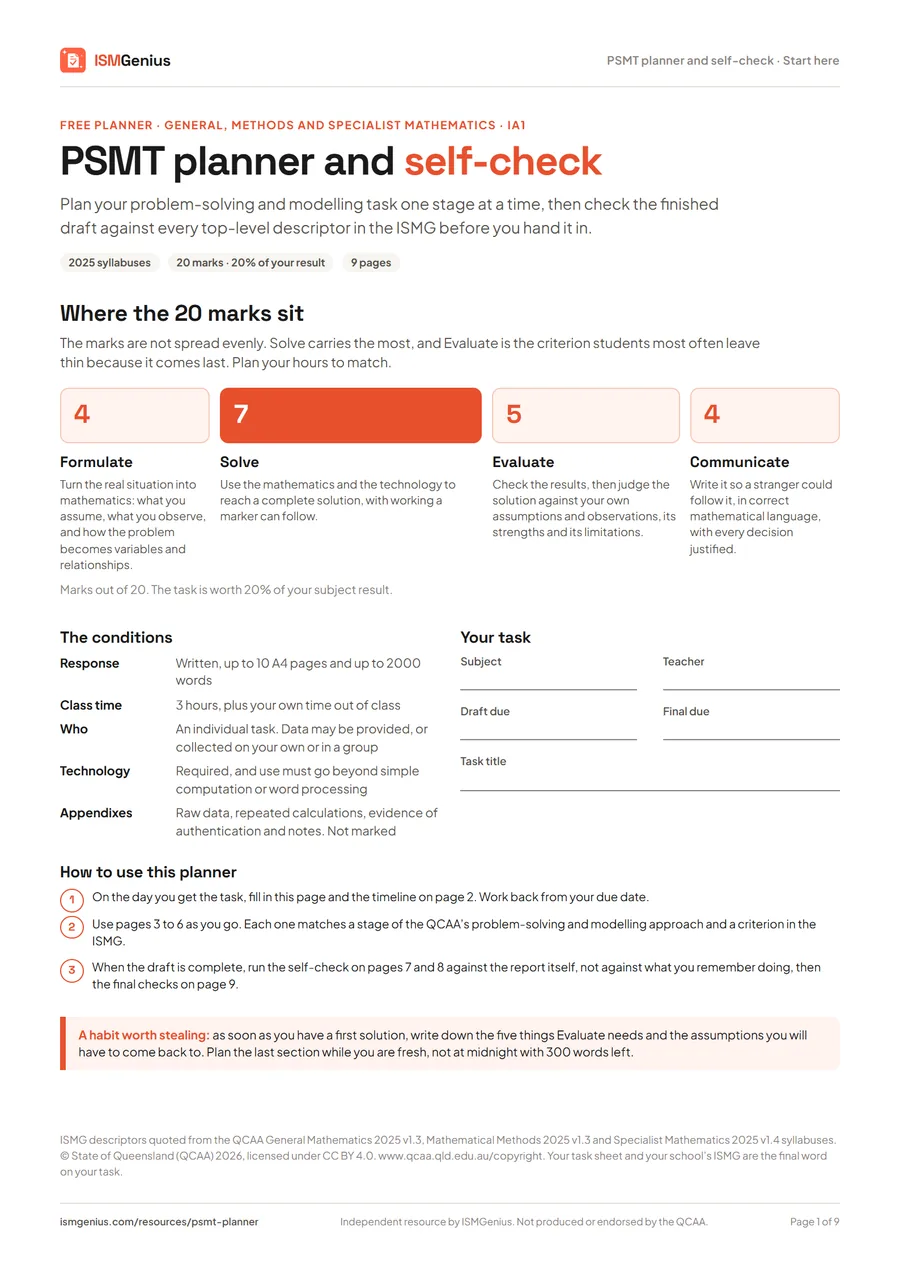
Where the 20 marks sit
The problem-solving and modelling task is IA1 in General Mathematics, Mathematical Methods and Specialist Mathematics, and it is worth 20% of your subject result. The marks are not spread evenly.
Formulate
Turn the real situation into mathematics: what you assume, what you observe, and how the problem becomes variables and relationships.
Solve
Use the mathematics and the technology to reach a complete solution, with working a marker can follow.
Evaluate
Check the results, then judge the solution against your own assumptions and observations, its strengths and its limitations.
Communicate
Write it so a stranger could follow it, in correct mathematical language, with every decision justified.
| Response | Written, up to 10 A4 pages and up to 2000 words |
| Class time | 3 hours, plus your own time out of class |
| Who | An individual task. Data may be provided, or collected on your own or in a group |
| Technology | Required, and use must go beyond simple computation or word processing |
| Appendixes | Raw data, repeated calculations, evidence of authentication and notes. Not marked |
From the self-check, page 8
The Evaluate self-check
Evaluate is worth 5 marks across five top-level descriptors, and it is the criterion students most often leave thin. The self-check turns each descriptor into a question to ask of your own report.
| Descriptor (4–5 marks) | The question to ask of your draft |
|---|---|
| verified results | Have I checked more than one important result with a second method, substitution, estimation, technology or research?Trap: One check is “a verified result”, which is the 2–3 wording. The top level is plural. |
| justified statements about the reasonableness of the solution by considering the assumptions | Have I gone back to each assumption from Formulate, by name, and said whether the solution still holds and why?Trap: A general “the answer seems reasonable” considers no assumption at all. |
| justified statements about the reasonableness of the solution by considering the observations | Have I done the same for each observation, by name?Trap: Students who revisit their assumptions often forget the observations. Both are listed. |
| justified statements of relevant strengths of the solution | Have I given at least two strengths of this solution, each with a reason?Trap: A strength of the method in general (“calculus is accurate”) is not a strength of your solution. |
| justified statements of relevant limitations of the solution | Have I given at least two limitations, each with a reason and, where it helps, its effect on the result?Trap: Limitations of your own effort (“I ran out of time”) are not limitations of the solution. |
Your teacher matches the evidence in your report to the descriptors and awards a mark for each criterion. Where a level has a two-mark range, such as 3–4, the QCAA describes a best-fit approach: in its subject reports, the upper mark needs evidence of all the descriptors in that level, and the lower mark matches most of them.
ISMG descriptors quoted from the QCAA General Mathematics 2025 v1.3, Mathematical Methods 2025 v1.3 and Specialist Mathematics 2025 v1.4 syllabuses. © State of Queensland (QCAA) 2026, licensed under CC BY 4.0. www.qcaa.qld.edu.au/copyright
That’s part of it.The full 9-page PDF has every worksheet and checklist, ready to print.
Download freeQuestions
Which subjects is this PSMT planner for?
Is the criterion called Evaluate or Evaluate and verify?
Do I have to print it?
Why do I need an account to download it?
Is this an official QCAA document?
Checked against
- Mathematical Methods 2025 v1.3 General senior syllabus (QCAA)
- General Mathematics 2025 v1.3 General senior syllabus (QCAA)
- Specialist Mathematics 2025 v1.4 General senior syllabus (QCAA)
- QCE and QCIA policy and procedures handbook, 8.2 and 9.6 (QCAA)
Written by ISMGenius and last checked on 6 November 2026. It is an independent resource, not produced or endorsed by the QCAA. Your task sheet, your ISMG and your school are the final word.
Print it, plan it,check it
The PSMT planner and self-check is free with an ISMGenius account. It takes about a minute, and there is nothing to pay.
More free resources: see them all
Keep going
- The PSMT write-up, criterion by criterionWhat each of the four criteria rewards, with examples that score.
- QCAA Mathematics and the PSMTWhere the 20 marks sit and where students most often lose them.
- IA draft self-check, free PDFRead your ISMG the way a marker does, turn every top-band descriptor into a question, and find the one change that would lift your draft the most.
- Year 12 2027 assessment planner, free PDFEvery term of Year 12 on one page each, with the 2027 Queensland term dates, the QCAA dates that shape when your assessment falls, and room for every due date.
- Year 11 QCE planner for 2027, free PDFThe QCE rules on one page, what Satisfactory and Unsatisfactory mean in Units 1 and 2, a credit tracker for every subject, and a page for each term of 2027.
- IA draft checklist by criterion, free PDFTwo pages to run the night before your draft is due: the verb, every criterion in your ISMG, what counts towards the limit, referencing and your school’s AI rules.