IA draftself-check
Any General subject · IA1, IA2 or IA3 · Years 11 and 12
Read your ISMG the way a marker does, turn every top-band descriptor into a question, and find the one change that would lift your draft the most.
8-page PDF · 590 KB. Needs a free ISMGenius account, with nothing to pay. Already have one? Sign in
Every page has a job
An A4 PDF that prints cleanly in black and white, or fills in on a tablet. Here is what each part does.
Your task at a glance
The cognitive verb, the limits and the dates, and how to use the next 45 minutes.
Read the ISMG first
Rank your criteria by marks and confidence, and take a descriptor apart into its qualifier and the thing judged.
Qualifier ladders
Real ladders from 2025 marking guides, so you can see how the same line changes from band to band.
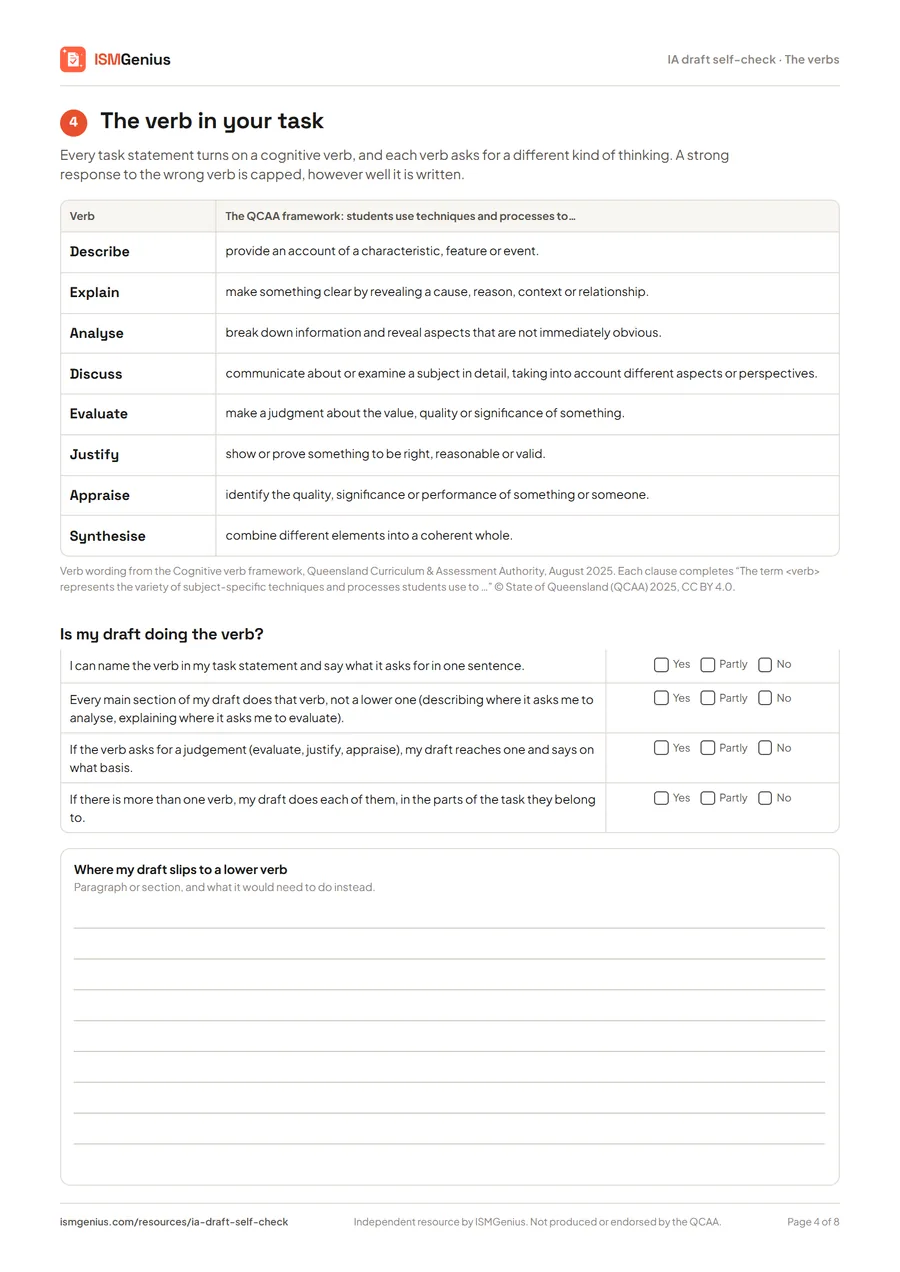
The verbs in your task
Eight cognitive verbs with the QCAA framework’s wording, and a check that your draft does the verb.
Descriptor-to-question grid
Copy each top-band descriptor, turn it into a question, and point to the evidence in your draft.
Best fit and your band
How a mark is decided in a two-mark range, and where your evidence lands, criterion by criterion.
Final checks and revision plan
What counts towards the word limit, integrity and authentication, and three changes in order.
A look inside
3 of the 8 pages, as they print, and part of the content below.
From page 2
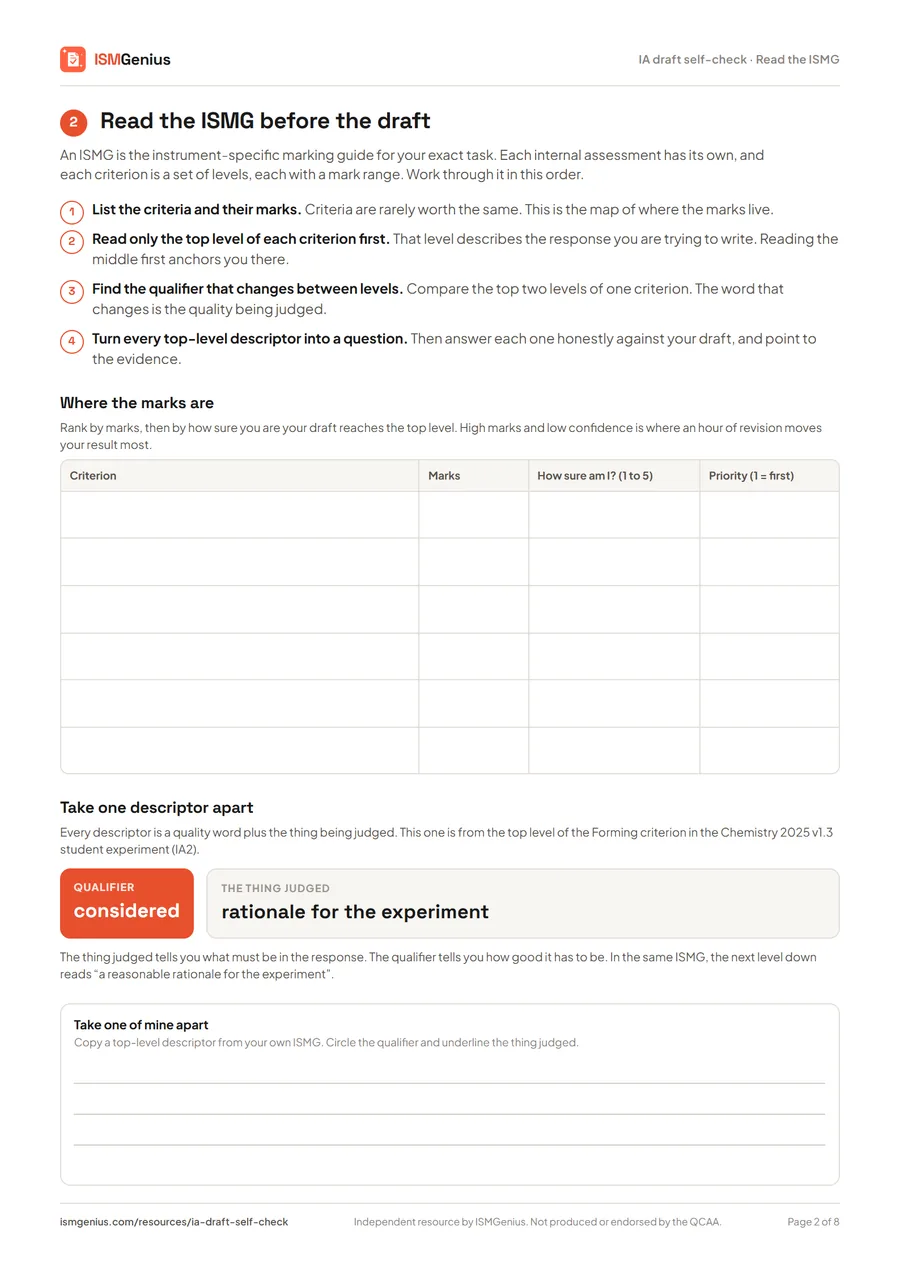
Read the ISMG before the draft
An ISMG is the instrument-specific marking guide for your exact task. Each internal assessment has its own, and each criterion is a set of levels with a mark range. Work through it in this order.
- List the criteria and their marks. Criteria are rarely worth the same. This is the map of where the marks live.
- Read only the top level of each criterion first. That level describes the response you are trying to write. Reading the middle first anchors you there.
- Find the qualifier that changes between levels. Compare the top two levels of one criterion. The word that changes is the quality being judged.
- Turn every top-level descriptor into a question. Then answer each one honestly against your draft, and point to the evidence.
From page 3
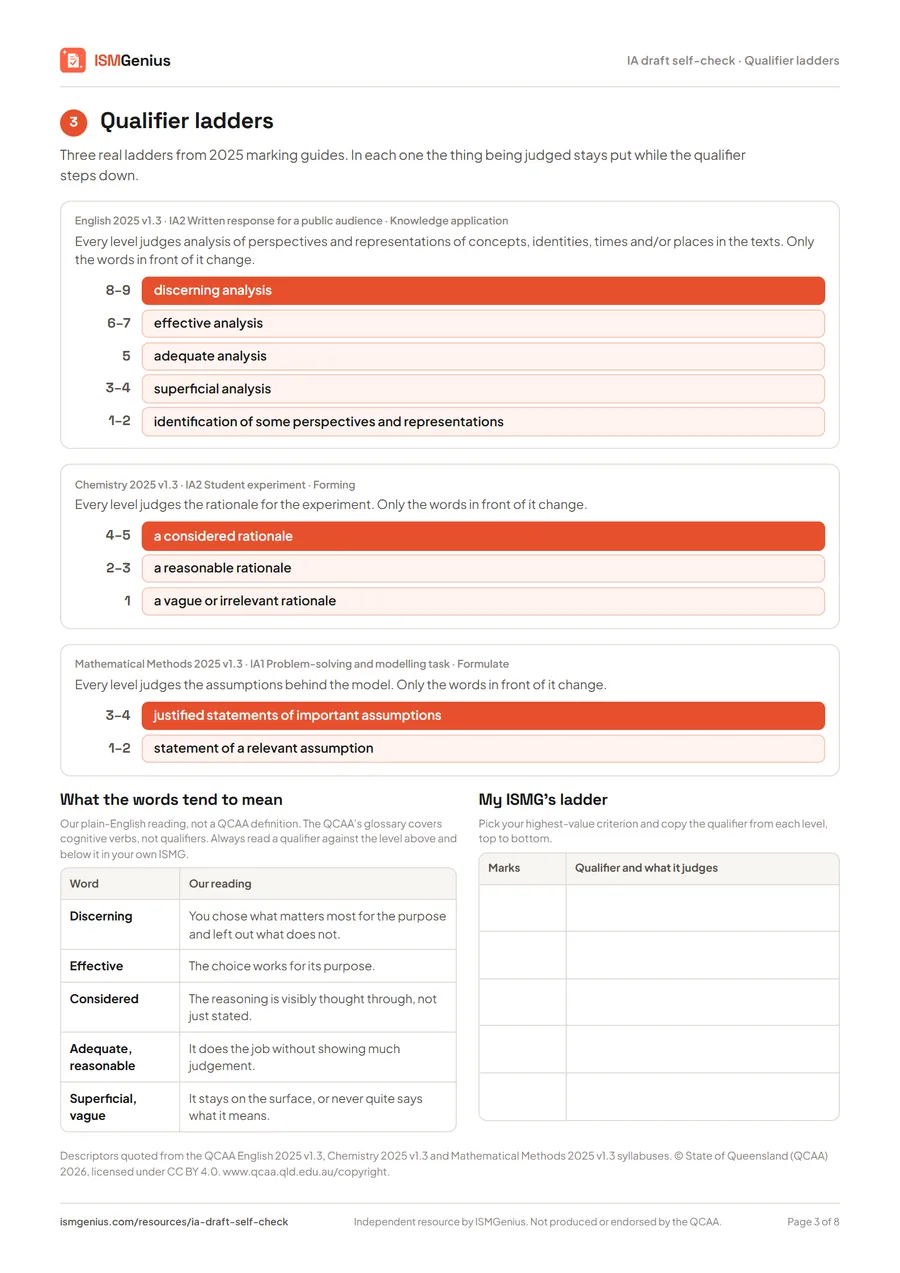
Qualifier ladders from real 2025 marking guides
Between levels, the thing being judged usually stays the same and the quality word in front of it, the qualifier, changes. That word is usually where the mark is decided.
English 2025 v1.3 · IA2 Written response for a public audience · Knowledge application
Chemistry 2025 v1.3 · IA2 Student experiment · Forming
- Your teacher matches the evidence in your response to the descriptors in each criterion and awards a mark for each criterion. The marks are not an average of ticks.
- Where a level has a two-mark range, the QCAA describes a best-fit approach. In its subject reports, the upper mark needs evidence of all the descriptors in that level, and the lower mark matches most of them, with the rest at the level below.
- So one missing line does not drop you out of a level, and one strong line does not lift a response whose evidence sits lower. Aim at the level, not the bullet.
Descriptors quoted from the QCAA English 2025 v1.3, Chemistry 2025 v1.3 and Mathematical Methods 2025 v1.3 syllabuses. © State of Queensland (QCAA) 2026, licensed under CC BY 4.0. www.qcaa.qld.edu.au/copyright.
That’s part of it.The full 8-page PDF has every worksheet and checklist, ready to print.
Download freeQuestions
Which subjects does the IA self-check work for?
When should I use it?
What is a qualifier in an ISMG?
Why do I need an account to download it?
Is this an official QCAA document?
Checked against
- QCE and QCIA policy and procedures handbook, 11.1 Making judgments about student achievement (QCAA)
- QCE and QCIA policy and procedures handbook, 9.6 Confirmation (QCAA)
- Cognitive verb framework, August 2025 (QCAA)
- Instrument-specific marking guides (QCAA)
Written by ISMGenius and last checked on 6 November 2026. It is an independent resource, not produced or endorsed by the QCAA. Your task sheet, your ISMG and your school are the final word.
Print it, plan it,check it
The IA draft self-check is free with an ISMGenius account. It takes about a minute, and there is nothing to pay.
More free resources: see them all
Keep going
- How to read an ISMGTake a descriptor apart, map the qualifier ladder and understand best fit.
- The ISMG rubric guideHow the marking guide your assessment is graded against is put together.
- PSMT planner and self-check, free PDFPlan your problem-solving and modelling task stage by stage, then check the draft against every top-band descriptor in the ISMG before you hand it in.
- Year 12 2027 assessment planner, free PDFEvery term of Year 12 on one page each, with the 2027 Queensland term dates, the QCAA dates that shape when your assessment falls, and room for every due date.
- Year 11 QCE planner for 2027, free PDFThe QCE rules on one page, what Satisfactory and Unsatisfactory mean in Units 1 and 2, a credit tracker for every subject, and a page for each term of 2027.
- IA draft checklist by criterion, free PDFTwo pages to run the night before your draft is due: the verb, every criterion in your ISMG, what counts towards the limit, referencing and your school’s AI rules.